THE CLASSIC COLLECTION✦An outlaw’s diary: the CommuneCLASSIC FREE BOOKS
An outlaw’s diary: the Commune
Cécile Tormay
THE CLASSIC COLLECTION · 1905
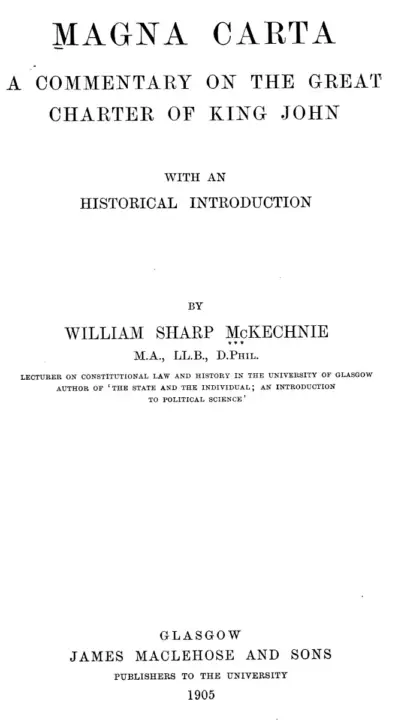
"Magna Carta: A Commentary on the Great Charter of King John" by William Sharp McKechnie is a historical account written in the early 20th century. This work delves into the significance and implications of the Magna Carta, focusing on its historical context and its role in the development of constitutional freedoms in England. The book aims to provide a fresh commentary on this pivotal document, critiquing earlier interpretations and emphasizing its relevance to the struggles for liberty. The opening of the commentary highlights that no significant modern analysis of Magna Carta has been published until now, despite the profound impact of the Great Charter on English constitutional history. McKechnie discusses the motivations behind his work, emphasizing the necessity of examining the various grievances that led to its creation and outlining the events that unfolded in the lead-up to its signing. He argues that the Magna Carta is deserving of detailed study due to its complexities and the wealth of knowledge in contemporary scholarship, setting the stage for a thorough exploration of its chapters and clauses in the remaining text.
Introduction adapted from the source catalogue; source summaries may be automatically generated.
Free to read · English · 212,300 words · No account needed
MAKE TIME FOR A GOOD BOOK
On by default. Untick to stop anonymous reading totals. Each page counts after 10 seconds in view. How this works.
Anonymous counting is on unless you have switched it off.
Footnote 911:
For the earliest notice of verderers see Select Pleas of the Forest, xix., n. Their appointment in the county court may indicate that they acted in some measure as a check on the professional foresters in the interests of the people generally, as well as a check on the warden in the interests of the king. Within the forest the warden, with the verderers and foresters, offered an exact parallel to the sheriff with the coroners and bailiffs (or serjeants) in other parts of a county.
Footnote 912:
See Carta de Foresta, c. 6.
Footnote 913:
After 1217, if not before, it was one of their duties to fix the number of foresters required, so that the inhabitants need not groan under a heavier burden than necessary.
Footnote 914:
In one document they were styled agistatores precii (Select Pleas, p. 1.), which suggests that fixing the rate was their chief duty. “Agist” was a general term; it was apparently correct to speak of "agisting a wood”, of “agisting cattle,” and of “agisting the money due.”
Mention ought, perhaps, to be made of the private foresters also, whom owners of woods within the forests were obliged to appoint. These “wood wards,” as they were sometimes called, while paid for by the owner of the wood, were expected to protect the king’s interests. In particular, they must prevent trees under their care from being destroyed or wasted: the king was an interested party in these, since they formed shelter for his game.
IV. Forest Courts. The judicial side of the forest system was developed in a manner equally elaborate. Three sets of tribunals must be distinguished: (1) The Court of Attachments (or “view of attachments”) was a petty tribunal, the chief duty of which was confined to taking evidence to be laid in due course before a higher court. Exceptionally, however, it had power to inflict fines for small trespasses against the "vert"—namely, for acts of waste not exceeding the value of fourpence. It met once in every forty days,[915] which seems in practice to have been interpreted as once every six weeks, the meetings being always held on the same day of the week.[916] (2) Courts of Inquisitions. When a serious trespass against the forest laws was discovered, a special court was, in early days, summoned immediately to make investigations. The foresters and verderers conducted the inquiry, but it was their right and their duty to assemble the men of the neighbouring townships to help them. In strictness, apparently, all the inhabitants might be compelled to attend. In practice, it was sufficient if four men and the reeve represented each of the four adjoining villages. Whenever a “beast” was found dead in the forest twenty men had thus to assemble, to the neglect of their own affairs; and they would be made to suffer if they failed to discover the culprit. In one district at least (Somerton) the definition of beasts of the chase extended to the ordinary hare; and we read[917] how four townships sat in solemn judgment, and found “that the said hare died of murrain, and that they know of nothing else except misadventure,” and how, this verdict not giving satisfaction, the townships were fined on the pretext that they were not fully represented. The real offence was their failure to disclose the culprit, which was held to imply a desire to shield him. Some alleviation of the burden of attendance was effected when, at some date posterior to 1215, special inquisitions were superseded by one general inquisition, held at regular intervals (usually every six weeks), to cover all trespasses committed during the interval. These courts of inquiry (whether special or general) only “kept” pleas without “trying” them—that is to say, they received and recorded accusations, while the judgments were reserved for the justices. (3) The courts of the forest justices in eyre. As the smaller courts, in the normal case, received verdicts and reports, without punishing the offences reported, it is evident that the whole system ultimately depended on the justices. Their eyres, however, were held at wide intervals—apparently once every seven years during the reign of Henry III. A very full attendance of forest officials and of the public was summoned to meet them. The evidence stored up as a result of the work of the smaller courts, supplemented by the Rolls of the Regard, was laid before the justices, who summarily judged “pleas of the vert,” inflicting small amercements, and “pleas of the venison,” punishing by imprisonment those previously found guilty, until they ransomed themselves by heavy fines. These eyres came to be known as “Courts of Justice Seat,” but not until long after the reign of John. No juries were present, nor were they required; the justices punished offenders who had already been convicted by juries at a lower court.
Your reading position is saved on this browser. Take it to another device with a library code. Reading pages adapt to text, rather than matching a printed edition.
BEHIND THE BOOK
This eBook is for the use of anyone anywhere in the United States and most other parts of the world at no cost and with almost no restrictions whatsoever. You may copy it, give it away or re-use it under the terms of the Project Gutenberg License included with this eBook or online at www.gutenberg.org. If you are not located in the United States, you will have to check the laws of the country where you are located before using this eBook. Read the source licence.
The original source file, including credits and licence, is retained by this library. Request an original-format copy at no charge. Please include the book title and Project Gutenberg identifier #65363.
KEEP YOUR CURIOSITY GOING
Cécile Tormay

Moritz Busch
John L. Ransom
Frances Wright
Cécile Tormay

Mabel Potter Daggett