THE CLASSIC COLLECTION✦An outlaw’s diary: the CommuneCLASSIC FREE BOOKS
An outlaw’s diary: the Commune
Cécile Tormay
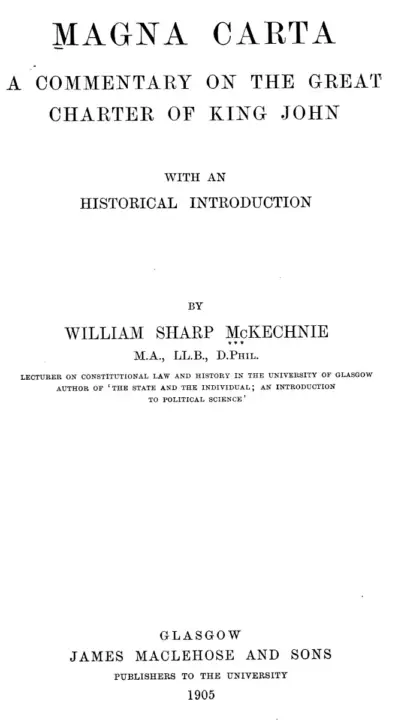
THE CLASSIC COLLECTION · 1905
"Magna Carta: A Commentary on the Great Charter of King John" by William Sharp McKechnie is a historical account written in the early 20th century. This work delves into the significance and implications of the Magna Carta, focusing on its historical context and its role in the development of constitutional freedoms in England. The book aims to provide a fresh commentary on this pivotal document, critiquing earlier interpretations and emphasizing its relevance to the struggles for liberty. The opening of the commentary highlights that no significant modern analysis of Magna Carta has been published until now, despite the profound impact of the Great Charter on English constitutional history. McKechnie discusses the motivations behind his work, emphasizing the necessity of examining the various grievances that led to its creation and outlining the events that unfolded in the lead-up to its signing. He argues that the Magna Carta is deserving of detailed study due to its complexities and the wealth of knowledge in contemporary scholarship, setting the stage for a thorough exploration of its chapters and clauses in the remaining text.
Introduction adapted from the source catalogue; source summaries may be automatically generated.
Free to read · English · 212,300 words · No account needed
MAKE TIME FOR A GOOD BOOK
On by default. Untick to stop anonymous reading totals. Each page counts after 10 seconds in view. How this works.
Anonymous counting is on unless you have switched it off.
The office was one of authority and of profit, usually paid in kind rather than by a salary. The warden often held a fief by a tenure connected with the service, and enjoyed rights and perquisites always of a valuable nature, though varying with each forest. These were sufficient to provide him with an income adequate to his position, and to allow him to find the wages of his under-keepers, who ought thus to have been paid officials. Such was the theory; as matter of fact, the foresters, instead of receiving wages, gladly paid large sums to the warden, and recouped themselves, with an ample profit, by extortions from the humble dwellers in their bailiwicks.[909] These unpaid foresters were expressively said “to live upon the country.” They formed a powerful official class, whose excessive numbers were a source of constant complaint. They may be classified in various ways, as, into riding and walking foresters (of whom there were one and four respectively in the normal case), or into foresters nominated by the wardens, and foresters in fee. These last had vested interests which the Forest Charter was careful to respect; as, where chapter 14 reserved to them the right to take “chiminage,” or way-leave, denied to other types of foresters; they might still enjoy, but not abuse, the “vested rights” reserved to them.[910]
Footnote 909:
Ibid., xxi.
Footnote 910:
The same chapter, however, fixed the rates of “chiminage.”
With these professional gamekeepers there co-operated, in later times at least, several groups of unpaid magistrates appointed from the knights and freeholders of the district. Of these honorary officials, whose original function was to supply supplementary machinery for protecting the rights of the Crown, but whose position as county gentlemen with a stake in the district led them also to act to some extent as arbitrators between the king and outside parties, there were three recognized kinds. (a) Towards the close of the twelfth century officers known as verderers (usually four for each forest) become prominent. They appear in the Carta de Foresta of 1217, but had not been mentioned in the Assize of Woodstock of 1184. It is probable that the office was devised in the interval as a check on the warden’s power, as the office of coroner had been instituted in the reign of Richard I. as a drag on the sheriff. In other important respects the duties of the verderers within the forests resembled those of coroners within the rest of the county. They were not royal employees, whose whole time was absorbed by the duties of office and remunerated by fixed salaries or by perquisites, but rather local landowners whose magisterial services were unpaid, and were presumably required only on special occasions. They were responsible directly to the king, and not to the warden; and were appointed in the county court, their “election” taking place in accordance with the terms of the writ “de viredario eligendo.” They attended the forest courts and swanimotes, and it appears from chapter 16 of Henry’s forest charter that it was their duty to bring before the Justices in Eyre lists of all offenders indicted in the lower courts. These “rolls of attachment” were certified by their seals.[911] (b) The Regarders were twelve knights appointed in each forest county to make tours of inspection every third year, finding answers to a series of questions known as the “Chapters of the Regard.” In this way they reviewed the Crown’s interests alike in “the venison and the vert” (the technical names for game and growing timber respectively), and reported upon all encroachments: upon hawks and falcons, bows and arrows, greyhounds and mastiffs (with special reference to “expeditation” or cutting of their claws),[912] and generally upon everything owned by private individuals likely to harm the beasts of the forest.[913] (c) The Agistors are mentioned in the same clause of the Assize of Woodstock which mentions the Regarders. Four knights were appointed, apparently by the warden of each forest, whose duty it was to protect the king’s interests in all matters connected with the pasturing of swine or cattle within the royal woods. For thirty days at Michaelmas pigs were turned loose with liberty to feed on the acorns and beech mast on payment by their owners of a small fixed sum per head. The four knights were required to take note of sums thus due, known as “pannage,” and to collect them at Martinmas.[914]
Your reading position is saved on this browser. Take it to another device with a library code. Reading pages adapt to text, rather than matching a printed edition.
BEHIND THE BOOK
This eBook is for the use of anyone anywhere in the United States and most other parts of the world at no cost and with almost no restrictions whatsoever. You may copy it, give it away or re-use it under the terms of the Project Gutenberg License included with this eBook or online at www.gutenberg.org. If you are not located in the United States, you will have to check the laws of the country where you are located before using this eBook. Read the source licence.
The original source file, including credits and licence, is retained by this library. Request an original-format copy at no charge. Please include the book title and Project Gutenberg identifier #65363.
KEEP YOUR CURIOSITY GOING
Cécile Tormay

Moritz Busch
John L. Ransom
Frances Wright
Cécile Tormay

Mabel Potter Daggett