THE CLASSIC COLLECTION✦South Australia and Western AustraliaCLASSIC FREE BOOKS
South Australia and Western Australia
Anthony Trollope
THE CLASSIC COLLECTION · 1882
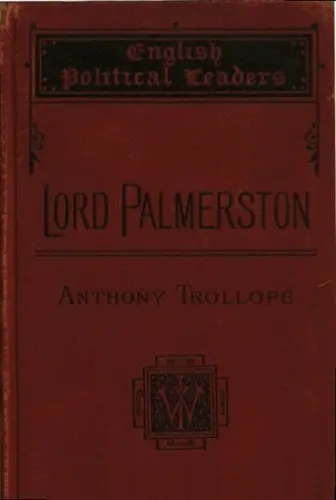
"Lord Palmerston" by Anthony Trollope is a historical account written in the late 19th century. The book provides a detailed examination of the life and political career of Henry John Temple, the 3rd Viscount Palmerston, who served as a prominent British statesman and Prime Minister during the 19th century. It covers his extensive impact on foreign and domestic policy, focusing particularly on his perception as a foreign minister and his clashes with other political figures, including the Prince Consort. The opening of "Lord Palmerston" introduces readers to the author's approach in compiling the memoir, citing various sources, including speeches and biographies. Trollope expresses his intention to navigate the complicated political landscape of Palmerston's life, emphasizing the controversies surrounding his dismissal as Foreign Minister and how he skillfully maneuvered through the political arena to regain power. The author hints at Palmerston's character, noting his determination and resilience, while also foreshadowing the key events in Palmerston’s career that would define his legacy in British politics. The initial narrative sets up a contextual framework for understanding Palmerston's role in significant historical events and debates, laying the groundwork for a deeper exploration of his life throughout the rest of the text.
Introduction adapted from the source catalogue; source summaries may be automatically generated.
Free to read · English · 65,828 words · No account needed
MAKE TIME FOR A GOOD BOOK
On by default. Untick to stop anonymous reading totals. Each page counts after 10 seconds in view. How this works.
Anonymous counting is on unless you have switched it off.
It is a great thing to be a Cabinet Minister. Every man when he begins a life of politics feels that. He feels it when he gets into Parliament, and when he joins a Government in some subordinate office. It is the goal to which his hopes aspire, and the success to which his ambition ventures to look. The young politician hardly expects to be Prime Minister, but he does, within his own bosom, think it possible that he may achieve an entrance within those doors which enclose that mysterious entity which we call the Cabinet. The Cabinet is essentially English in its abnormal constitution, having grown to its present enormous responsibility without any written rules or defined powers. There is nothing to prescribe its numbers, which do indeed vary very greatly; nor indeed is there any law requiring that this or that officer of the Government should be a member of it,--as there is no law by which its very existence is made necessary. It is considered essential that the Chancellor and the Secretaries of State should be of the Cabinet, but we have no law which would be broken were it to be completed without them. But it is understood by all men that the governing of the country is in the hands of a small junta of individuals who form the Cabinet, and it is equally well understood that all members of the Government who are not in the Cabinet are responsible for nothing beyond the proper performances of their own official duties; though they, too, are bound to resign when their betters resign, and are bound also to support their betters by parliamentary aid and judicious backing in all but the very few matters which are regarded as “open questions.” In fact, the Cabinet Minister is a governing power, and the Minister not in the Cabinet is simply the servant of the Premier. It is therefore undoubtedly the ambition of every political servant of his country to make good his claim to a seat in the Cabinet. And although there may now be some little advance in the thorough distinction of the two places since the days in which Lord Palmerston was first enlisted as a servant of the Crown, rather more than seventy years ago, yet even then the feeling as to the power of the Cabinet Minister existed as it does now. It has been told how, in 1809, Mr. Percival offered to make Lord Palmerston Chancellor of the Exchequer. “Annexed to this office he offered a seat in the Cabinet, if I chose it,” he said in a letter to Lord Malmesbury, asking for advice. “And he thought it better I should have it. I, of course, expressed to him how much honoured I felt by this very flattering proof of the good opinion he was pleased to entertain of me; but also my great fears that I should find myself wholly incompetent for the situation, both from my inexperience in the details of matters of finance, and my want of practice in public speaking.” From this we see how much surprised Lord Palmerston had himself been by the offer. But with that wonderful reliance on his own power which always marked him, and which was as conspicuous when he doubted his power as when he relied on it, he declined the offer. And he added, “A bad speech, though tolerated in any person not in a responsible situation, would make a Chancellor of the Exchequer exceedingly ridiculous, particularly if his friends could not set off against his bad oratory a great knowledge and capacity for business.” Actuated by these reasons, Lord Palmerston declined the offer, and then came into office simply as Secretary at War without a seat in the Cabinet. His self-diffidence was repaid by sixteen years of comparative exclusion. Mr. Percival had been murdered, and Lord Liverpool, who became Prime Minister in Mr. Percival’s place, had either thought less of Lord Palmerston or had been thought less of by him. The fact probably was that as Palmerston grew in years he had learned to discard many of the ideas of Toryism, and that he became year by year less palatable to so thorough a Tory as was Lord Liverpool. Be that as it may, we can fancy that before he reached the age of forty-three he must occasionally have looked back with watering lips at that offer which had once been made to him. Governor-Generalships and peerages were not to his taste. Such rich rewards would have removed him from that central and busy life which he intended for himself in the House of Commons. But the fruition of the central and busy life, though it had been offered to him young, had been long delayed before it came again within his grasp. I can fancy that he must have felt this, though in his letters there is no word of baulked expectations or of disappointed hopes. He took it all as it came, resolving to be useful after his kind, and resolving also to be powerful. Wherever he might be, he would be interfered with by none, by Kings or Kaisers, by Prime Ministers or Commanders-in-Chief, nor would he interfere with any others in their line. I am far from saying that in this manner a servant of his country, who is anxious to be useful rather than powerful, may best do his duty. Lord Palmerston was a man with whom it must often have been difficult for a colleague to serve. The lines of demarcation between one officer and another, and between one class of duty and another class, are not so plain as to make it easy if practicable, or to make it always pleasant; but this was a man with whom such a theory was a determined principle, and acting upon that he went to the end with greater success than might have been possible in the hands of another. He had shown his stubbornness even when not in the Cabinet, and now that he was to be in the Cabinet, it was not probable that he would become more malleable than before. I do not say that a determination so to act had come from that process of mind which we call thinking a thing out. It was not in his nature to think many things out beyond the matters which he had in hand; but given the matter, it was so that he acted. In a book just published,[F] the author speaks of “the childish perversity which marked Lord Palmerston’s dealings with Greece in these years, from his stubborn defence of Count Armansperg down to his disputes about etiquette.” This perversity was an essential part of Lord Palmerston’s character,--and of his strength.
Your reading position is saved on this browser. Take it to another device with a library code. Reading pages adapt to text, rather than matching a printed edition.
Anthony Trollope

Anthony Trollope

Anthony Trollope

Anthony Trollope
BEHIND THE BOOK
This eBook is for the use of anyone anywhere in the United States and most other parts of the world at no cost and with almost no restrictions whatsoever. You may copy it, give it away or re-use it under the terms of the Project Gutenberg License included with this eBook or online at www.gutenberg.org. If you are not located in the United States, you will have to check the laws of the country where you are located before using this eBook. Read the source licence.
The original source file, including credits and licence, is retained by this library. Request an original-format copy at no charge. Please include the book title and Project Gutenberg identifier #55648.
KEEP YOUR CURIOSITY GOING
Cécile Tormay

Moritz Busch
John L. Ransom
Frances Wright
Cécile Tormay

Mabel Potter Daggett