THE CLASSIC COLLECTION✦South Australia and Western AustraliaCLASSIC FREE BOOKS
South Australia and Western Australia
Anthony Trollope
THE CLASSIC COLLECTION · 1882
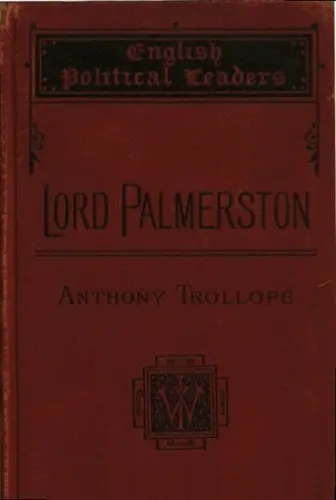
"Lord Palmerston" by Anthony Trollope is a historical account written in the late 19th century. The book provides a detailed examination of the life and political career of Henry John Temple, the 3rd Viscount Palmerston, who served as a prominent British statesman and Prime Minister during the 19th century. It covers his extensive impact on foreign and domestic policy, focusing particularly on his perception as a foreign minister and his clashes with other political figures, including the Prince Consort. The opening of "Lord Palmerston" introduces readers to the author's approach in compiling the memoir, citing various sources, including speeches and biographies. Trollope expresses his intention to navigate the complicated political landscape of Palmerston's life, emphasizing the controversies surrounding his dismissal as Foreign Minister and how he skillfully maneuvered through the political arena to regain power. The author hints at Palmerston's character, noting his determination and resilience, while also foreshadowing the key events in Palmerston’s career that would define his legacy in British politics. The initial narrative sets up a contextual framework for understanding Palmerston's role in significant historical events and debates, laying the groundwork for a deeper exploration of his life throughout the rest of the text.
Introduction adapted from the source catalogue; source summaries may be automatically generated.
Free to read · English · 65,828 words · No account needed
MAKE TIME FOR A GOOD BOOK
On by default. Untick to stop anonymous reading totals. Each page counts after 10 seconds in view. How this works.
Anonymous counting is on unless you have switched it off.
When Lord Liverpool died he was forty. And he had lived as a man conspicuous in the world,--in office the whole time, holding a rank there next to that of the Cabinet, remarkable for his official carefulness, for his industry, for his resolution to let nothing pass without his notice. Soon after he had joined the War Office, in 1809, he had remarked on the insufficiency of the departmental resources. “Its inadequacy to get through the current business that comes before it is really a disgrace to the country; and the arrear of regimental accounts unsettled is of a magnitude not to be conceived. We are now working at the Treasury, to induce them to agree to a plan, proposed originally by Sir James Pulteney and reconsidered by Granville Leveson, by which, I think, we shall provide for the current business, and the arrear must then be got rid of as well as we can contrive to do it.” But he had clung to his work during the whole period with that tenacity which in official life will get the better of all arrears. And in doing so he had made his character known to all official men. It was not because he was a good speaker, as is now generally the case, that he was chosen by one Minister after another, and that Lord Liverpool had been so anxious to retain him, but because the office work was safe in his hands, and because he had shown that he would make fewer mistakes than another man. He had always the pluck to stand up for himself and his office in a becoming manner, caring nothing for any, whether they were in opposition, or below him in office or above; whether they were in the Cabinet or of royal blood, as was the Duke of York. “Come on then and fight, if it has to be.” This is what he would say, with all good-humour; but had never any special desire to have his official points and aspirations and beliefs made matter of debate in either House of Parliament. Such was his official character, and joined to this was his fame as a man of fashion. He did all things that young men did, and did them well, and at forty he was still a young man. Or if he did not do them well, he did them as a young man of fashion ought to do them. If he was not at first successful with his racing, he carried on the amusement in the grand manner. He did not bet. It was not the fashion for a nobleman in those days to plunge. But he kept his horses with a first-class trainer, and was careful to see that the stable as far as possible was made to pay its expenses. We can imagine that he was much thought of at Almack’s, and was a desired guest at the houses of all the exquisites. There is little, or indeed nothing, said about his tailors or bootmakers in any of his letters that have come to us. But we can imagine that he was very careful in his dress, without descending to the outspoken vanity of dandyism. He lived a life full to overflowing in every direction, and on which the society of beautiful women must have had great effect. But with beautiful women he got into no troubles. There exists at least no record of such trouble. He passed on, a young man of fashion, for a period of twenty years, sipping all the honey from all the flowers, but without any of the usual consequences of such sipping. It was characteristic of him that neither in his early or in his later life was there any love of display. He was a man desirous of all things that were pleasant, but seems to have wished that they should be accorded to him simply as his deserts, and not in obedience to any demand that he had made for them. In 1827, when he was nearly forty-three years old, he was called into the Cabinet. This formed the dividing point in his life, up to which I have regarded him as a young man, and after which I will not call him by that name though it may have been deserved. But I will ask my readers to remark that when that time came he had already a long time since refused to be a Cabinet Minister; refused to be Chancellor of the Exchequer; had twice refused to be Governor-General of India; had refused to be the Governor of Jamaica, an office for which George IV. seems to have thought him peculiarly qualified; and refused to be Postmaster-General, a place which in those days required the holder to be a peer. But of the records of his life up to that period little is but now thought, and even yet three years more had to run by, and the discreet age of forty-six had to be reached, before he was placed at the Foreign Office, in the administration of which department he will, I think, be best known in history.
Your reading position is saved on this browser. Take it to another device with a library code. Reading pages adapt to text, rather than matching a printed edition.
Anthony Trollope

Anthony Trollope

Anthony Trollope

Anthony Trollope
BEHIND THE BOOK
This eBook is for the use of anyone anywhere in the United States and most other parts of the world at no cost and with almost no restrictions whatsoever. You may copy it, give it away or re-use it under the terms of the Project Gutenberg License included with this eBook or online at www.gutenberg.org. If you are not located in the United States, you will have to check the laws of the country where you are located before using this eBook. Read the source licence.
The original source file, including credits and licence, is retained by this library. Request an original-format copy at no charge. Please include the book title and Project Gutenberg identifier #55648.
KEEP YOUR CURIOSITY GOING
Cécile Tormay

Moritz Busch
John L. Ransom
Frances Wright
Cécile Tormay

Mabel Potter Daggett