THE CLASSIC COLLECTION✦South Australia and Western AustraliaCLASSIC FREE BOOKS
South Australia and Western Australia
Anthony Trollope
THE CLASSIC COLLECTION · 1882
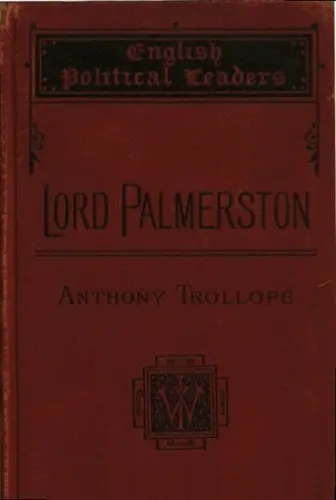
"Lord Palmerston" by Anthony Trollope is a historical account written in the late 19th century. The book provides a detailed examination of the life and political career of Henry John Temple, the 3rd Viscount Palmerston, who served as a prominent British statesman and Prime Minister during the 19th century. It covers his extensive impact on foreign and domestic policy, focusing particularly on his perception as a foreign minister and his clashes with other political figures, including the Prince Consort. The opening of "Lord Palmerston" introduces readers to the author's approach in compiling the memoir, citing various sources, including speeches and biographies. Trollope expresses his intention to navigate the complicated political landscape of Palmerston's life, emphasizing the controversies surrounding his dismissal as Foreign Minister and how he skillfully maneuvered through the political arena to regain power. The author hints at Palmerston's character, noting his determination and resilience, while also foreshadowing the key events in Palmerston’s career that would define his legacy in British politics. The initial narrative sets up a contextual framework for understanding Palmerston's role in significant historical events and debates, laying the groundwork for a deeper exploration of his life throughout the rest of the text.
Introduction adapted from the source catalogue; source summaries may be automatically generated.
Free to read · English · 65,828 words · No account needed
MAKE TIME FOR A GOOD BOOK
On by default. Untick to stop anonymous reading totals. Each page counts after 10 seconds in view. How this works.
Anonymous counting is on unless you have switched it off.
The story of Don Pacifico is interesting, dramatic, and peculiar, and emblematic in the highest degree of Lord Palmerston’s manner of feeling and condition of mind. In it he will be seen carrying British honesty, British honour, and British determination to the very verge of absurdity and arrogance, till he pushes his principles almost beyond the verge. But who shall say what is absurdity? And he is held to have been thoroughly triumphant in the whole affair, because at last he got a majority of the House of Commons to vote that he had been splendidly English and splendidly honest rather than absurd and arrogant. We may be sure that the statesmen of other nations ridiculed him, but that they did so with a mixture of awe, knowing that it was Palmerston,--and knowing that Palmerston must be allowed to have his own way in such matters,--unless he were stopped by his own countrymen. And a great attempt was made by his own countrymen to keep him down, and to prove that he had been ridiculous. Lord Stanley, who, since 1844, had been in the Upper House, brought a direct motion against him, in which he was supported by Lord Aberdeen and Lord Canning; and he carried his resolution by a majority of thirty-seven. Lord Stanley had not forgotten the accusations of official ignorance made against him by Lord Palmerston; and Lord Aberdeen’s memory was still laden with the bitterness of that “example of antiquated imbecility,” as which he had been represented to the House of Commons. For amenities such as these Lord Palmerston was too wise to expect in return aught but similar amenities.
“I can only say,” said Lord Stanley, “that I have arisen from the perusal of these papers,”--and he describes the documents in his hands, all referring to claims made by Lord Palmerston against Greece, as a weary waste of papers,--“with regret and shame for the part which my country has played.” Then he takes the proud ground that the weakest and the strongest nations should in such matters be treated alike; and he asks whether such has been the case--imputing, of course, to Lord Palmerston the degrading fault that he has been imperious only against the weak. Then he recapitulates the absurd cases for redress as to which Lord Palmerston sent the British Fleet to the Piræus,--a fleet larger, as Lord Aberdeen goes on to say, than that with which Nelson conquered at Trafalgar. Can this, we wonder, have been true? There is the matter of Stellio Sumachi, the blacksmith, which was of itself a very trivial affair. Then there was the question of two of our war vessels, the Fantôme and the Spitfire. A midshipman out of one had landed in plain clothes where he ought not to have landed, and officers of the one ship were taken to have been officers of the other. This had given ground for great offence to British honour. There was the plunder of some Ionian boats at Salcina, Ionians being regarded in Athens as being Greeks well able to take care of themselves,--whereas to Lord Palmerston they were British subjects. Then there was the case of certain Ionians who had laid themselves down in the street to get rid of the fleas which were intolerable in their houses. With these men the police had interfered, as they certainly should not have interfered with British subjects afraid of fleas. Then there was a bit of ground, which Mr. Finlay had bought for £10 or £20, amounting to less than an acre. This was included in King Otho’s garden without payment, whereas a Britisher should, of course, have been paid,--and Mr. Finlay demanded about £1,500. He did ultimately get £1,000. And lastly there was Don Pacifico, the Jew. It had been the custom of the Greeks at a certain festival to burn the figure of Judas; but one of the Rothschilds had come to Athens, and it was thought that this Christian ceremony would be distasteful to him. Therefore the Greeks omitted to burn the Judas, but did burn Don Pacifico’s house, and among the rioters who burnt it was the son of the Greek Minister of War. Now, Don Pacifico, though his relations were supposed to have been Portuguese-Jews, had resided at Gibraltar, or, as some said, had been born there. He had at any rate made out for himself some claim to British citizenship. It sufficed for Lord Palmerston; but the amount of compensation claimed by Don Pacifico was, among the many absurdities, the most absurd. There were certain Portuguese documents which were represented as of immense value. They had been burned, and £26,000 had been charged for them, though they seem to have consisted only of letters from Don Pacifico in which he made his claim, and from the Portuguese Government denying that anything was due to him. All these points Lord Stanley exposed, and he ended by moving; “That, while the House fully recognizes the right and duty of the Government to secure to her Majesty’s subjects residing in Foreign States the full protection of the laws of those States, it regrets to find, by the correspondence recently laid upon the table by her Majesty’s command, that various claims against the Greek Government, doubtful in points of justice, or exaggerated in amount, have been enforced by coercive measures, directed against the commerce and people of Greece, and calculated to endanger the continuance of our friendly relations with other Powers.” He carried his motion, as I have said, by thirty-seven votes. During the debate, Lord Aberdeen spoke of the “cry of indignation” which had been called forth throughout Europe by the doings of our fleet; and Lord Cardigan threatened the peers with a great war.
Your reading position is saved on this browser. Take it to another device with a library code. Reading pages adapt to text, rather than matching a printed edition.
Anthony Trollope

Anthony Trollope

Anthony Trollope

Anthony Trollope
BEHIND THE BOOK
This eBook is for the use of anyone anywhere in the United States and most other parts of the world at no cost and with almost no restrictions whatsoever. You may copy it, give it away or re-use it under the terms of the Project Gutenberg License included with this eBook or online at www.gutenberg.org. If you are not located in the United States, you will have to check the laws of the country where you are located before using this eBook. Read the source licence.
The original source file, including credits and licence, is retained by this library. Request an original-format copy at no charge. Please include the book title and Project Gutenberg identifier #55648.
KEEP YOUR CURIOSITY GOING
Cécile Tormay

Moritz Busch
John L. Ransom
Frances Wright
Cécile Tormay

Mabel Potter Daggett