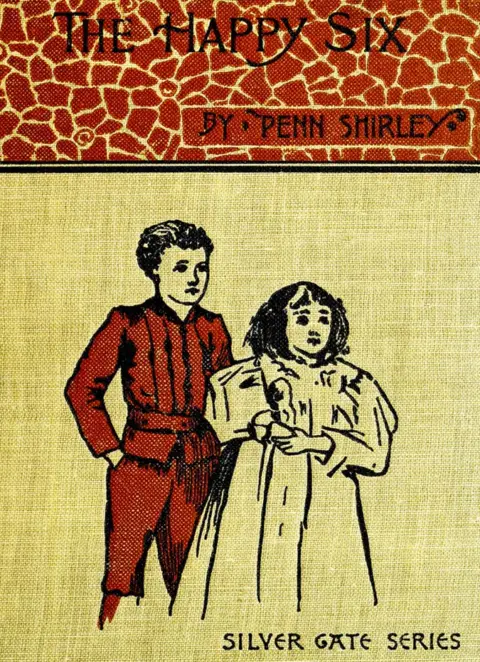
The happy six
Penn Shirley
THE CLASSIC COLLECTION · 1886
"Little Miss Weezy" by Penn Shirley is a children's novel written in the late 19th century. It follows the high-spirited toddler Louise “Weezy” Rowe through a string of domestic adventures with her family and neighbors, blending humor with gentle moral lessons. The vignettes spotlight Weezy’s mischief and charm alongside the foibles and growth of her siblings, parents, and kindly Uncle Doctor, with affectionate attention to everyday life and the virtues of honesty, obedience, and kindness. Readers who enjoy warm family stories and lively child viewpoints will find it playful and tender. The opening of the story introduces Weezy’s nickname and home circle, then sweeps through a series of comic scrapes: she locks the maid out while the wash boils over, disrupts church by serenading the hymn with “Little Sally Walker,” and later follows a beggar child and gets lost before a policeman and the girl help her home. She and a helper, Ellen, trigger a memorable moment when a pickle turns up in the teapot at a minister’s dinner; she climbs a clock to steal the desk key and cuts paper dolls from a deed; she suffers the mumps while braiding her uncle’s beard; and she inadvertently sends her father down the street with her yarn doll “Sambo” tied to his coat. Weezy “goes calling” with visiting-cards, returns in a delivery wagon with figs, and is wrongly suspected of taking a dime until it’s found. A parallel thread shows brother Kirke’s lapse and honest confession at school, while Weezy’s own judgment shines when she refuses a birthday drive until a “stealing apples” joke is cleared up. A winter visit to grandparents adds a schoolroom mix-up—promising “one slide” but “heeling and toeing” the snowy bank instead—before her father arrives to bring her home for Christmas, with a mysterious moving, musical present teased as the scene breaks.
Introduction adapted from the source catalogue; source summaries may be automatically generated.
Free to read · English · 18,512 words · No account needed
MAKE TIME FOR A GOOD BOOK
On by default. Untick to stop anonymous reading totals. Each page counts after 10 seconds in view. How this works.
Anonymous counting is on unless you have switched it off.
It was more than a year after Weezy's birthday drive that grandpa and grandma Rowe came to her father's house to spend Thanksgiving.
When they returned to the parsonage away up among the Berkshire hills, they took Weezy; and, that Weezy might not be homesick, they invited little Kisty Nye to go with her.
Weezy was five years old now, but, alas! no nearer Kisty's age than she had been before; for Kisty was now six. They found at the parsonage Mr. Henry Bishop, grandpa's oldest grandson, who took Weezy up in his lap and told her that he was her cousin, and that he boarded at grandpa's, and taught the village school.
"Kisty and I haven't ever been to school, not ever," said Weezy plaintively. "Please can't we go, Mr. Cousin Bishop?"
"You? I'm afraid you don't know enough," said Mr. Bishop, patting her cheek. "Can you say all your letters?"
"Most all, incept two or three little ones," said Weezy briskly. "I
can spell too."
"Indeed! What can you spell?"
"Oh, I can spell all the easy words,--d, o, g, dog; c, a, t, cat; g, o, t, goat," said Weezy, proud of her knowledge.
"Oh, I see, you spell by sound, the phonetic way!" said Mr. Bishop, throwing back his head and laughing.
"Don't know what is fonetti-quay," returned Weezy, rather disturbed. "My brother could spell it, I guess. He can spell awful hard words."
Then she frisked away to beg grandma to send her and Kisty to school to
"Mr. Cousin Bishop."
"What should I do without my dear little girls?" said grandma, smiling over her spectacles. "No, no, I couldn't spare them."
But, by the close of the week, the "dear little girls" had become so tired and cross from endless romping, that grandma concluded she could spare them very well. The schoolhouse was near, and she thought it would be really better for them to go to school than to play all day long: so the next Monday morning she dressed them in their warm plaid gowns, and sent them off, each with a cooky in her pocket.
They were by far the smallest scholars of any; and Mr. Bishop soon found that when they were not at his knee, picking out their letters in the primer, it was puzzling to know what to do with them. If they sat together, they would whisper and make too much noise; and if they sat apart, Kisty would go to sleep, and Weezy would be miserable.
At last he hit upon the expedient of sending them out to play in the sunshine the moment they had recited. They liked this very much.
Your reading position is saved on this browser. Take it to another device with a library code. Reading pages adapt to text, rather than matching a printed edition.
Penn Shirley
BEHIND THE BOOK
This eBook is for the use of anyone anywhere in the United States and most other parts of the world at no cost and with almost no restrictions whatsoever. You may copy it, give it away or re-use it under the terms of the Project Gutenberg License included with this eBook or online at www.gutenberg.org. If you are not located in the United States, you will have to check the laws of the country where you are located before using this eBook. Read the source licence.
The original source file, including credits and licence, is retained by this library. Request an original-format copy at no charge. Please include the book title and Project Gutenberg identifier #76122.
KEEP YOUR CURIOSITY GOING
Coulson Kernahan

Maurice Baring
Frances Wright
Cécile Tormay

Frederic Jesup Stimson

W. H. P. (William Henry Pope) Jarvis