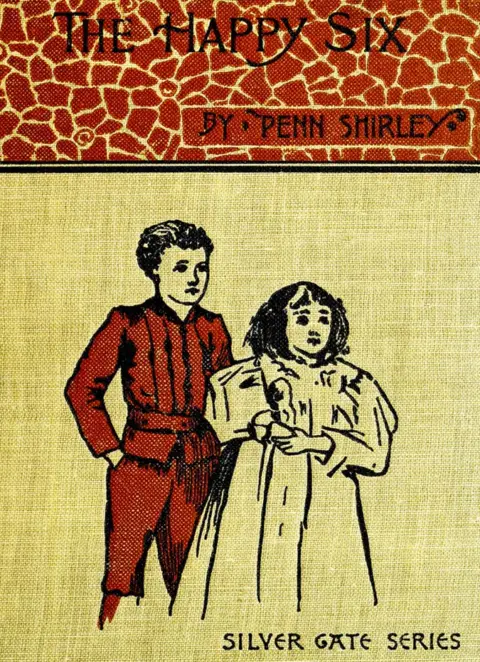
The happy six
Penn Shirley
THE CLASSIC COLLECTION · 1886
"Little Miss Weezy" by Penn Shirley is a children's novel written in the late 19th century. It follows the high-spirited toddler Louise “Weezy” Rowe through a string of domestic adventures with her family and neighbors, blending humor with gentle moral lessons. The vignettes spotlight Weezy’s mischief and charm alongside the foibles and growth of her siblings, parents, and kindly Uncle Doctor, with affectionate attention to everyday life and the virtues of honesty, obedience, and kindness. Readers who enjoy warm family stories and lively child viewpoints will find it playful and tender. The opening of the story introduces Weezy’s nickname and home circle, then sweeps through a series of comic scrapes: she locks the maid out while the wash boils over, disrupts church by serenading the hymn with “Little Sally Walker,” and later follows a beggar child and gets lost before a policeman and the girl help her home. She and a helper, Ellen, trigger a memorable moment when a pickle turns up in the teapot at a minister’s dinner; she climbs a clock to steal the desk key and cuts paper dolls from a deed; she suffers the mumps while braiding her uncle’s beard; and she inadvertently sends her father down the street with her yarn doll “Sambo” tied to his coat. Weezy “goes calling” with visiting-cards, returns in a delivery wagon with figs, and is wrongly suspected of taking a dime until it’s found. A parallel thread shows brother Kirke’s lapse and honest confession at school, while Weezy’s own judgment shines when she refuses a birthday drive until a “stealing apples” joke is cleared up. A winter visit to grandparents adds a schoolroom mix-up—promising “one slide” but “heeling and toeing” the snowy bank instead—before her father arrives to bring her home for Christmas, with a mysterious moving, musical present teased as the scene breaks.
Introduction adapted from the source catalogue; source summaries may be automatically generated.
Free to read · English · 18,512 words · No account needed
MAKE TIME FOR A GOOD BOOK
On by default. Untick to stop anonymous reading totals. Each page counts after 10 seconds in view. How this works.
Anonymous counting is on unless you have switched it off.
Right behind the schoolhouse was a steep bank, down which the boys and girls coasted at noon and at recess. Kisty and Weezy thought it fine fun to slide there all by themselves, and clumsy Kisty did not mind a fall or two, with only Weezy to see.
One afternoon, indeed, she grew so daring that she slid standing up for the whole length of the slope; but unfortunately she lost her balance at the foot, and pitched forward on her little snub nose. It bled furiously; any nose would have bled, treated in that way; and Kisty howled so dismally that Mr. Bishop heard her from his desk, and sent one of the large girls to bring her in.
The girl found frightened Weezy mopping Kisty's face with her own Mikado pocket-handkerchief, and tugging with all her might to drag her up the bank.
"This accident puts an end to your sport, little girls," said Mr. Bishop, after they were again in their seats. "I must forbid your sliding any more."
"I think it's real mean," whispered Weezy behind her primer. "He's just as selfish as he can be!"
"'Tisn't his bank either," grumbled Kisty.
"I wish you wouldn't go and be such a little tumble-down girl, Kisty Nye," went on Weezy rather spitefully. "If you hadn't gone and hurt your nose, he would have let us slide some more."
"Well, do you s'pose I could help it, Weezy Rowe? Do you s'pose I
hurted my nose to purpose?" retorted Kisty, burying her face in her
apron.
"Don't cry," said Weezy, putting both arms around Kisty's neck. "Please not cry. It makes the blood leak out again."
"The primer class next," called Mr. Bishop.
Pulling her apron from her head, Kisty followed Weezy down the aisle to his desk for their reading-lesson.
Mr. Bishop enjoyed his two little pupils, and had taken so much pains in teaching them that they could now spell out such sentences as, "Do we go up?" quite glibly.
"That'll do," said he, when they had finished the page, and had each spelled "goat" and "coat" three times over without missing.
Then Weezy jogged Kisty's elbow, and Kisty jogged Weezy's; and it was
Weezy that spoke first.
"Please can't Kisty 'n' I go out and play?"
"I hardly dare let you," replied Mr. Bishop regretfully.
"Please," pleaded Weezy. "I'll hold on to Kisty so tight she can't
fall."
"She'll hold on to me," echoed Kisty.
"Will you promise to take only one slide?"
"Yes, sir, truly; but bare one," cried they in a breath.
"Well, if you'll be very careful, I'll try you," said Mr. Bishop, smiling; and they ran away, two happy little children.
Your reading position is saved on this browser. Take it to another device with a library code. Reading pages adapt to text, rather than matching a printed edition.
Penn Shirley
BEHIND THE BOOK
This eBook is for the use of anyone anywhere in the United States and most other parts of the world at no cost and with almost no restrictions whatsoever. You may copy it, give it away or re-use it under the terms of the Project Gutenberg License included with this eBook or online at www.gutenberg.org. If you are not located in the United States, you will have to check the laws of the country where you are located before using this eBook. Read the source licence.
The original source file, including credits and licence, is retained by this library. Request an original-format copy at no charge. Please include the book title and Project Gutenberg identifier #76122.
KEEP YOUR CURIOSITY GOING
Coulson Kernahan

Maurice Baring
Frances Wright
Cécile Tormay

Frederic Jesup Stimson

W. H. P. (William Henry Pope) Jarvis