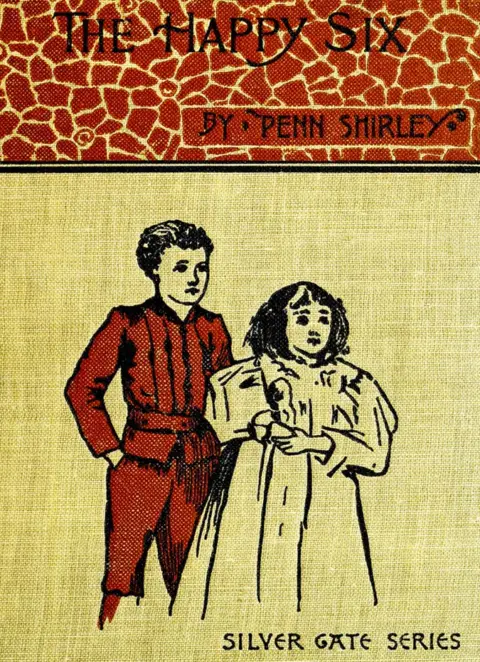
The happy six
Penn Shirley
THE CLASSIC COLLECTION · 1886
"Little Miss Weezy" by Penn Shirley is a children's novel written in the late 19th century. It follows the high-spirited toddler Louise “Weezy” Rowe through a string of domestic adventures with her family and neighbors, blending humor with gentle moral lessons. The vignettes spotlight Weezy’s mischief and charm alongside the foibles and growth of her siblings, parents, and kindly Uncle Doctor, with affectionate attention to everyday life and the virtues of honesty, obedience, and kindness. Readers who enjoy warm family stories and lively child viewpoints will find it playful and tender. The opening of the story introduces Weezy’s nickname and home circle, then sweeps through a series of comic scrapes: she locks the maid out while the wash boils over, disrupts church by serenading the hymn with “Little Sally Walker,” and later follows a beggar child and gets lost before a policeman and the girl help her home. She and a helper, Ellen, trigger a memorable moment when a pickle turns up in the teapot at a minister’s dinner; she climbs a clock to steal the desk key and cuts paper dolls from a deed; she suffers the mumps while braiding her uncle’s beard; and she inadvertently sends her father down the street with her yarn doll “Sambo” tied to his coat. Weezy “goes calling” with visiting-cards, returns in a delivery wagon with figs, and is wrongly suspected of taking a dime until it’s found. A parallel thread shows brother Kirke’s lapse and honest confession at school, while Weezy’s own judgment shines when she refuses a birthday drive until a “stealing apples” joke is cleared up. A winter visit to grandparents adds a schoolroom mix-up—promising “one slide” but “heeling and toeing” the snowy bank instead—before her father arrives to bring her home for Christmas, with a mysterious moving, musical present teased as the scene breaks.
Introduction adapted from the source catalogue; source summaries may be automatically generated.
Free to read · English · 18,512 words · No account needed
MAKE TIME FOR A GOOD BOOK
On by default. Untick to stop anonymous reading totals. Each page counts after 10 seconds in view. How this works.
Anonymous counting is on unless you have switched it off.
Weezy's Sambo had hardly rallied from the mumps when she herself was attacked by the same disease. One afternoon her face and throat began to swell, and by the next morning she looked like a fat young Eskimo.
"Oh, ho! What a cheeky little girl! I never saw a little girl so cheeky," cried Kirke, laughing merrily, at his first glimpse of her, bolstered up in her mother's bed.
"I isn't sheeky 'ittle girl. Make him 'top, mamma," moaned wretched little Weezy, beginning to cry.
"Now, mamma, I didn't mean to tease her. I didn't, honest," exclaimed Kirke, balancing himself across the foot-board. "She cries as easy as a wink."
"Oh, she does, does she?" said Dr. Wyman, bustling in. "Well, my young man, we must forgive her. Mumps seldom make people jolly."
"O unker Docker, I don't want any more mumps," wailed Weezy, reaching
out both hands.
One held the comb with which she had been arranging Viola Maud's blonde wig. Viola Maud was the lovely great wax doll that Mrs. Rowe called "her own," and lent to Weezy only when the little girl was ill or unhappy.
"Of course you don't want any more mumps, dearie, and so you're going to stay in mamma's room, and keep quiet," said her uncle cheerfully, sitting down beside the bed.
"But the mumps is here, unker Docker. They's got in," replied
Weezy, in a discouraged tone.
"Is that so?" asked Dr. Wyman, pretending to be very serious. "Then, I tell you what we'll do to get 'em out. We'll take some castor-oil. Mumps don't like castor-oil."
"Don't they?" said Weezy, deeply interested.
"I was afraid she would object to taking medicine, and I am agreeably disappointed," thought the doctor, sending Kirke at once for a teaspoon, and a little milk in an egg-glass.
But when Dr. Wyman had poured some oil into the milk, and brought it to Weezy, it became evident that there had been a misunderstanding.
"No, no. Unker Docker take slippy oil hisse'f. Unker Docker make naughty mumps go 'way. Weezy don't want slippy oil," cried she, putting her hands over her mouth.
Plainly she reasoned that, provided the medicine was swallowed, it did not matter who swallowed it; and if unker Docker had not meant to do his part in driving out the mumps, why had he said, "We'll take some castor-oil"?
Dr. Wyman disliked to scold a little girl who looked so feverish and heavy-eyed, and he began to talk to Weezy in a coaxing manner.
"Come, darling," said he, "if you'll take this like a good little lady, the minute you are well, I'll give you a nice long ride."
Your reading position is saved on this browser. Take it to another device with a library code. Reading pages adapt to text, rather than matching a printed edition.
Penn Shirley
BEHIND THE BOOK
This eBook is for the use of anyone anywhere in the United States and most other parts of the world at no cost and with almost no restrictions whatsoever. You may copy it, give it away or re-use it under the terms of the Project Gutenberg License included with this eBook or online at www.gutenberg.org. If you are not located in the United States, you will have to check the laws of the country where you are located before using this eBook. Read the source licence.
The original source file, including credits and licence, is retained by this library. Request an original-format copy at no charge. Please include the book title and Project Gutenberg identifier #76122.
KEEP YOUR CURIOSITY GOING
Coulson Kernahan

Maurice Baring
Frances Wright
Cécile Tormay

Frederic Jesup Stimson

W. H. P. (William Henry Pope) Jarvis