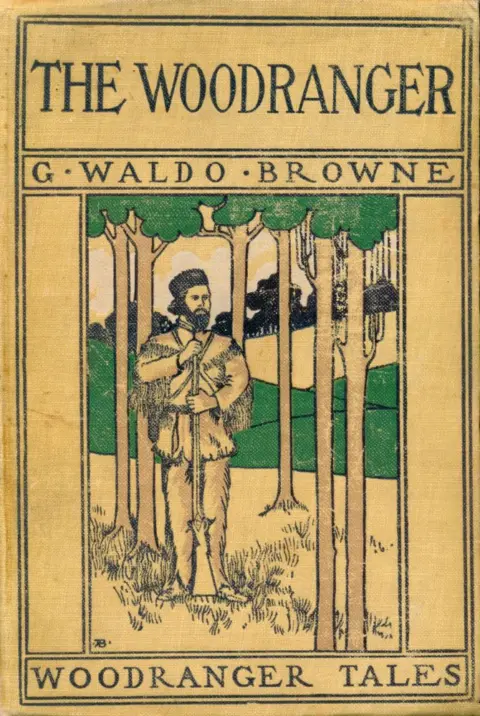
The Woodranger
George Waldo Browne
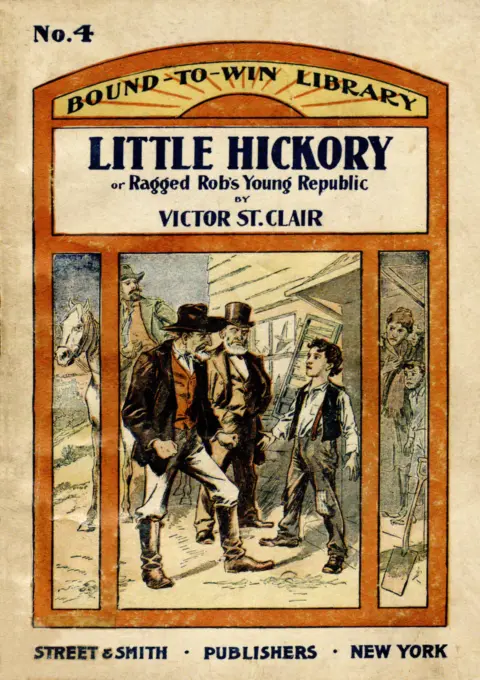
THE CLASSIC COLLECTION · 1901
"Little Hickory; or, Ragged Rob's Young Republic" by George Waldo Browne is a novel written in the early 20th century. The story revolves around a young bootblack named Ragged Rob, also known as Little Hickory, who navigates the challenging landscape of New York City, meets various characters, and ultimately finds himself embroiled in a series of adventures that illustrate themes of friendship, courage, and aspiration against the backdrop of urban struggles. The opening of the book sets the stage for Little Hickory's encounters in the bustling city, where he meets Deacon Elihu Cornhill, a bewildered newcomer from the countryside. Their interaction quickly escalates as Deacon Cornhill becomes a target for theft, prompting Rob to spring into action. Despite the chaos, he manages to retrieve the lost belongings. Through this lively introduction, we are drawn into the rich tapestry of characters and conflicts, highlighting the stark contrast between innocence and the urban environment. As Rob's story unfolds, it hints at deeper themes of belonging and the pursuit of a greater life amid adversity.
Introduction adapted from the source catalogue; source summaries may be automatically generated.
Free to read · English · 46,736 words · No account needed
MAKE TIME FOR A GOOD BOOK
On by default. Untick to stop anonymous reading totals. Each page counts after 10 seconds in view. How this works.
Anonymous counting is on unless you have switched it off.
“You had better not,” cried Joe, but her heart began to fail as she realized how helpless she was. She could only hope that the others had succeeded in secreting Mary so the officers could not find her. But if they did, what then?
The sheriff lost no time in seeking the side door, ’Squire Hardy and one of the men remaining in front, as if he was afraid to face the brave girl in the doorway alone.
“It will be better for the girl to come along peaceably,” he said.
But Joe made no reply, while she listened for sounds of what was taking
place within the house.
Sheriff Stanyan did not gain an entrance until Mary had been concealed in a closet, but the frightened aspect of the little group in the room told the keen-eyed officer that he was on the right track.
“Where is the girl?” he demanded. “Oh, she need not think she can escape me. I saw her enter this house, and I will find her if we have to tear the old shell down. It is a fitting abode for such as you, and you may thank your stars that I am not after the whole of you.”
Mrs. Bayne tried to speak, but the words died away in a whisper, while Mrs. Little could only sob out her anguish.
At that moment Mr. Little, leaning heavily on his cane, entered the room. He had overheard enough to know what was causing the excitement, and facing the sheriff, he said, defiantly:
“Our daughter a thief! never, sir! Begone from these premises, and
never darken----”
“So you dare to offer resistance?” cried the officer. “Nothing suits me better than to snap these handcuffs on your wrists, which, no doubt, have felt their like before.”
The women screamed, and Mr. Little, in his righteous indignation, ordered the sheriff to stand back. In the midst of the scene the door opened, and Mary stepped into the apartment, saying:
“Let them take me, father. It will be better so. I am not a thief, but it does not matter what they will do with me.”
Tears and cries of pain followed, but they availed nothing. Eager to finish his work, the officer took Mary Little by the arm and led her from the room, his associates covering his retreat.
“Don’t let them rob me of my child!” moaned the distracted mother; but her grief and her appeals fell on hearts of stone.
Joe Willet realized how futile had been their defence, as she saw the exultant party drive away with poor Mary in their midst, a prisoner, charged with stealing from her employer.
Your reading position is saved on this browser. Take it to another device with a library code. Reading pages adapt to text, rather than matching a printed edition.
George Waldo Browne
George Waldo Browne
George Waldo Browne
George Waldo Browne
BEHIND THE BOOK
This eBook is for the use of anyone anywhere in the United States and most other parts of the world at no cost and with almost no restrictions whatsoever. You may copy it, give it away or re-use it under the terms of the Project Gutenberg License included with this eBook or online at www.gutenberg.org. If you are not located in the United States, you will have to check the laws of the country where you are located before using this eBook. Read the source licence.
The original source file, including credits and licence, is retained by this library. Request an original-format copy at no charge. Please include the book title and Project Gutenberg identifier #68532.
KEEP YOUR CURIOSITY GOING
Coulson Kernahan

Maurice Baring
Frances Wright
Cécile Tormay

Frederic Jesup Stimson

W. H. P. (William Henry Pope) Jarvis