The Woodranger
George Waldo Browne
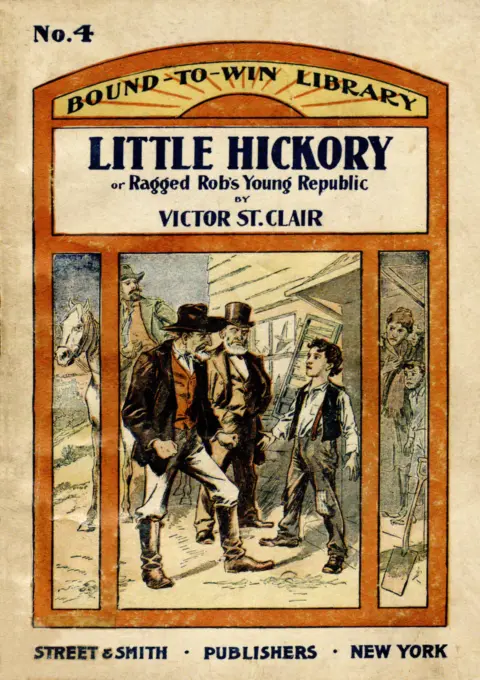
THE CLASSIC COLLECTION · 1901
"Little Hickory; or, Ragged Rob's Young Republic" by George Waldo Browne is a novel written in the early 20th century. The story revolves around a young bootblack named Ragged Rob, also known as Little Hickory, who navigates the challenging landscape of New York City, meets various characters, and ultimately finds himself embroiled in a series of adventures that illustrate themes of friendship, courage, and aspiration against the backdrop of urban struggles. The opening of the book sets the stage for Little Hickory's encounters in the bustling city, where he meets Deacon Elihu Cornhill, a bewildered newcomer from the countryside. Their interaction quickly escalates as Deacon Cornhill becomes a target for theft, prompting Rob to spring into action. Despite the chaos, he manages to retrieve the lost belongings. Through this lively introduction, we are drawn into the rich tapestry of characters and conflicts, highlighting the stark contrast between innocence and the urban environment. As Rob's story unfolds, it hints at deeper themes of belonging and the pursuit of a greater life amid adversity.
Introduction adapted from the source catalogue; source summaries may be automatically generated.
Free to read · English · 46,736 words · No account needed
MAKE TIME FOR A GOOD BOOK
On by default. Untick to stop anonymous reading totals. Each page counts after 10 seconds in view. How this works.
Anonymous counting is on unless you have switched it off.
At sound of Ragged Rob’s ringing words every gaze in the spacious room, even to that of the grim recorder, was turned upon the fearless young bootblack, who, despite his grimy features and soiled, ragged clothes, looked every inch a hero. One countenance lightened at sight of him, and she at the prisoner’s bar cried, in a joyful voice:
“Oh, Rob!” and then she seemed about to fall, as if the glad appearance of her friend had overcome her. But she quickly mastered her weakness, saying, in a supplicating tone:
“Save me from the workshop, Rob! Mother does so need me.”
“I will, Joey; never fear. What is the charge, Mister Recorder?”
“Vagrancy, coupled with trying to pass bad money and being generally a suspicious character,” replied the recorder, recovering his usual stern exterior.
“There’s not a word of truth in it!” exclaimed Rob, impetuously.
“Order!” commanded the recorder, and a burly officer moved toward the excited youth, ready to seize him at the word from his superior. A murmur of excitement ran over the throng of spectators.
“Has she been sentenced?” asked Rob, recovering his self-possession, and speaking with a calmness he was far from feeling.
“Blackwell’s--thirty days,” was the stern reply.
“It must not be!” declared Rob, boldly. “She cannot be guilty, Mister Recorder. Is there no way to save her from the workhouse?”
“As this seems to be her first offense, if there was some one to answer for her, she might be let off this time,” and though it may have been his imagination, Rob thought the recorder said this gladly. At any rate, it gave him hope, and he said, promptly:
“I will answer for her, Mister Recorder.”
“That could hardly be, as you are but a minor, as well as unknown to
us.”
Rob’s countenance fell; but at that moment a loud voice from the rear of the courtroom exclaimed:
“I’ll answer for her, judge! That gal must never go to the workhouse. It would be a burning shame, in this Christian age.”
A buzz of surprise ran over the scene, while Deacon Cornhill, who had made the bold declaration, pushed his way forward to the side of the young bootblack.
“It’s too bad to send such an innercent to the workhouse, judge. How much is there to pay?”
“Who are you, sir?” demanded the recorder, looking askance at the
countrified speaker.
“Deacon Elihu Cornhill, of Basinburg, your honor.”
“And you promise that she shall be provided for, Mr. Cornhill?”
“I do, judge.”
Your reading position is saved on this browser. Take it to another device with a library code. Reading pages adapt to text, rather than matching a printed edition.
George Waldo Browne
George Waldo Browne
George Waldo Browne
George Waldo Browne
BEHIND THE BOOK
This eBook is for the use of anyone anywhere in the United States and most other parts of the world at no cost and with almost no restrictions whatsoever. You may copy it, give it away or re-use it under the terms of the Project Gutenberg License included with this eBook or online at www.gutenberg.org. If you are not located in the United States, you will have to check the laws of the country where you are located before using this eBook. Read the source licence.
The original source file, including credits and licence, is retained by this library. Request an original-format copy at no charge. Please include the book title and Project Gutenberg identifier #68532.
KEEP YOUR CURIOSITY GOING
Coulson Kernahan

Maurice Baring
Frances Wright
Cécile Tormay

Frederic Jesup Stimson

W. H. P. (William Henry Pope) Jarvis