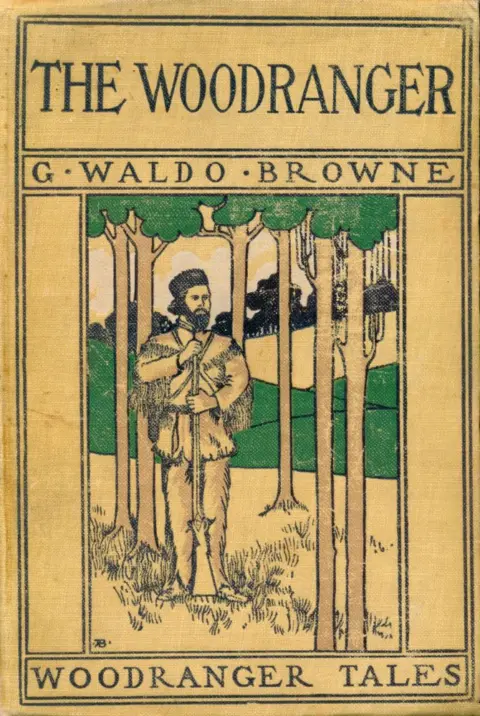
The Woodranger
George Waldo Browne
THE CLASSIC COLLECTION · 1901
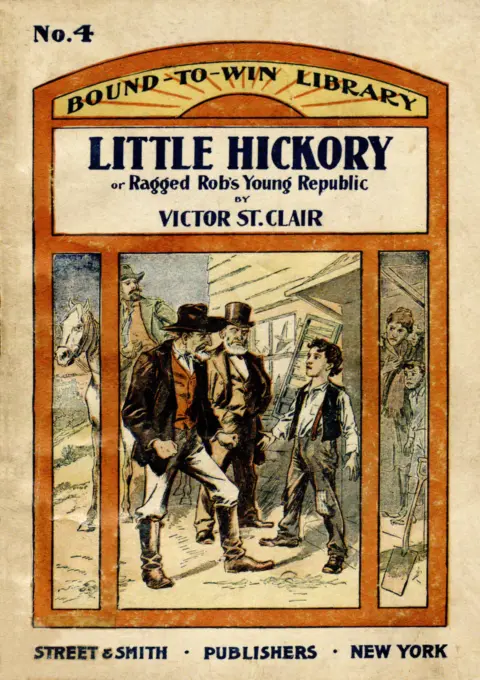
"Little Hickory; or, Ragged Rob's Young Republic" by George Waldo Browne is a novel written in the early 20th century. The story revolves around a young bootblack named Ragged Rob, also known as Little Hickory, who navigates the challenging landscape of New York City, meets various characters, and ultimately finds himself embroiled in a series of adventures that illustrate themes of friendship, courage, and aspiration against the backdrop of urban struggles. The opening of the book sets the stage for Little Hickory's encounters in the bustling city, where he meets Deacon Elihu Cornhill, a bewildered newcomer from the countryside. Their interaction quickly escalates as Deacon Cornhill becomes a target for theft, prompting Rob to spring into action. Despite the chaos, he manages to retrieve the lost belongings. Through this lively introduction, we are drawn into the rich tapestry of characters and conflicts, highlighting the stark contrast between innocence and the urban environment. As Rob's story unfolds, it hints at deeper themes of belonging and the pursuit of a greater life amid adversity.
Introduction adapted from the source catalogue; source summaries may be automatically generated.
Free to read · English · 46,736 words · No account needed
MAKE TIME FOR A GOOD BOOK
On by default. Untick to stop anonymous reading totals. Each page counts after 10 seconds in view. How this works.
Anonymous counting is on unless you have switched it off.
At the same time Mary was being taken away by Sheriff Stanyan, Larry Little, without dreaming of the ill fate which had overtaken his sister, was the central figure in a scene of most peculiar and vivid interest.
The young orator paused suddenly in the midst of his speech, and at sight of Pluto Snyder the following words issued from his lips:
“Get down there, you cow-headed----”
“Stop the fool!” cried some one, directing his remarks against the newcomer, rather than Larry.
A constable happening to stand near, and misunderstanding the real situation, he seized upon Pluto and began to drag him from the scene. The more the hapless young Snyder struggled the firmer he was held in the grasp of the officer, who showed him no mercy, but pulled him away, while the crowd cheered him for his efforts.
In a moment the quiet was restored, but Larry stood dumb with dismay,
unable to know what to do.
“Go on!” cried Job Westcott. “That fellow shan’t pester you any more.”
Others urged Larry to proceed, and, like one taking a leap in the dark, he again began his speech. The well-rounded periods of the law student gone from him, Larry was obliged to depend upon himself. It was the best thing that could have happened to him. Fortunately, too, he selected a subject familiar to him, and in glowing language he pictured the lives of those lowly ones dwelling in the narrow streets and dark alleys of the great city who had never heard of a Fourth of July, much less tasted of its joys.
As he kept on, Larry really waxed eloquent, and for more than twenty minutes he held his listeners’ undivided attention.
It was an address which is still talked over at Gainsboro. At its close a deafening applause, which lasted for several minutes, rang up and down the grove.
When he stepped down from the platform Larry was greeted by a circle of admirers, and as soon as she could reach his side Lucy came forward with her compliments, which were worth more than all the other praise showered upon him. But he was too confused to speak intelligently.
“It was all a mistake--a miserable mistake, and----”
At this juncture Pluto Snyder, having broken from his captors, reached the spot, and, boiling with rage, cried out:
“Let me get at the hoodlum! He stole my speech--he is a sneaking----”
Seeing Lucy standing by Larry, he suddenly stopped his storm of abuse,
saying, in a milder tone:
“You here, Miss Lucy, in the company of such a scapegoat? Let us go home, and I will tell you of the miserable trick he played on me.”
Your reading position is saved on this browser. Take it to another device with a library code. Reading pages adapt to text, rather than matching a printed edition.
George Waldo Browne
George Waldo Browne
George Waldo Browne
George Waldo Browne
BEHIND THE BOOK
This eBook is for the use of anyone anywhere in the United States and most other parts of the world at no cost and with almost no restrictions whatsoever. You may copy it, give it away or re-use it under the terms of the Project Gutenberg License included with this eBook or online at www.gutenberg.org. If you are not located in the United States, you will have to check the laws of the country where you are located before using this eBook. Read the source licence.
The original source file, including credits and licence, is retained by this library. Request an original-format copy at no charge. Please include the book title and Project Gutenberg identifier #68532.
KEEP YOUR CURIOSITY GOING
Coulson Kernahan

Maurice Baring
Frances Wright
Cécile Tormay

Frederic Jesup Stimson

W. H. P. (William Henry Pope) Jarvis