Letters to a Friend, Written to Mrs. Ezra S. Carr, 1866-1879
John Muir
THE CLASSIC COLLECTION · 1921
"Lichens" by Annie Lorrain Smith is a scientific publication written in the early 20th century. This book serves as a comprehensive study of lichens, covering their historical classification, morphology, physiology, and ecological significance. The work is likely targeted towards botanists, lichenologists, and students interested in the intricacies of these unique symbiotic organisms. The opening of the text provides context for its publication, emphasizing the challenges faced during the First World War that delayed its release. The preface explains the book's structure, indicating that it will include historical accounts of lichenology, practical information such as a glossary and bibliography, and detailed analysis of the constituents of lichens. It also acknowledges contributions from various experts in the field who assisted with research and observations, thereby establishing a foundation for the detailed exploration of lichens that follows in the subsequent chapters.
Introduction adapted from the source catalogue; source summaries may be automatically generated.
Free to read · English · 184,755 words · No account needed
MAKE TIME FOR A GOOD BOOK
On by default. Untick to stop anonymous reading totals. Each page counts after 10 seconds in view. How this works.
Anonymous counting is on unless you have switched it off.
E. M. Holmes[1332] has published recently an account of a substance which seems in some respects to answer to the description of manna (Exodus xvi.; Numbers xi.) more nearly than the generally accepted Lecanora esculenta. The information is quoted from Swann’s book: Fighting the slave-hunters in Central Africa. The author writes (p. 116): “I was shown a curious white substance similar to porridge. It was found early in the morning before the sun rose. On examination it was found to possess all the characteristics of the manna ... of the Israelites. In appearance it resembled coriander seed, was white in colour like hoar frost, sweet to the taste, melted in the sun and if kept over night was full of worms in the morning. It required to be baked if you intended to keep it for any length of time. It looked as if it was deposited on the ground in the night.” The writer has suggested that “the substance might be mushroom spawn as, on the spot where it melted tiny fungi sprung up the next night.” Swann’s statement has been confirmed by Dr Wareham, a medical missionary from the same district, who states, however, that it is of rare occurrence.
[1] E. Acton (1909) has described a primitive lichen Botrydina vulgaris, in which there is no fruiting stage, and in which the fungus seems to show affinity with a Hyphomycete.
[2] Luyken 1809.
[3] Hornschuch 1819.
[4] Raab 1819.
[5] Dillenius 1741, p. 200.
[6] Wallroth 1825.
[7] Agardh 1820.
[8] See p. 27.
[9] Schwendener 1867.
[10] Fink 1913.
[11] Lindsay 1876.
[12] Nylander 1869.
[13] Crombie 1891.
[14] Nylander 1891.
[15] Crombie 1874.
[16] Crombie 1877.
[17] Crombie 1885.
[18] Fink 1913.
[19] Elfving 1913.
[20] Moreau 1918.
[21] Peirce 1898.
[22] French 1898.
[23] Morison 1699.
[24] Tournefort 1694 and 1700.
[25] Dillenius 1741.
[26] Krempelhuber 1867-1872.
[27] Grete Herball 1526.
[28] Ruel 1536.
[29] Dorstenius 1540.
[30] Camerarius 1586.
[31] Tabernaemontanus 1590.
[32] L’Obel 1576.
[33] Dodoens 1583.
[34] Gerard 1597.
[35] Schwenckfeld 1600.
[36] Colonna 1606.
[37] Bauhin 1623, pp. 360-2.
[38] Parkinson 1640.
[39] How 1650.
[40] Merrett 1666.
[41] Plot 1686.
[42] Morison 1699.
[43] Ray 1670.
[44] Ray 1686.
[45] Ray 1690.
[46] Petiver 1695.
[47] Plukenet 1691-1696.
[48] Malpighi 1686.
[49] Porta 1688.
[50] Tournefort 1694.
[51] Tournefort 1700.
[52] Rupp 1718.
[53] Buxbaum 1721.
[54] Vaillant 1727.
[55] Dillenius 1724 and 1741.
[56] Micheli 1729.
[57] Dillenius 1719.
[58] See Druce and Vines 1907.
[59] Crombie 1880.
[60] Haller 1742.
[61] Linnaeus 1753.
[62] Schneider 1897.
[63] Hill 1751. Hill’s genus Collema is Nostoc, etc.
[64] Hill 1760.
[65] Watson 1759.
[66] Scopoli 1760.
[67] Adanson 1763.
[68] Hudson 1762 and 1778.
[69] Withering 1776.
[70] Lightfoot 1777.
[71] Dickson 1785.
[72] Weber 1780.
[73] Sibthorp 1794.
[74] Relhan 1785 and 1820.
[75] Smith 1790.
[76] Hoffmann 1798.
[77] Persoon 1794.
[78] Buxbaum 1728.
[79] Petiver 1712.
[80] Sloane 1796 and 1807.
[81] Swartz 1788 and 1791.
[82] Desfontaines 1798-1800.
[83] Georgi 1797.
[84] Willomet, etc. 1787.
[85] Acharius 1798.
[86] Acharius 1803.
[87] Acharius 1810.
[88] Acharius 1814.
[89] Hue 1908.
[90] De Candolle 1805.
[91] Flörke 1815-1819.
[92] Davies 1813.
[93] Forster 1816.
[94] S. F. Gray 1821.
[95] Carrington 1870.
[96] See List of the Books, etc. by John Edward Gray, p. 3, 1872.
[97] Hooker 1821.
[98] Hooker 1831.
[99] Greville 1823-1827.
[100] Greville 1824.
[101] Hooker 1833.
[102] Taylor 1836.
[103] Fries 1831.
[104] Fée 1824.
[105] Flörke 1828.
[106] Wallroth 1829.
[107] Delise 1822.
[108] Chevalier 1824.
[109] Wallroth 1825.
[110] Meyer 1825.
[111] Holle 1849.
[112] Koerber 1839.
[113] Michaux 1803.
[114] Mühlenberg 1813.
[115] Torrey 1819.
[116] Halsey 1824.
[117] Tuckerman 1839.
[118] Fée 1824.
[119] Martius 1833.
[120] Montagne 1851.
[121] Hooker 1841.
[122] Schaerer 1850.
[123] Eschweiler 1824.
[124] Fée 1824.
[125] De Notaris 1846.
[126] Massalongo 1852.
[127] Norman 1852.
[128] Koerber 1855.
[129] Mudd 1861.
[130] Lindsay 1856.
[131] Leighton 1851, etc.
[132] See Hue 1899.
[133] Nylander 1854 and 1855.
[134] Tulasne 1852.
[135] Lauder Lindsay 1859.
[136] Itzigsohn 1854-1855.
[137] Speerschneider 1853.
[138] Sachs 1855.
[139] Thwaites 1849.
[140] Schwendener 1863-1868.
[141] Leighton 1851.
[142] Leighton 1854.
[143] Leighton 1856.
[144] Mudd 1865.
[145] Th. Fries 1858.
[146] Schwendener 1867.
[147] Nylander 1874.
[148] Crombie 1885.
[149] Lett 1890.
[150] Fünfstück 1898.
[151] Zahlbruckner 1903-1907.
[152] Ventenat 1794, p. 36.
[153] Cassini 1817, p. 395.
[154] Agardh 1820.
[155] Scopoli 1760, p. 79.
[156] Persoon 1794, p. 17.
[157] Sprengel 1804, p. 325.
Your reading position is saved on this browser. Take it to another device with a library code. Reading pages adapt to text, rather than matching a printed edition.
BEHIND THE BOOK
This eBook is for the use of anyone anywhere in the United States and most other parts of the world at no cost and with almost no restrictions whatsoever. You may copy it, give it away or re-use it under the terms of the Project Gutenberg License included with this eBook or online at www.gutenberg.org. If you are not located in the United States, you will have to check the laws of the country where you are located before using this eBook. Read the source licence.
The original source file, including credits and licence, is retained by this library. Request an original-format copy at no charge. Please include the book title and Project Gutenberg identifier #61616.
KEEP YOUR CURIOSITY GOING
John Muir
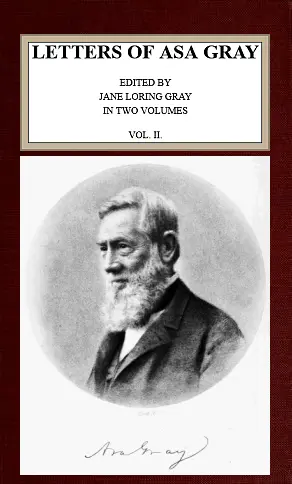
Asa Gray
Asa Gray
Florence Nightingale
Elizabeth Robins Pennell
Denison Olmsted