Letters to a Friend, Written to Mrs. Ezra S. Carr, 1866-1879
John Muir
THE CLASSIC COLLECTION · 1921
"Lichens" by Annie Lorrain Smith is a scientific publication written in the early 20th century. This book serves as a comprehensive study of lichens, covering their historical classification, morphology, physiology, and ecological significance. The work is likely targeted towards botanists, lichenologists, and students interested in the intricacies of these unique symbiotic organisms. The opening of the text provides context for its publication, emphasizing the challenges faced during the First World War that delayed its release. The preface explains the book's structure, indicating that it will include historical accounts of lichenology, practical information such as a glossary and bibliography, and detailed analysis of the constituents of lichens. It also acknowledges contributions from various experts in the field who assisted with research and observations, thereby establishing a foundation for the detailed exploration of lichens that follows in the subsequent chapters.
Introduction adapted from the source catalogue; source summaries may be automatically generated.
Free to read · English · 184,755 words · No account needed
MAKE TIME FOR A GOOD BOOK
On by default. Untick to stop anonymous reading totals. Each page counts after 10 seconds in view. How this works.
Anonymous counting is on unless you have switched it off.
The algae of the cephalodia belong mostly to genera that form the normal gonidia of other lichens. They are:
Stigonema,—in Lecanora gelida, Stereocaulon, Pilophorus robustus, and Lecidea pelobotrya.
Scytonema,—a rare constituent of cephalodia.
Nostoc,—the most frequent gonidium of cephalodia. It occurs in those of the genera Sticta, Lobaria, Peltigera, Nephroma, Solorina and Psoroma; occasionally in Stereocaulon and in Lecidea pallida.
Lyngbya and Rivularia,—rarely present, the latter in Sticta
oregana[462].
Chroococcus and Gloeocapsa,—also very rare.
Scytonema, Chroococcus, Gloeocapsa and Lyngbya are generally found in combination with some other cephalodia-building alga, though Nylander[463] found Scytonema alone in the lobulate cephalodia of Sphaerophorus stereocauloides, a New Zealand lichen, and the only species of that genus in which cephalodia are developed; and Hue[460] records Gloeocapsa as forming internal cephalodia in two species of Aspicilia. Bornet[464] found Lyngbya associated with Scytonema in the cephalodia of Stereocaulon ramulosum, and, in the same lichen, Forssell[465] found, in the several cephalodia of one specimen, Nostoc, Scytonema, and Lyngbya, while, in those of another, Scytonema and Stigonema were present. In the latter instance these algae were living free on the podetium. Forssell[465] also determined two different algae, Gloeocapsa magma and Chroococcus turgidus, present in a cephalodium on Lecidea panaeola var. elegans.
As a general rule only one kind of alga enters into the formation of the cephalodia of any species or genus. A form of Nostoc, for instance, is invariably the gonidial constituent of these bodies in the genera, Lobaria, Sticta, etc. In other lichens different blue-green algae, as noted above, may occupy the cephalodia even on the same specimen. Forssell finds alternative algae occurring in the cephalodia of:
Lecanora gelida and Lecidea illita contain either Stigonema or
Nostoc;
Lecidea panaeola, with Gloeocapsa, Stigonema or Chroococcus;
Lecidea pelobotrya, with Stigonema or Nostoc;
Pilophorus robustus, with Gloeocapsa, Stigonema, or Nostoc.
Riddle[466] has employed cephalodia with their enclosed algae as diagnostic characters in the genus Stereocaulon. When the alga is Stigonema, as in S. paschale, etc., the cephalodia are generally very conspicuous, grey in colour, spherical, wrinkled or folded, though sometimes black and fibrillose (S. denudatum). Those containing Nostoc are, on the contrary, minute and are coloured verdigris-green (S. tomentosum and S. alpinum).
Instances are recorded of algal colonies adhering to, and even penetrating, the thallus of lichens, but as they never enter into relationship with the lichen hyphae, they are antagonistic rather than symbiotic and have no relation to cephalodia.
Your reading position is saved on this browser. Take it to another device with a library code. Reading pages adapt to text, rather than matching a printed edition.
BEHIND THE BOOK
This eBook is for the use of anyone anywhere in the United States and most other parts of the world at no cost and with almost no restrictions whatsoever. You may copy it, give it away or re-use it under the terms of the Project Gutenberg License included with this eBook or online at www.gutenberg.org. If you are not located in the United States, you will have to check the laws of the country where you are located before using this eBook. Read the source licence.
The original source file, including credits and licence, is retained by this library. Request an original-format copy at no charge. Please include the book title and Project Gutenberg identifier #61616.
KEEP YOUR CURIOSITY GOING
John Muir
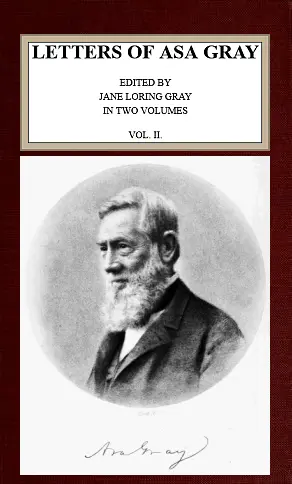
Asa Gray
Asa Gray
Florence Nightingale
Elizabeth Robins Pennell
Denison Olmsted