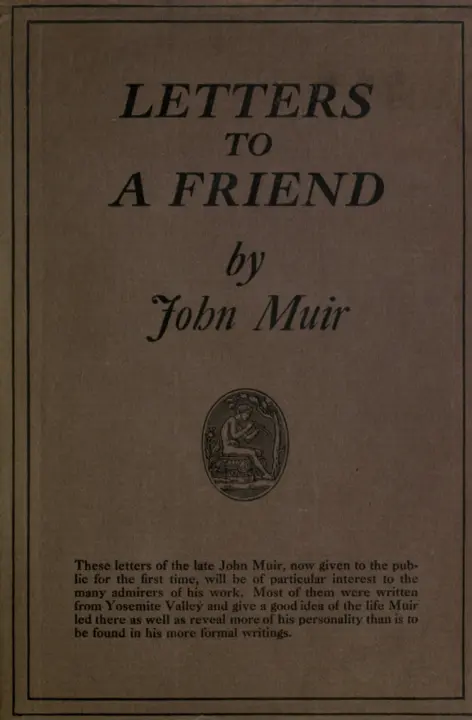
Letters to a Friend, Written to Mrs. Ezra S. Carr, 1866-1879
John Muir
THE CLASSIC COLLECTION · 1921
"Lichens" by Annie Lorrain Smith is a scientific publication written in the early 20th century. This book serves as a comprehensive study of lichens, covering their historical classification, morphology, physiology, and ecological significance. The work is likely targeted towards botanists, lichenologists, and students interested in the intricacies of these unique symbiotic organisms. The opening of the text provides context for its publication, emphasizing the challenges faced during the First World War that delayed its release. The preface explains the book's structure, indicating that it will include historical accounts of lichenology, practical information such as a glossary and bibliography, and detailed analysis of the constituents of lichens. It also acknowledges contributions from various experts in the field who assisted with research and observations, thereby establishing a foundation for the detailed exploration of lichens that follows in the subsequent chapters.
Introduction adapted from the source catalogue; source summaries may be automatically generated.
Free to read · English · 184,755 words · No account needed
MAKE TIME FOR A GOOD BOOK
On by default. Untick to stop anonymous reading totals. Each page counts after 10 seconds in view. How this works.
Anonymous counting is on unless you have switched it off.
Some account must be taken in any ecological survey of those lichens that are indifferent to substrata. Certain species have become so adapted to some special habitat that they never or rarely wander; others, on the contrary, are true vagabonds in the lichen kingdom and settle on any substance that affords a foothold: on leather, bones, iron, pottery, etc. There can be no sustenance drawn from these supports, or at most extremely little, and it is interesting to note in this connection that while some rock-lichens are changed to a rusty-red colour by the infiltration of iron—often from a water medium containing iron-salts—those that live directly on iron are unaffected.
The “wanderers” are more or less the same in every locality and they pass easily from one support to another. Bouly de Lesdain[1179] made a tabulation of such as he found growing on varied substances on the dunes round Dunkirk and they well represent these omnicolous communities. It is in such a no man’s land that one would expect to find an accumulation of derelict materials, not only favourably exposed to light and moisture, but undisturbed for long periods and bordering on normal lichen associations of soil, tree and stones. Arnold[1180] also noted many of these peculiar habitats.
The following were noted by Lesdain and other workers:
=On iron=—Xanthoria parietina, Physcia obscura and var. virella, Ph. ascendens, Placodium (flavescens) sympageum, Pl. pyraceum, Pl. citrinum, Candelariella vitellinum, Rinodina exigua, Lecanora campestris, L. umbrina, L. galactina, Lecania erysibe, Bacidia inundata. Xanthoria parietina is one of the commonest wandering species; it was found by Richard[1181] on an old cannon lying near water, that was exfoliated by rust.
=On tar=—Lecanora umbrina.
=On charcoal=—Rinodina exigua, Lecanora umbrina.
=On bones=—Xanthoria parietina, Physcia ascendens, Ph. tenella, Placodium citrinum, Pl. lacteum, Rinodina exigua, Lecanora galactina, L. dispersa, L. umbrina, Lecania erysibe, L. cyrtella, Acarospora pruinosa, A. Heppii, Bacidia inundata, B. muscorum, Verrucaria anceps, V. papillosa.
In Arctic regions in Ellesmere Land and King Oscar Land, Darbishire[1182] found on bones: Lecanora varia, L. Hageni, Rinodina turfacea and Buellia parasema (disciformis). He could not trace any effect of the lichens on the substratum.
=On charcoal=—Rinodina exigua, Lecanora umbrina.
=On dross or clinkers=—Parmelia dubia, Physcia obscura, Ph. ascendens f. tenella, Ph. pulverulenta, Xanthoria parietina, Placodium pyraceum, Pl. citrinum, Rinodina exigua, Lecanora dispersa, L. umbrina, Lecania erysibe.
=On glass=[1183]—Physcia ascendens f. tenella, Buellia canescens. Richard has recorded the same lichens on the broken glass of walls and in addition: Xanthoria parietina, Lecanora crenulata, L. dispersa, Lecania erysibe, Rinodina exigua, and Buellia canescens.
=On earthenware, china, etc.=—Physcia ascendens f. tenella, Lecanora umbrina, L. dispersa, Lecania (? Biatorina) cyrtella, Verrucaria papillosa, Bacidia inundata.
Your reading position is saved on this browser. Take it to another device with a library code. Reading pages adapt to text, rather than matching a printed edition.
BEHIND THE BOOK
This eBook is for the use of anyone anywhere in the United States and most other parts of the world at no cost and with almost no restrictions whatsoever. You may copy it, give it away or re-use it under the terms of the Project Gutenberg License included with this eBook or online at www.gutenberg.org. If you are not located in the United States, you will have to check the laws of the country where you are located before using this eBook. Read the source licence.
The original source file, including credits and licence, is retained by this library. Request an original-format copy at no charge. Please include the book title and Project Gutenberg identifier #61616.
KEEP YOUR CURIOSITY GOING
John Muir

Asa Gray
Asa Gray
Florence Nightingale
Elizabeth Robins Pennell
Denison Olmsted