Letters to a Friend, Written to Mrs. Ezra S. Carr, 1866-1879
John Muir
THE CLASSIC COLLECTION · 1921
"Lichens" by Annie Lorrain Smith is a scientific publication written in the early 20th century. This book serves as a comprehensive study of lichens, covering their historical classification, morphology, physiology, and ecological significance. The work is likely targeted towards botanists, lichenologists, and students interested in the intricacies of these unique symbiotic organisms. The opening of the text provides context for its publication, emphasizing the challenges faced during the First World War that delayed its release. The preface explains the book's structure, indicating that it will include historical accounts of lichenology, practical information such as a glossary and bibliography, and detailed analysis of the constituents of lichens. It also acknowledges contributions from various experts in the field who assisted with research and observations, thereby establishing a foundation for the detailed exploration of lichens that follows in the subsequent chapters.
Introduction adapted from the source catalogue; source summaries may be automatically generated.
Free to read · English · 184,755 words · No account needed
MAKE TIME FOR A GOOD BOOK
On by default. Untick to stop anonymous reading totals. Each page counts after 10 seconds in view. How this works.
Anonymous counting is on unless you have switched it off.
=Stratum=, a layer of tissue in the thallus, 70.
=Symbiont=, one of two dissimilar organisms living together, 32.
=Symbiosis=, a living together of dissimilar organisms, also termed commensalism, 31, 32 et seq.
=Tegulicolous=, living on tiles, 369.
=Terebrator=, boring apparatus, term used by Lindau for the lichen
“trichogyne,” 179.
=Thalline margin=, an apothecial margin formed of and usually coloured like the thallus; cf. amphithecium.
=Thallus=, vegetative body or soma of the lichen plant, 11, 421. Endogenous thallus in which the alga predominates, 68. Exogenous thallus in which the fungus predominates, 69.
=Theca=, enlarged cell containing spores; cf. ascus.
=Thecium=, layer of tissue in the apothecium consisting of asci and paraphyses; cf. hymenium, 157.
=Trichogyne=, prolongation of the egg-cell in Florideae which acts as a receptive tube; septate hypha in lichens arising from the ascogonium, 160, 177-181, 273.
=Woronin’s hypha=, a coiled hypha occurring in the centre of the fruit
primordium, 159, 163.
p. 24. For Baranetsky read Baranetzky.
p. 277. For Ascolium read Acolium.
p. 318. For Lepolichen coccophora read coccophorus.
Transcriber’s Note: The errata have been corrected.
Lichens are, with few exceptions, perennial aerial plants of somewhat lowly organization. In the form of spreading encrustations, horizontal leafy expansions, of upright strap-shaped fronds or of pendulous filaments, they take possession of the tree-trunks, palings, walls, rocks or even soil that afford them a suitable and stable foothold. The vegetative body, or thallus, which may be extremely long-lived, is of varying colour, white, yellow, brown, grey or black. The great majority of lichens are Ascolichens and reproduction is by ascospores produced in open or closed fruits (apothecia or perithecia) which often differ in colour from the thallus. There are a few Hymenolichens which form basidiospores. Vegetative reproduction by soredia is frequent.
Lichens abound everywhere, from the sea-shore to the tops of high mountains, where indeed the covering of perpetual snow is the only barrier to their advance; but owing to their slow growth and long duration, they are more seriously affected than are the higher plants by chemical or other atmospheric impurities and they are killed out by the smoke of large towns: only a few species are able to persist in somewhat depauperate form in or near the great centres of population or of industry.
Your reading position is saved on this browser. Take it to another device with a library code. Reading pages adapt to text, rather than matching a printed edition.
BEHIND THE BOOK
This eBook is for the use of anyone anywhere in the United States and most other parts of the world at no cost and with almost no restrictions whatsoever. You may copy it, give it away or re-use it under the terms of the Project Gutenberg License included with this eBook or online at www.gutenberg.org. If you are not located in the United States, you will have to check the laws of the country where you are located before using this eBook. Read the source licence.
The original source file, including credits and licence, is retained by this library. Request an original-format copy at no charge. Please include the book title and Project Gutenberg identifier #61616.
KEEP YOUR CURIOSITY GOING
John Muir
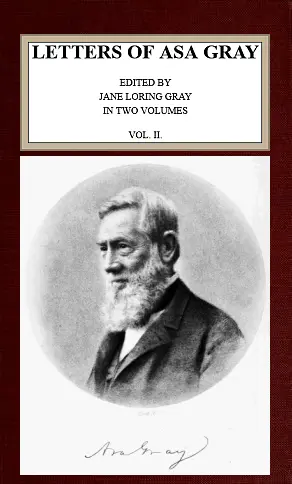
Asa Gray
Asa Gray
Florence Nightingale
Elizabeth Robins Pennell
Denison Olmsted