Letters to a Friend, Written to Mrs. Ezra S. Carr, 1866-1879
John Muir
THE CLASSIC COLLECTION · 1921
"Lichens" by Annie Lorrain Smith is a scientific publication written in the early 20th century. This book serves as a comprehensive study of lichens, covering their historical classification, morphology, physiology, and ecological significance. The work is likely targeted towards botanists, lichenologists, and students interested in the intricacies of these unique symbiotic organisms. The opening of the text provides context for its publication, emphasizing the challenges faced during the First World War that delayed its release. The preface explains the book's structure, indicating that it will include historical accounts of lichenology, practical information such as a glossary and bibliography, and detailed analysis of the constituents of lichens. It also acknowledges contributions from various experts in the field who assisted with research and observations, thereby establishing a foundation for the detailed exploration of lichens that follows in the subsequent chapters.
Introduction adapted from the source catalogue; source summaries may be automatically generated.
Free to read · English · 184,755 words · No account needed
MAKE TIME FOR A GOOD BOOK
On by default. Untick to stop anonymous reading totals. Each page counts after 10 seconds in view. How this works.
Anonymous counting is on unless you have switched it off.
=Medulla=, the loose hyphal layer in the interior of the thallus, 88 et
passim.
=Meristematic=, term applied by Wainio to growing hyphae, 48.
=Microgonidia=, term applied by Minks to minute greenish bodies in lichen
hyphae, 26.
=Multi-septate=, term applied to spores with numerous transverse septa,
316 et seq.
=Murali-divided=, =Muriform=, term applied to spores divided like the
masonry of a wall, 187.
=Oidium=, reproductive cell formed by the breaking up of the hyphae, 189.
=Oil-cell=, hyphal cell containing fat globules, 215.
=Orculiform=, see polarilocular.
=Orthidium=, supposed new type of fructification in lichens, 192.
=Palisade-cells=, the terminal cells of the hyphae forming the fastigiate
cortex, 82, 83.
=Panniform=, having a felted or matted appearance, 260.
=Paraphysis=, sterile filament in the hymenium, 157.
=Parasymbiosis=, associated harmless but not mutually useful growth of
two organisms, 263.
=Parathecium=, hyphal layer round the apothecium, 157.
=Peltate=, term applied to orbicular and horizontal apothecia in the form
of a shield, 336.
=Perithecium=, roundish fructification usually with an apical opening (ostiole) containing ascospores, 158 et passim.
=Pervious=, referring to scyphi with an opening at the base (Perviae),
118.
=Phycolichens=, lichens in which the gonidia are blue-green
(Myxophyceae), 52 et passim.
=Placodioid=, thallus with a squamulose determinate outline, generally orbicular; cf. effigurate, 80.
=Placodiomorph=, see polarilocular.
=Plectenchyma= (=Plectenchymatous=), pseudoparenchyma of fungi and
lichens, 66 et passim.
=Pleurogenous=, borne laterally on hyphal cells; see spermatium, 312.
=Pluri-septate=, term applied to spores with several transverse septa,
321 et seq.
=Podetium=, stalk-like secondary thallus of Cladoniaceae, 114, 293 et
seq.
=Polarilocular=, =Polaribilocular=, two-celled spores with thick median wall traversed by a connecting tube, 188, 340-341.
=Polytomous=, arising of several branches of the podetium from one level,
118.
=Proper margin=, the hyphal margin surrounding the apothecium, 157.
=Prothallus=, =Protothallus=, first stages of hyphal growth; cf.
hypothallus, 71.
=Pycnidiospores=, stylospores borne in pycnidia, 198 et passim.
=Pycnidium=, roundish fructification, usually with an opening at the apex, containing sporophores and stylospores; cf. spermogonium, 192 et seq.
=Pyrenolichens=, in which the fructification is a closed perithecium, 173
et passim.
=Radiate thallus=, the tissues radiate from a centre, 98 et seq.
=Rhagadiose=, deeply chinked, 74; cf. rimose.
=Rhizina=, attaching “rootlet,” 92-94.
=Rimose=, =Rimulose=, cleft or chinked into areolae, 73.
=Rimose-diffract=, widely cracked or chinked, 74.
=Scutellate=, shaped like a platter, 156.
=Scyphus=, cup-like dilatation of the podetium, 111, 117.
=Signature=, a term in ancient medicine to signify the resemblance of a plant to any part of the human body, 406, 409.
=Soralium=, group of soredia surrounded by a definite margin, 144.
=Soredium=, minute separable particle arising from the gonidial tissue of the thallus, and consisting of algae and hyphae, 141.
=Spermatium=, spore-like body borne in the spermogonium, regarded as a non-motile male cell or as a pycnidiospore, 201.
=Spermogonium=, roundish closed receptacle containing spermatia, 192.
=Sphaeroid-cell=, swollen hyphal cell, containing fat globules, 215.
=Squamule=, a small thalline lobe or scale, 74 et passim.
=Sterigma=, Nylander’s term for the spermatiophore, 197.
=Stratose thallus=, where the tissues are in horizontal layers, 70.
Your reading position is saved on this browser. Take it to another device with a library code. Reading pages adapt to text, rather than matching a printed edition.
BEHIND THE BOOK
This eBook is for the use of anyone anywhere in the United States and most other parts of the world at no cost and with almost no restrictions whatsoever. You may copy it, give it away or re-use it under the terms of the Project Gutenberg License included with this eBook or online at www.gutenberg.org. If you are not located in the United States, you will have to check the laws of the country where you are located before using this eBook. Read the source licence.
The original source file, including credits and licence, is retained by this library. Request an original-format copy at no charge. Please include the book title and Project Gutenberg identifier #61616.
KEEP YOUR CURIOSITY GOING
John Muir
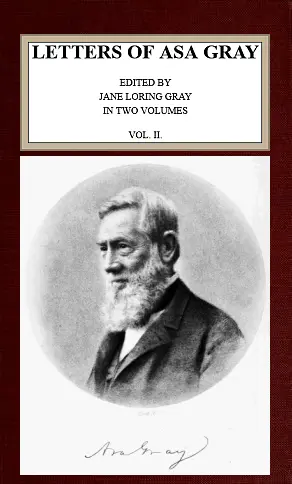
Asa Gray
Asa Gray
Florence Nightingale
Elizabeth Robins Pennell
Denison Olmsted