
Last letters from the living dead man
David Patterson (Spirit) Hatch
THE CLASSIC COLLECTION · 1881
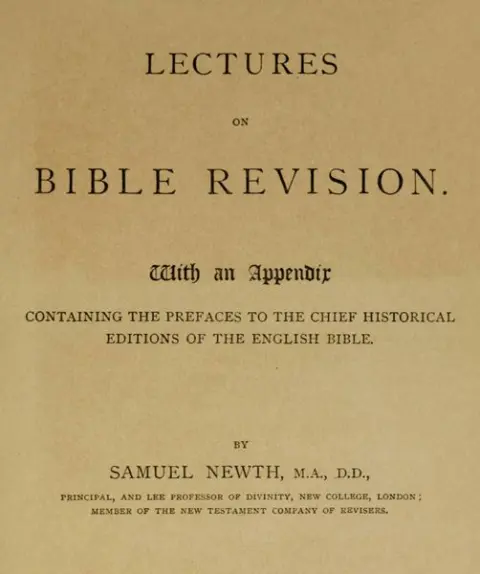
"Lectures on Bible Revision" by Samuel Newth is a scholarly examination written in the late 19th century. The text focuses on the significance of biblical revisions, particularly the need for an updated understanding of the English Bible in light of historical and linguistic changes. It serves as a resource for Sunday-school and Bible-class teachers to navigate the complexities of these revisions and engage thoughtfully with their communities. The opening of the work introduces the author's aim to clarify the distinctions between the substance and form of Scripture, urging readers to acknowledge that while the truths contained in the Bible are eternal, the language and translations are subject to change. Newth emphasizes that reverence for the Scriptures should focus on the underlying truths rather than the specific wording, which has evolved over time. He reflects on historical translations and revisions, illustrating how the English Bible has transformed through various interpreters and linguistic shifts, underscoring the necessity of ongoing revision to maintain its relevance and accuracy for contemporary readers.
Introduction adapted from the source catalogue; source summaries may be automatically generated.
Free to read · English · 79,829 words · No account needed
MAKE TIME FOR A GOOD BOOK
On by default. Untick to stop anonymous reading totals. Each page counts after 10 seconds in view. How this works.
Anonymous counting is on unless you have switched it off.
And here good reader, great cause we have to extoll the wonderous wisdome of God, and with great thankes to prayse his prouidence, considering howe he hath preserued and renued from age to age by speciall [Sidenote: Hebr. v.] miracle, the incomparable treasure of his Churche. For first he did inspire Moyses, as Iohn Chrisostome doth testifie, to wryte the stonie tables, and kept him in the mountayne fourtie dayes to giue him his lawe: after him he sent the prophetes, but they suffred many thousande aduersities, for battayles did folowe, all were slayne, all were destroyed, bookes were brent vp. He then inspired agayne another man to repayre these miraculous scriptures, Esdras I meane, who of their leauings set them agayne together: after that he provided that the seuentie interpreters should take them in hande: at the laste came Christe him selfe, the Apostles did receaue them, and spread them throughout all nations, Christe wrought his miracles and wonders: and what followed? after these great volumes the Apostles also did wryte as Saint Paul doth say, [Sidenote: 1 Cor. x.] These be wrytten to the instruction of vs that be come into the ende of the worlde: [Sidenote: Math. xxii.] and Christe doth say, Ye therefore erre, because ye knowe not the scriptures nor the power of God: and Paul dyd say, [Sidenote: Colo. iii.] Let the worde of Christe be plentifull among you: and agayne saith Dauid, [Sidenote: Psal. cxix.] Oh howe sweete be thy wordes to my throte: he saide not to my hearing, but to my throte, aboue the hony or the hony combe to my mouth. Yea, Moyses saith, [Sidenote: Deut. xvi.] Thou shalt meditate in them evermore when thou risest, when thou sittest downe, when thou goest to sleepe, continue in them he saith: and a thousand places more. And yet after so many testimonies thus spoken, there be some persons that do not yet so much as knowe what the scriptures be: Wherevpon nothing is in good state amongst vs, nothing worthyly is done amongest vs: In this whiche pertayne to this lyfe, we make very great haste, but of spirituall goodes we have no regarde. Thus farre Iohn Chrisost. It must nedes signifie some great thing to our vnderstanding, that almightie God hath had such care to prescribe these bookes thus vnto vs: I say not prescribe them only, but to maintaine them and defende them against the malignitie of the deuill and his ministers, who alway went about to destroy them: and yet could these never be so destroyed, but that he woulde have them continue whole and perfect to this day, to our singular comfort and instruction, where other bookes of mortall wise men haue perished in great numbers. It is recorded that Ptolomeus Philadelphus kyng of Egypt, had gathered together in one librarie at Alexandria by his great coste and diligence, seuen hundred thousand bookes, wherof the principall were the bookes of Moyses, which reserued not much more, then by the space of two hundred yeres, were all brent and consumed, in that battayle when Cæsar restored Cleopatra agayne after her expulsion. At Constantinople perished under Zenon by one common fire, a hundred and twentie thousande bookes. [Sidenote: Iohannes Sarisberi. In Policratico, lib. 8, cap. 19. W. de regibus.] At Rome when Lucius Aurel Antonius dyd raigne, his notable librarie by a lightning from heauen was quite consumed: Yea it is recorded that Gregorie the first, dyd cause a librarie at Rome contayning only certaine Paynim’s workes to be burned, to thintent the scriptures of God should be more read and studied. What other great libraries haue there ben cōsumed but of late daies? And what libraries haue of olde throughout this realme almost in euery abbey of the same, ben destroyed at sundry ages, besides the losse of other men’s private studies, it were to long to rehearse. Wherevpon seyng almightie God by his diuine prouidence, hath preserued these bookes of the scriptures safe and sounde, and that in their natiue languages they were first written, in the great ignoraunce that raigned in these tongues, and contrary to all other casualties, chaunced vpon all other bookes in mauger of all worldly wittes, who would so fayne haue had them destroyed, and yet he by his mightie hande, would haue them extant as witnesses and interpreters of his will toward mankind: we may soone see cause most reuerently to embrace these deuine testimonies of his will, to studie them, and to searche them, to instruct our blinde nature so sore corrupted and fallen from the knowledge in whiche first we were created. Yet hauing occasion geuen somewhat to recover our fall and to returne againe to that deuine nature wherein we were once made, and at the last to be inheritours in the celestiall habitation with God almightie, after the ende of our mortalitie here brought to his dust agayne: These bookes I say beyng of such estimation and aucthoritie, so much reuerenced of them who had any meane taste of them, coulde neuer be put out of the way, neither by the spyte of any tiraunt, as that [Sidenote: Galfride mon] tiraunt Maximian destroyed all the holy scriptures wheresoeuer they coulde be founde, and burnt them in the middes of the market, neither the hatred either of any Porphiran philosopher or Rhetoritian, neither by the enuie of the romanystes, and of such hypocrites who from tyme to time did euer barke against them, some of them not in open sort of condempnation: but more cunningly vnder suttle pretences, for that as they say, they were so harde to vnderstande, and specially for that they affirm it to be a perilous matter to translate the text of the holy scripture, and therefore it cannot be well translated. And here we may beholde the endeuour of some men’s cauillation, who labour all they can to slaunder the translatours, to finde faulte in some wordes of the translation: but them selfe will neuer set pen to the booke, to set out any translation at al. They can in their constitutions prouinciall, [Sidenote: Tho Arūdel in concilio apud Oxon. An 1407 articlo 7.] vnder payne of excommunication, inhibite al other men to translate them without the ordinaries or the prouinciall counsayle agree therevnto. But they wyll be well ware neuer to agree or geue counsayle to set them out. Whiche their suttle compasse in effect, tendeth but to bewray what inwardly they meane, if they could bring it about, that is, vtterly to suppresse them: being in this their iudgement, farre vnlike the olde fathers in the primitiue church, who hath exhorted indifferently all persons, aswell men as women, to exercise them selues in the scriptures, which by Saint Hieroms aucthoritie be the scriptures of the people. Yea they be farre vnlike their olde forefathers that have ruled in this realme, who in their times, and in diuers ages did their diligence to translate the whole bookes of the scriptures to the erudition of the laytie, as yet at this day be to be seene diuers bookes translated into the vulgar tongue, some by kynges of the realme, some by bishoppes, some by abbotts, some by other deuout godly fathers: so desirous they were of olde tyme to have the lay sort edified in godlynes by reading in their vulgar tongue, that very many bookes be yet extant, though for the age of the speache and straungenesse of the charect of many of them almost worne out of knowledge. In whiche bookes may be seene euidently howe it was vsed among the Saxons, to haue in their churches read the foure gospels, so distributed and piked out in the body of the euangelistes bookes, that to euery Sunday and festiuall day in the yere, they were sorted out to the common ministers of the church in their common prayers to be read to their people. [Sidenote: 1 Pet. i.] Now as of the most auncient fathers the prophets, Saint Peter testifieth that these holy men of God had the impulsion of the holy Ghost, to speak out these deuine testimonies: so it is not to be doubted but that these latter holy fathers of the Englishe Church, had the impulsion of the holy Ghost to set out these sacred bookes in their vulgar language, to the edification of the people, [Sidenote: Acts xvii.] by the helpe whereof they might the better folowe the example of the godly Christians, in the beginning of the Churche, who not only receaued the worde withall readinesse of heart, but also did searche diligently in the scriptures, whether the doctrine of the Apostles were agreable to the same scripture. And these were not of the rascall sort (saith the deuine storie) but they were of the best and of most noble byrth among the Thessalonians, Birrhenses by name. [Sidenote: 1 Pet. i.] Yea the prophetes them selues in their dayes, writeth S. Peter, were diligent searchers to inquire out this saluation by Christe, searching when and at what article of time this grace of Christes dispensation shoulde appeare to the world. What ment the fathers of the Church in their writinges, but the advauncing of these holy bookes, where some do attribute no certaintie of vndoubted veritie, but to the canonicall scriptures: [Sidenote: Aug. contra epistolam permemini Hieronimus Tertullian de doctrina Christiana Chrisost in Matt. Ho. 47. Basilius Hieronim.] Some do affirm it to be a foolishe rashe boldnesse to beleue hym, who proueth not by the scriptures that whiche he affirmeth in his worde. Some do accurse all that is deliuered by tradition, not found in the legall and evangelicall scriptures. Some say that our fayth must needes stagger, if it be not grounded vpon the aucthoritie of the scripture. Some testifieth that Christe and his Churche ought to be aduouched out of the scriptures, and do contende in disputation, that the true Church can not be knowen, but only by the holy scriptures: For all other thinges (saith the same aucthor) may be found among the heretikes. Some affirme it to be a sinfull tradition that is obtruded without the scripture. [Sidenote: 1 Pet. i.] Some playnely pronounce, that not to knowe the scriptures is not to know Christe. Wherefore let men extoll out the Churche practises as hyghly as they can, and let them set out their traditions and customes, their decisions in synodes and counsayles, with vaunting the presence of the holy Ghost among them really, as some doth affirme it in their writing, let their groundes and their demonstrations, their foundations be as stable and as strong as they blase them out: [Sidenote: 1 Pet. i.] Yet wyll we be bolde to say with Saint Peter, Habemus nos firmiorem sermonem propheticum. We have for our part a more stable grounde, the propheticall wordes (of the scriptures) and doubt not to be commended therefore of the same Saint Peter with these wordes: Cui dum attenditis ceu lucerne apparenti in obscuro loco, recte facitis donec dies illucescat &c. Wherevnto saith he, whyle ye do attende as to alight shining in a darke place, ye do well vntill the day light appeare, and till the bright starre do arise vnto our heartes, For this we know, that al the propheticall scripture standeth not in any priuate interpretation of vayne names, of severall Churches, of catholique vniuersall seas, of singuler and wylfull heades, whiche wyll chalenge custome all decision to pertayne to them only, who be working so muche for their vayne superioritie, that they be not ashamed now to be of that number, [Sidenote: Psal. xi.] Qui dixerunt linguam nostram magnificabimus, labia nostra a nobis sunt, quis noster dominus est: Which haue sayd with our tongue wyll we preuayle, we are they that ought to speake, who is Lord ouer vs. And whyle they shall contende for their straunge claymed aucthoritie, we will proceede in the reformation begun, and doubt no more by the helpe of Christe his grace, of the true vnity to Christes catholique Churche, [Sidenote: Concilium braccar secundum.] and of the vprightnesse of our fayth in this prouince, then the Spanishe cleargie once gathered together in counsaile (only by the commaundement of their king, before whiche tyme the Pope was not so acknowledged in his aucthoritie which he now claymeth) I say as surely dare we trust, as they dyd trust of their faith and veritie. Yea no lesse confidence haue we to professe that, whiche the fathers of the vniuersall counsaile at Carthage in Affrike as they wryte them selfe did professe in their epistle written to Pope Celestine, laying before his face the foule corruption of him selfe (as two other of his predecessors did the like errour) in falsifiying the canons of Nicen counsayle, for his wrong chalenge of his newe claymed aucthoritie: Thus wrytyng. Prudentissime enim iustissimeque prouiderunt (Nicena et Affricana dicreta) quecunque negotia in suis locis (vbi orta sunt) finienda, nec vnicuiqui prouinciæ gratiam sancti spiritus defuturam qua equitas a Christi sacerdotibus et prudenter videatur, et constantissime teneatur, maxime quia vnicuique concessum est, si iuditio offensus fuerit cognitorum, ad concilia suae prouinciæ vel etiam vniuersale prouocare. That (the Nicen and Affrican decrees) haue most prudently and iustly prouided for all maner of matters to be ended in their teritories where they had their beginning, and they trusted that not to any one prouince shoulde want the grace of the holy Ghost, whereby both the truth or equitie might prudently be seene of the Christian prelates of Christe, and might be also by them most constantly defended, specially for that it is graunted to euery man (if he be greeued) by the iudgement of the cause once knowen to appeale to the counsayles of his owne prouince or els to the vniuersall. Except there be any man, whiche may beleue that our Lorde God woulde inspire the righteousnesse of examination, to any one singular person, and to denie the same to priestes gathered together into counsaile without number, &c. And there they do require the bishop of Rome to send none of his clarkes to execute such prouinciall causes, lest els say they, mought be brought in the vayne pride of the world into the Churche of Christe. In this antiquitie may we in this christian catholique Churche of Englande repose our selfe, knowyng by our owne annales of auncient recorde that Kyng Lucius whose conscience was much touched with the miracles whiche the seruauntes of Christe wrought in diuers nations, thervpon beyng in great loue with the true fayth, sent vnto Eleutherius then byshop of Rome requiring of hym the christian religion. [Sidenote: Inter legis Edwardi.] But Eleutherius did redyly geue ouer that care to King Lucius in his epistle, for that the King as he wryteth, the vicar of God in his owne kingdome, and for that he had receiued the faith of Christe: And for that he had also both testamentes in his realme, he wylled hym to drawe out of them by the grace of God, and by the counsaile of his wisemen, his lawes, and by that lawe of God to gouerne his realme of Britanie, and not so much to desire the Romane and Emperour’s lawes, in the whiche some defaulte might be founde saith he, but in the lawes of God nothing at all. [Sidenote: Ex archiuis de statio landauensis ecclie in vita archiepiscopi dubritii, et in I. capgraue.] With which aunswere the Kinges legates, Eluanus and Medwinus sent as messengers by the King to the Pope, returned to Britanie agayne, Eluanus beyng made a byshop, and Medwine alowed a publique teacher: who for the eloquence and knowledge they had in the holy Scriptures, they repayred home agayne to Kyng Lucius, and by their holy preachings, Lucius and the noble men of the whole Britanie receiued their baptisme, &c. Thus farre in the storie. Nowe therefore knowing and beleuing with Saint Paul, Quod quecumque prescripta sunt, ad nostram doctrinam prescripta sunt vt per pacientiam et consolationem scripturarum spem habeamus: [Sidenote: Rom. xv.] Whatsoeuer is afore written, is written before for our instruction, [Sidenote: =And yet may it be true that W., of Malsberie, writeth that Phaganus and Dernuianus were sent after (as Coadiutours) with these learned men to the preaching of the Gospell, whiche was neuer extinguished in Britaine frō Joseph of Aramathia his time as to S. Austen, the first byshop of Canter, they do openly abouche.=] that we through the patience and comfort of scriptures might haue hope, the only suretie to our fayth and conscience, is to sticke to the scriptures. Wherevpon whyle this eternall worde of God be our rocke and anker to sticke vnto, we will haue pacience with all the vayne inuentions of men, who labour so highly to magnifie their tongues, to exalt them selues aboue al that is God. We wil take comfort by the holy scriptures against the maledictions of the aduersaries, and doubt not to nourishe our hope continually therewith so to liue and dye in this comfortable hope, and doubt not to pertayne to the elect number of Christes Churche, howe farre soeuer we be excommunicated out of the sinagogue of suche who suppose themselues to be the vniuersall lordes of all the world, Lordes of our fayth and consciences, at pleasure.
Your reading position is saved on this browser. Take it to another device with a library code. Reading pages adapt to text, rather than matching a printed edition.
BEHIND THE BOOK
This eBook is for the use of anyone anywhere in the United States and most other parts of the world at no cost and with almost no restrictions whatsoever. You may copy it, give it away or re-use it under the terms of the Project Gutenberg License included with this eBook or online at www.gutenberg.org. If you are not located in the United States, you will have to check the laws of the country where you are located before using this eBook. Read the source licence.
The original source file, including credits and licence, is retained by this library. Request an original-format copy at no charge. Please include the book title and Project Gutenberg identifier #42514.
KEEP YOUR CURIOSITY GOING
David Patterson (Spirit) Hatch

David Patterson (Spirit) Hatch

David Patterson (Spirit) Hatch
Cécile Tormay

Moritz Busch
John L. Ransom