READ · DISCOVER · ENJOYClassic literature · Always free
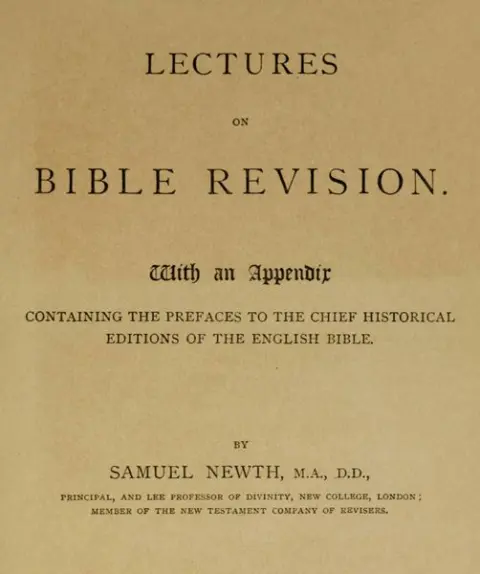
Lectures on Bible Revision — digital edition cover

THE CLASSIC COLLECTION · 1881

Lectures on Bible Revision

"Lectures on Bible Revision" by Samuel Newth is a scholarly examination written in the late 19th century. The text focuses on the significance of biblical revisions, particularly the need for an updated understanding of the English Bible in light of historical and linguistic changes. It serves as a resource for Sunday-school and Bible-class teachers to navigate the complexities of these revisions and engage thoughtfully with their communities. The opening of the work introduces the author's aim to clarify the distinctions between the substance and form of Scripture, urging readers to acknowledge that while the truths contained in the Bible are eternal, the language and translations are subject to change. Newth emphasizes that reverence for the Scriptures should focus on the underlying truths rather than the specific wording, which has evolved over time. He reflects on historical translations and revisions, illustrating how the English Bible has transformed through various interpreters and linguistic shifts, underscoring the necessity of ongoing revision to maintain its relevance and accuracy for contemporary readers.

Introduction adapted from the source catalogue; source summaries may be automatically generated.

Start reading ↓

Free to read · English · 79,829 words · No account needed

MAKE TIME FOR A GOOD BOOK

Lectures on Bible Revision

On by default. Untick to stop anonymous reading totals. Each page counts after 10 seconds in view. How this works.

Anonymous counting is on unless you have switched it off.

Lectures on Bible Revision

Finally to commend further vnto thee good reader the cause in part before intreated, it shalbe the lesse needefull, hauing so nye folowing that learned preface, which sometime was set out by the diligence of that godly father Thomas Cranmer, late byshop in the sea of Canterburie, which he caused to be prefixed before the translation of that Byble that was then set out. And for that the copies thereof be so wasted, that very many Churches do want their conuenient Bybles, it was thought good to some well disposed men, to recognise the same Byble againe into this fourme as it is nowe come out, with some further diligence in the printing, and with some more light added, partly in the translation, and partly in the order of the text, not as condemning the former translation, whiche was folowed mostly of any other translation, excepting the originall text from whiche as litle variaunce was made as was thought meete to such as toke paynes therein: desiring thee good reader if ought be escaped, eyther by such as had the expending of the bookes, or by the ouersight of the printer, to correct the same in the spirite of charitie, calling to remembraunce what diuersitie hath ben seene in mens iudgementes in the translation of these bookes before these dayes, though all directed their labours to the glory of God, to the edification of the Churche, to the comfort of their christian brethren, and alwayes as God dyd further open vnto them, so euer more desirous they were to refourme their former humain ouersightes, rather then in a stubborne wylfulnesse to resist the gyft of the holy Ghost, who from tyme to tyme is resident as that heauenly teacher and leader into all trueth, by whose direction the Churche is ruled and gouerned. And let all men remember in them selfe howe errour and ignoraunce is created with our nature; [Sidenote: Eccle. xi. Sapi. ix.] let frayle man confesse with that great wise man, that the cogitations and inuentions of mortall man be very weake, and our opinions sone deceaued: For the body so subiect to corruption doth oppresse the soule, that it cannot aspire so hye as of dutie it ought. Men we be all, and that whiche we know, is not the thousand part of that we knowe not. Whereupon saith Saint Austen, otherwyse to iudge then the truth is, this temptation ryseth of the frailtie of man. [Sidenote: De doctri Christia.] A man so to loue and sticke to his owne iudgement, or to enuie his brothers to the perill of dissoluing the christian communion, or to the perill of schisme, and of heresie, this is diabolicall presumption: but so to iudge in euery matter as the truth is, this belongeth onely to the angellicall perfection. Notwithstanding good reader, thou mayest be well assured nothing to be done in this translation eyther of malice or wylfull meaning in altering the text, eyther by putting more or lesse to the same, as of purpose to bring in any priuate iudgement by falsification of the wordes, as some certaine men hath ben ouer bold so to do, litle regarding the maiestie of God his scripture: but so to make it serue to their corrupt error, as in alleaging the sentence of Saint Paule to the Romaines the 6. One certaine wryter to proue his satisfaction, was bold to turne the worde of Sanctificationem into the worde of Satisfactionem, thus, Sicut exhibuimus antea membra nostra seruire immundicie et iniquitati ad iniquitatem ita deinceps exhibeamus membra nostra seruire iustitiae in satisfactionem. [Sidenote: Hosius in confessione catholicæ fidi de sacrō penitentiæ Idem Hosius de spe. et oratione.] That is, as we have geuen our members to vncleannesse, from iniquitie to iniquitie: euen so from hencefoorth let vs geue our members to serue righteousnesse into satisfaction: where the true worde is into sanctification. Even so likewise for the auauntage of his cause, to proue that men may haue in their prayer fayth vpon saintes, corruptly alleageth Saint Paules text, Ad philemonem, thus, Fidem quam habes in domino Iesu et in omnes sanctos, leauing out the worde charitatem, which would have rightly ben distributed vnto Omnes sanctos. As fidem vnto in domino Iesu. Where the text is Audiens charitatem tuam et fidem quam habes in domino Iesu in omnes sanctos, &c. It were to long to bryng in many examples, as may be openly founde in some mens wrytynges in these dayes, who would be counted the chiefe pillers of the Catholique fayth, or to note how corruptly they of purpose abuse the text to the comoditie of their cause. What maner of translation may men thinke to looke for at their handes, if they should translate the scriptures to the comfort of God’s elect, whiche they neuer did, nor be not like to purpose it, but be rather studious only to seeke quarrels in other mens well doynges, to picke fault where none is: and where any is escaped through humaine negligence, there to crye out with their tragicall exclamations, but in no wyse to amende by the spirite of charitie and lenitie, that whiche might be more aptly set. Whervpon for frayle man (compassed hym selfe with infirmitie) it is most reasonable not to be to seuere in condemning his brothers knowledge or diligence where he doth erre, not of malice, but of simplicitie, and specially in handeling of these so deuine bookes so profounde in sense, so farre passing our naturall vnderstanding. And with charitie it standeth, the reader not to be offended with the diuersitie of translators, nor with the ambiguitie of translations: For as Saint Austen doth witnesse, [Sidenote: De doctr. Christi. lib. 2. cap. 5.] by God’s prouidence it is brought about, that the holy scriptures whiche be the salue for euery mans sore, though at the first they came from one language, and thereby might have ben spread to the whole worlde: nowe by diuersitie of manye languages, the translatours shoulde spreade the saluation (that is contayned in them) to all nations, by suche wordes of vtteraunce as the reader might perceaue the minde of the translatour, and so consequently to come to the knowledge of God his wyll and pleasure. And though many rashe readers be deceaued in the obscurities and ambiguities of their translations, whyle they take one thing for another, and whyle they vse muche labour to extricate them selues out of the obscurities of the same: yet I thinke (saith he) this is not wrought without the prouidence of God, both to tame the proude arrogancie of man by his suche labour of searching, as also to kepe his minde from lothsomnesse and contempt, where if the scriptures vniuersally were to easie, he woulde lesse regarde them. And though (saith he) in the primitive Churche the late interpreters whiche did translate the scriptures, be innumerable, yet wrought this rather an helpe, than an impediment to the readers, if they be not to negligent. For saith he, diuers translations haue made many tymes the harder and darker sentences, the more open and playne: so that of congruence, no offence can iustly be taken for this newe labour, nothing preiudicing any other mans iudgement by this doyng, nor yet hereby professing this to be so absolute a translation, as that hereafter might folowe no other that might see that whiche as yet was not vnderstanded. In this poynt it is conuenient to consider the iudgement that John, once byshop of Rochester was in, who thus wrote: [Sidenote: Articulo, 17, contra Luth.] It is not vnknowen, but that many thinges hath ben more diligently discussed, and more clearely vnderstanded by the wittes of these latter dayes, as well concerning the gospels as other scriptures, then in olde tyme they were. The cause whereof is (saith he) for that to the olde men the yse was not broken, or for that their age was not sufficient exquisitely to expende the whole mayne sea of the scriptures, or els for that in this large field of the scriptures, a man may gather some eares vntouched, after the haruest men howe diligent soeuer they were. For there be yet (saith he) in the Gospels very many darke places, whiche without all doubt to the posteritie shalbe made muche more open. For why should we despayre herein, seing the Gospell (wryteth he) was deliuered to this intent, that it might be vtterly vnderstanded of vs, yea to the very inche. Wherefore, forasmuch as Christe showeth no lesse loue to his Churche now, then hitherto he hath done, the aucthoritie wherof is as yet no whit diminished, and forasmuch as that holy spirite the perpetuall Keper and Gardian of the same Church, whose gyftes and graces do flowe as continually and as aboundantly as from the beginning: who can doubt, but that such thinges as remayne yet unknowen in the Gospell, shalbe hereafter made open to the latter wittes of our posteritie, to their cleare vnderstanding. Only good readers let vs oft call vpon the holy spirite of God our heauenly father, by the mediation of our Lorde and Sauiour, with the wordes of the octonary psalme of Dauid, who did so importunately craue of God to haue the vnderstanding of his lawes and testament: [Sidenote: Psal. cxix.] Let vs humblye on our knees pray to almightie God, with that wyse [Sidenote: Sapi. ix.] Kyng Solomon in his very wordes saying thus--O God of my fathers, and Lorde of mercies (that thou hast made all thynges with thy worde, and didst ordain man through thy wisdome, that he shoulde haue dominion ouer thy creatures whiche thou hast made, and that he shoulde order the worlde according to holinesse and righteousnesse, and that he shoulde execute iudgement with a true heart) geue me wisdome whiche is euer about thy feate, and put me not out from among thy chyldren: For I thy seruant and sonne of thy handmayden am a feeble person, of a short time, and to weake to the vnderstanding of thy iudgementes and lawes. And though a man be neuer so perfect among the children of men, yet if thy wisdome be not with him, he shalbe of no value. O sende her out therefore from thy holy heauens, and from the throne of thy maiestie, that she may be with me, and labour with me, that I may know what is acceptable in thy sight: for she knoweth and vnderstandeth all thinges, and she shall lead me soberly in my workes, and preserue me in her power, So shall my workes be acceptable by Christe our Lorde, To whom with the father and the holy Ghost, be all honour and glorie, worlde without ende. Amen.

Your reading position is saved on this browser. Take it to another device with a library code. Reading pages adapt to text, rather than matching a printed edition.

BEHIND THE WORDS

About Samuel Newth

Samuel Newth (1821–1898). Explore Lectures on Bible Revision in this collection. These books span history, religion & spirituality.

Explore this author’s books →

THE READERS’ VERDICT

How did this story stay with you?

Not rated yet
Your rating for Lectures on Bible Revision

Be the first to share your verdict.

One rating per browser, which you can change or remove. A necessary browser identifier remembers your vote. How ratings work

A GOOD STORY DESERVES COMPANY

Pass this book along.

A great read is even better when it’s shared.

SEND A LITTLE INSPIRATION

Share this book

BEHIND THE BOOK

Edition & source details.

Title
Lectures on Bible Revision
Author
Samuel Newth
First publication (Open Library catalogue match)
1881
Digital edition publisher
Project Gutenberg
Gutenberg release date
2013-04-12
Language
English
Source edition imprint
Not stated in source catalogue
Source identifier
Project Gutenberg #42514
Contributors
No additional named contributors in source metadata

Public-domain source & licence

This eBook is for the use of anyone anywhere in the United States and most other parts of the world at no cost and with almost no restrictions whatsoever. You may copy it, give it away or re-use it under the terms of the Project Gutenberg License included with this eBook or online at www.gutenberg.org. If you are not located in the United States, you will have to check the laws of the country where you are located before using this eBook. Read the source licence.

Full source licence and obtaining an original copy

The original source file, including credits and licence, is retained by this library. Request an original-format copy at no charge. Please include the book title and Project Gutenberg identifier #42514.

the full Project Gutenberg License must appear
prominently whenever any copy of a Project Gutenberg work (any work
on which the phrase “Project Gutenberg” appears, or with which the
phrase “Project Gutenberg” is associated) is accessed, displayed,
performed, viewed, copied or distributed:

This eBook is for the use of anyone anywhere in the United States and most
other parts of the world at no cost and with almost no restrictions
whatsoever. You may copy it, give it away or re-use it under the terms
of the Project Gutenberg™ License included with this eBook or online
at www.gutenberg.org. If you
are not located in the United States, you will have to check the laws
of the country where you are located before using this eBook.

1.E.2. If an individual Project Gutenberg electronic work is
derived from texts not protected by U.S. copyright law (does not
contain a notice indicating that it is posted with permission of the
copyright holder), the work can be copied and distributed to anyone in
the United States without paying any fees or charges. If you are
redistributing or providing access to a work with the phrase “Project
Gutenberg” associated with or appearing on the work, you must comply
either with the requirements of paragraphs 1.E.1 through 1.E.7 or
obtain permission for the use of the work and the Project Gutenberg
trademark as set forth in paragraphs 1.E.8 or 1.E.9.

1.E.3. If an individual Project Gutenberg electronic work is posted
with the permission of the copyright holder, your use and distribution
must comply with both paragraphs 1.E.1 through 1.E.7 and any
additional terms imposed by the copyright holder. Additional terms
will be linked to the Project Gutenberg License for all works
posted with the permission of the copyright holder found at the
beginning of this work.

1.E.4. Do not unlink or detach or remove the full Project Gutenberg
License terms from this work, or any files containing a part of this
work or any other work associated with Project Gutenberg.

1.E.5. Do not copy, display, perform, distribute or redistribute this
electronic work, or any part of this electronic work, without
prominently displaying the sentence set forth in paragraph 1.E.1 with
active links or immediate access to the full terms of the Project
Gutenberg License.

1.E.6. You may convert to and distribute this work in any binary,
compressed, marked up, nonproprietary or proprietary form, including
any word processing or hypertext form. However, if you provide access
to or distribute copies of a Project Gutenberg work in a format
other than “Plain Vanilla ASCII” or other format used in the official
version posted on the official Project Gutenberg website
(www.gutenberg.org), you must, at no additional cost, fee or expense
to the user, provide a copy, a means of exporting a copy, or a means
of obtaining a copy upon request, of the work in its original “Plain
Vanilla ASCII” or other form. Any alternate format must include the
full Project Gutenberg License as specified in paragraph 1.E.1.

1.E.7. Do not charge a fee for access to, viewing, displaying,
performing, copying or distributing any Project Gutenberg works
unless you comply with paragraph 1.E.8 or 1.E.9.

1.E.8. You may charge a reasonable fee for copies of or providing
access to or distributing Project Gutenberg electronic works
provided that:

• You pay a royalty fee of 20% of the gross profits you derive from
the use of Project Gutenberg works calculated using the method
you already use to calculate your applicable taxes. The fee is owed
to the owner of the Project Gutenberg trademark, but he has
agreed to donate royalties under this paragraph to the Project
Gutenberg Literary Archive Foundation. Royalty payments must be paid
within 60 days following each date on which you prepare (or are
legally required to prepare) your periodic tax returns. Royalty
payments should be clearly marked as such and sent to the Project
Gutenberg Literary Archive Foundation at the address specified in
Section 4, “Information about donations to the Project Gutenberg
Literary Archive Foundation.”

• You provide a full refund of any money paid by a user who notifies
you in writing (or by e-mail) within 30 days of receipt that s/he
does not agree to the terms of the full Project Gutenberg™
License. You must require such a user to return or destroy all
copies of the works possessed in a physical medium and discontinue
all use of and all access to other copies of Project Gutenberg™
works.

• You provide, in accordance with paragraph 1.F.3, a full refund of
any money paid for a work or a replacement copy, if a defect in the
electronic work is discovered and reported to you within 90 days of
receipt of the work.

• You comply with all other terms of this agreement for free
distribution of Project Gutenberg™ works.


1.E.9. If you wish to charge a fee or distribute a Project
Gutenberg™ electronic work or group of works on different terms than
are set forth in this agreement, you must obtain permission in writing
from the Project Gutenberg Literary Archive Foundation, the manager of
the Project Gutenberg™ trademark. Contact the Foundation as set
forth in Section 3 below.

1.F.

1.F.1. Project Gutenberg volunteers and employees expend considerable
effort to identify, do copyright research on, transcribe and proofread
works not protected by U.S. copyright law in creating the Project
Gutenberg™ collection. Despite these efforts, Project Gutenberg™
electronic works, and the medium on which they may be stored, may
contain “Defects,” such as, but not limited to, incomplete, inaccurate
or corrupt data, transcription errors, a copyright or other
intellectual property infringement, a defective or damaged disk or
other medium, a computer virus, or computer codes that damage or
cannot be read by your equipment.

1.F.2. LIMITED WARRANTY, DISCLAIMER OF DAMAGES - Except for the “Right
of Replacement or Refund” described in paragraph 1.F.3, the Project
Gutenberg Literary Archive Foundation, the owner of the Project
Gutenberg™ trademark, and any other party distributing a Project
Gutenberg™ electronic work under this agreement, disclaim all
liability to you for damages, costs and expenses, including legal
fees. YOU AGREE THAT YOU HAVE NO REMEDIES FOR NEGLIGENCE, STRICT
LIABILITY, BREACH OF WARRANTY OR BREACH OF CONTRACT EXCEPT THOSE
PROVIDED IN PARAGRAPH 1.F.3. YOU AGREE THAT THE FOUNDATION, THE
TRADEMARK OWNER, AND ANY DISTRIBUTOR UNDER THIS AGREEMENT WILL NOT BE
LIABLE TO YOU FOR ACTUAL, DIRECT, INDIRECT, CONSEQUENTIAL, PUNITIVE OR
INCIDENTAL DAMAGES EVEN IF YOU GIVE NOTICE OF THE POSSIBILITY OF SUCH
DAMAGE.

1.F.3. LIMITED RIGHT OF REPLACEMENT OR REFUND - If you discover a
defect in this electronic work within 90 days of receiving it, you can
receive a refund of the money (if any) you paid for it by sending a
written explanation to the person you received the work from. If you
received the work on a physical medium, you must return the medium
with your written explanation. The person or entity that provided you
with the defective work may elect to provide a replacement copy in
lieu of a refund. If you received the work electronically, the person
or entity providing it to you may choose to give you a second
opportunity to receive the work electronically in lieu of a refund. If
the second copy is also defective, you may demand a refund in writing
without further opportunities to fix the problem.

1.F.4. Except for the limited right of replacement or refund set forth
in paragraph 1.F.3, this work is provided to you ‘AS-IS’, WITH NO
OTHER WARRANTIES OF ANY KIND, EXPRESS OR IMPLIED, INCLUDING BUT NOT
LIMITED TO WARRANTIES OF MERCHANTABILITY OR FITNESS FOR ANY PURPOSE.

1.F.5. Some states do not allow disclaimers of certain implied
warranties or the exclusion or limitation of certain types of
damages. If any disclaimer or limitation set forth in this agreement
violates the law of the state applicable to this agreement, the
agreement shall be interpreted to make the maximum disclaimer or
limitation permitted by the applicable state law. The invalidity or
unenforceability of any provision of this agreement shall not void the
remaining provisions.

1.F.6. INDEMNITY - You agree to indemnify and hold the Foundation, the
trademark owner, any agent or employee of the Foundation, anyone
providing copies of Project Gutenberg™ electronic works in
accordance with this agreement, and any volunteers associated with the
production, promotion and distribution of Project Gutenberg™
electronic works, harmless from all liability, costs and expenses,
including legal fees, that arise directly or indirectly from any of
the following which you do or cause to occur: (a) distribution of this
or any Project Gutenberg work, (b) alteration, modification, or
additions or deletions to any Project Gutenberg work, and (c) any
Defect you cause.

Section 2. Information about the Mission of Project Gutenberg

Project Gutenberg is synonymous with the free distribution of
electronic works in formats readable by the widest variety of
computers including obsolete, old, middle-aged and new computers. It
exists because of the efforts of hundreds of volunteers and donations
from people in all walks of life.

Volunteers and financial support to provide volunteers with the
assistance they need are critical to reaching Project Gutenberg’s
goals and ensuring that the Project Gutenberg collection will
remain freely available for generations to come. In 2001, the Project
Gutenberg Literary Archive Foundation was created to provide a secure
and permanent future for Project Gutenberg and future
generations. To learn more about the Project Gutenberg Literary
Archive Foundation and how your efforts and donations can help, see
Sections 3 and 4 and the Foundation information page at www.gutenberg.org.

Section 3. Information about the Project Gutenberg Literary Archive Foundation

The Project Gutenberg Literary Archive Foundation is a non-profit
501(c)(3) educational corporation organized under the laws of the
state of Mississippi and granted tax exempt status by the Internal
Revenue Service. The Foundation’s EIN or federal tax identification
number is 64-6221541. Contributions to the Project Gutenberg Literary
Archive Foundation are tax deductible to the full extent permitted by
U.S. federal laws and your state’s laws.

The Foundation’s business office is located at 41 Watchung Plaza #516,
Montclair NJ 07042, USA, +1 (862) 621-9288. Email contact links and up
to date contact information can be found at the Foundation’s website
and official page at www.gutenberg.org/contact

Section 4. Information about Donations to the Project Gutenberg
Literary Archive Foundation

Project Gutenberg™ depends upon and cannot survive without widespread
public support and donations to carry out its mission of
increasing the number of public domain and licensed works that can be
freely distributed in machine-readable form accessible by the widest
array of equipment including outdated equipment. Many small donations
($1 to $5,000) are particularly important to maintaining tax exempt
status with the IRS.

The Foundation is committed to complying with the laws regulating
charities and charitable donations in all 50 states of the United
States. Compliance requirements are not uniform and it takes a
considerable effort, much paperwork and many fees to meet and keep up
with these requirements. We do not solicit donations in locations
where we have not received written confirmation of compliance. To SEND
DONATIONS or determine the status of compliance for any particular state
visit www.gutenberg.org/donate.

While we cannot and do not solicit contributions from states where we
have not met the solicitation requirements, we know of no prohibition
against accepting unsolicited donations from donors in such states who
approach us with offers to donate.

International donations are gratefully accepted, but we cannot make
any statements concerning tax treatment of donations received from
outside the United States. U.S. laws alone swamp our small staff.

Please check the Project Gutenberg web pages for current donation
methods and addresses. Donations are accepted in a number of other
ways including checks, online payments and credit card donations. To
donate, please visit: www.gutenberg.org/donate.

Section 5. General Information About Project Gutenberg electronic works

Professor Michael S. Hart was the originator of the Project
Gutenberg concept of a library of electronic works that could be
freely shared with anyone. For forty years, he produced and
distributed Project Gutenberg eBooks with only a loose network of
volunteer support.

Project Gutenberg eBooks are often created from several printed
editions, all of which are confirmed as not protected by copyright in
the U.S. unless a copyright notice is included. Thus, we do not
necessarily keep eBooks in compliance with any particular paper
edition.

Most people start at our website which has the main PG search
facility: www.gutenberg.org.

This website includes information about Project Gutenberg,
including how to make donations to the Project Gutenberg Literary
Archive Foundation, how to help produce our new eBooks, and how to
subscribe to our email newsletter to hear about new eBooks.


KEEP YOUR CURIOSITY GOING

Your next chapter awaits.