
Last letters from the living dead man
David Patterson (Spirit) Hatch
THE CLASSIC COLLECTION · 1881
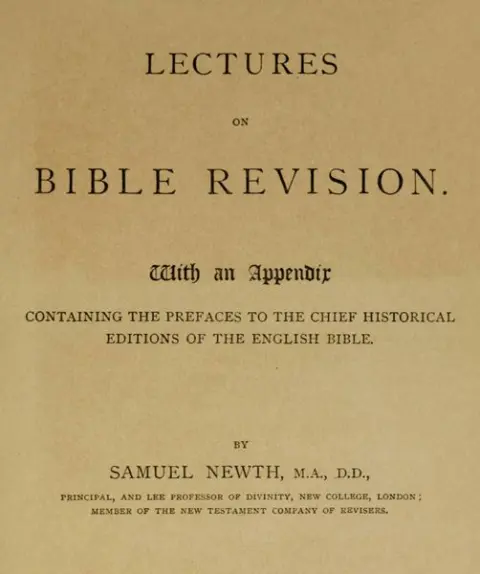
"Lectures on Bible Revision" by Samuel Newth is a scholarly examination written in the late 19th century. The text focuses on the significance of biblical revisions, particularly the need for an updated understanding of the English Bible in light of historical and linguistic changes. It serves as a resource for Sunday-school and Bible-class teachers to navigate the complexities of these revisions and engage thoughtfully with their communities. The opening of the work introduces the author's aim to clarify the distinctions between the substance and form of Scripture, urging readers to acknowledge that while the truths contained in the Bible are eternal, the language and translations are subject to change. Newth emphasizes that reverence for the Scriptures should focus on the underlying truths rather than the specific wording, which has evolved over time. He reflects on historical translations and revisions, illustrating how the English Bible has transformed through various interpreters and linguistic shifts, underscoring the necessity of ongoing revision to maintain its relevance and accuracy for contemporary readers.
Introduction adapted from the source catalogue; source summaries may be automatically generated.
Free to read · English · 79,829 words · No account needed
MAKE TIME FOR A GOOD BOOK
On by default. Untick to stop anonymous reading totals. Each page counts after 10 seconds in view. How this works.
Anonymous counting is on unless you have switched it off.
Vatican Manuscript, 83
Van Dyke, Dr. C. V. A., 115
Vaughan, Dean, 111, 125
Version, Æthiopic, 87
---- Armenian, 87
---- Gothic, 87
---- Italic, 8
---- Memphitic, 87
---- Old Latin, 8
---- Septuagint, 6
---- Syriac, 8
---- Thebaic, 87
Vulgate, 9
Wakefield, G., his translation of the New Testament, 98
Walker, Anthony, his Life of Bois, 46n, 49n
Walton’s Polyglot, 99
Ward, Dr. S., 44n
Ward, T., his Errata to the Protestant Bible, 33n, 93
Warren, Dr. W. F., 115, 116
Weir, Dr. D. H., 112
Wemyss, T., his Reasons in favour of a new translation, 102
Westcott, Canon, 22n, 41n, 111, 125
Whittingham’s New Testament, 25
---- his version and the Genevan compared, 28, 29
Wicked Bible, 54n
Wilberforce, Bishop, 105, 106, 111, 125
Woolsey, Dr. T. D., 115
Wordsworth, Dr. Christopher (Bishop of Lincoln), 107, 110
Wordsworth, Dr. Charles (Bishop of St. Andrews), 112, 125
Worsley, J., his translation of the New Testament, 97
Wright, Dr. W., 109n, 112
Wright, Mr. W. A., 110, 113
Wycliffe, John, 13, 14
---- his Bible, 16, 35
---- preface to his Bible, 129
Zurich Bible, 19
W. Brendon and Son, Plymouth.
[1] From the Latin for seventy, this being the supposed number of the translators. It is referred to as the translation of the Seventy Elders so early as the middle of the second century. See Justin Martyr, Dialogue with Trypho, c. 68.
[2] See Philo Judæus, Life of Moses, book ii. Josephus, Antiquities, xii. ii. 5, 11, 12, 14. Eusebius, Eccl. Hist., v. 8. Josephus states that the translation was made by seventy-two elders in seventy-two days. The story as given in Eusebius is, that the seventy elders were placed apart in seventy different cells, that each translated the entire Scriptures, and that the seventy translations when compared were found to agree to a word.
[3] And this he gave, not by any formal enactment, but by using Jerome’s translation as the basis of his own Exposition of the Book of Job. (See Gregory’s Letter to Leander, forming the preface to that work.) The old version of the Psalms retained its ground apparently from its close connection with the music of the Church. From a like cause the old version of the English Psalms, which in fact was made from the Latin of the Vulgate, retains its place in the Psalter of the Prayer Book. It should however be noted that it is but the translation of the translation of a translation.
[4] Anglo-Saxon Chronicle, A.D. 709.
Your reading position is saved on this browser. Take it to another device with a library code. Reading pages adapt to text, rather than matching a printed edition.
BEHIND THE BOOK
This eBook is for the use of anyone anywhere in the United States and most other parts of the world at no cost and with almost no restrictions whatsoever. You may copy it, give it away or re-use it under the terms of the Project Gutenberg License included with this eBook or online at www.gutenberg.org. If you are not located in the United States, you will have to check the laws of the country where you are located before using this eBook. Read the source licence.
The original source file, including credits and licence, is retained by this library. Request an original-format copy at no charge. Please include the book title and Project Gutenberg identifier #42514.
KEEP YOUR CURIOSITY GOING
David Patterson (Spirit) Hatch

David Patterson (Spirit) Hatch

David Patterson (Spirit) Hatch
Cécile Tormay

Moritz Busch
John L. Ransom