
Last letters from the living dead man
David Patterson (Spirit) Hatch
THE CLASSIC COLLECTION · 1881
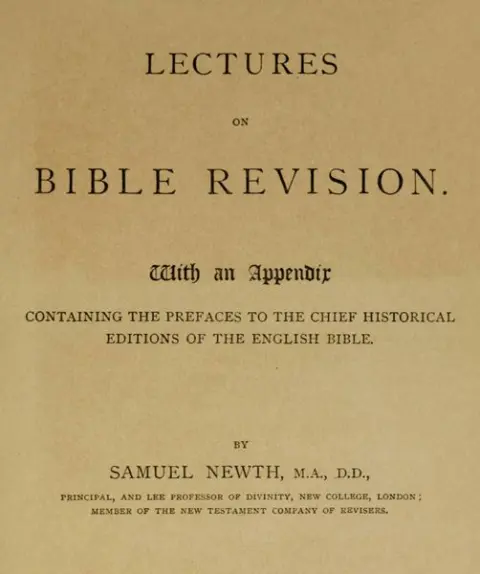
"Lectures on Bible Revision" by Samuel Newth is a scholarly examination written in the late 19th century. The text focuses on the significance of biblical revisions, particularly the need for an updated understanding of the English Bible in light of historical and linguistic changes. It serves as a resource for Sunday-school and Bible-class teachers to navigate the complexities of these revisions and engage thoughtfully with their communities. The opening of the work introduces the author's aim to clarify the distinctions between the substance and form of Scripture, urging readers to acknowledge that while the truths contained in the Bible are eternal, the language and translations are subject to change. Newth emphasizes that reverence for the Scriptures should focus on the underlying truths rather than the specific wording, which has evolved over time. He reflects on historical translations and revisions, illustrating how the English Bible has transformed through various interpreters and linguistic shifts, underscoring the necessity of ongoing revision to maintain its relevance and accuracy for contemporary readers.
Introduction adapted from the source catalogue; source summaries may be automatically generated.
Free to read · English · 79,829 words · No account needed
MAKE TIME FOR A GOOD BOOK
On by default. Untick to stop anonymous reading totals. Each page counts after 10 seconds in view. How this works.
Anonymous counting is on unless you have switched it off.
=Searche therefore=, good reader (on God’s name), as Christe byddeth thee the holy scripture, wherein thou mayest find thy saluation: Let not the volume of this booke (by Gods owne warrant) depart from thee but occupie thy selfe therein in the whole journey of this [Sidenote: Psal. i.] thy wordly pilgrimage, to vnderstand thy way howe to walke ryghtly before hym all the dayes of thy lyfe. Remember that the prophete David pronounceth hym the blessed man whiche wyll muse in the lawe of God [Sidenote: Psal. cxix.] both day and night, remember that he calleth him blessed whiche walketh in the way of the Lorde, which wyll searche diligently his testimonies, and wyll in their whole heart seeke the same. Let not the couert suspicious insinuations of the adversaries driue thee from the searche of the holy scripture, either for the obscuritie whiche they say is in them, or for the inscrutable hidden misteries they talke to be comprised in them, or for the straungnes and homlynes of the phrases they would charge Gods booke with. Christe exhorteth thee therefore the rather for the difficultie of the same, to searche them diligently. [Sidenote: Hebr. v. 1 Cor. xiiii.] Saint Paul wylleth thee to haue thy senses exercised in them, and not to be a chylde in thy senses, but in malice. Though many thinges may be difficulte to thee to vnderstand, impute it rather to thy dull hearing and reading, then to thinke that the scriptures be insuperable, to them whiche with diligent searching labour to discern the evil from the good. [Sidenote: Math. vii.] Only searche with an humble spirite, aske in continuall prayer, seek with puritie of life, knocke with perpetuall perseueraunce, and crye to that good spirite of Christe the Comforter: and surely to euery suche asker it wyll be geuen, such searchers must nedes finde, to them it wylbe opened. Christ hym selfe wyll open the sense of the scriptures, [Sidenote: Math. xi. Esai. lxi.] not to the proude, or to the wyse of the worlde, but to the lowly and contrite in heart; [Sidenote: 1 Cor. xii.] for he hath the kay of Dauid, who openeth and no man shutteth, who shutteth and no man openeth. [Sidenote: Apoc. iii.] For as this spirite is a bening and liberall spirite, and wyll be easyly founde of them which wyll early in carefulnesse ryse to seeke hym, [Sidenote: Sapi i.] and as he promiseth he will be the comforter from aboue to teache vs, and to leade vs into all the wayes of truth, [Sidenote: Iob xiiii.] if that in humilitie we bowe vnto hym, deniyng our owne naturall senses, our carnall wittes and reasons: [Sidenote: Sapi i.] so is he the spirite of puritie and cleannes, and will receede from him, whose conscience is subiect to filthynesse of lyfe. Into suche a soule this heavenly wysdome wyll not enter, for all peruerse cogitations wyll separate vs from God: [Sidenote: Psal. lxviii.] and then howe busyly soeuer we searche this holy table of the scripture, yet will it then be a table to suche to their owne snare, a trap, a stumbling stocke, and a recompense to them selfe. We ought therefore to searche to finde out the trueth, not to oppresse it, we ought to seeke Christe, not as Herode did vnder the pretence of worshipping hym to destroy hym, or as the Pharisees searched the scriptures to disproue Christe, and to discredite him, and not to folowe him; but to embrace the saluation whiche we may learne by them. Nor yet is it inough so to acknowledge the scriptures as some of the Iewes dyd, of the holyest of them, who vsed such diligence, that they could number precisely, not only euery verse, but euery word and sillable, how oft euery letter of the alphabete was repeated in the whole scriptures: They had some of them suche reuerence to that booke, that they woulde not suffer in a greate heape of bookes, any other to lay over them, they woulde not suffer that booke to fall to the grounde as nye as they coulde, they woulde costly bynde the bookes of holy scriptures, and cause them to be exquisitely and ornately written. Whiche deuotion yet though it was not to be discommended, yet was it not for that intent, why Christe commended the scriptures, nor they therof alowed before God: For they did not call vpon God in a true fayth. they were not charitable to their neighbours, but in the middes of all this deuotion, they did steale, they were adulterers, they were slaunderers and backbiters, euen muche like many of our Christian men and women nowe a dayes, who glory muche that they reade the scriptures, that they searche them and loue them, that they frequente the publique sermons in an outwarde shewe of all honestie and perfection, yea they can pike out of the scriptures vertuous sentenses and godly preceptes to lay before other men. And though these maner of men do not muche erre for suche searching and studying, yet they see not the scope and the principall state of the scriptures, which is as Christe declareth it, to finde Christe as their Sauiour, to cleaue to his saluation and merites, and to be brought to the lowe repentaunce of their liues, and to amend them selfe, to rayse vp their fayth to our Sauiour Christe, so to thinke of him as the scriptures do testifie of hym. These be the principall causes why Christe did sende the Iewes to searche the scriptures: for to this ende were they wrytten, saith Saint Iohn, Hae scripta sunt ut credatis, et vt credentes vitam habeatis eternam. These were written to this intent, that ye shoulde beleue, [Sidenote: Iohn xx.] and that through your beliefe ye shoulde haue euerlasting life.
Your reading position is saved on this browser. Take it to another device with a library code. Reading pages adapt to text, rather than matching a printed edition.
BEHIND THE BOOK
This eBook is for the use of anyone anywhere in the United States and most other parts of the world at no cost and with almost no restrictions whatsoever. You may copy it, give it away or re-use it under the terms of the Project Gutenberg License included with this eBook or online at www.gutenberg.org. If you are not located in the United States, you will have to check the laws of the country where you are located before using this eBook. Read the source licence.
The original source file, including credits and licence, is retained by this library. Request an original-format copy at no charge. Please include the book title and Project Gutenberg identifier #42514.
KEEP YOUR CURIOSITY GOING
David Patterson (Spirit) Hatch

David Patterson (Spirit) Hatch

David Patterson (Spirit) Hatch
Cécile Tormay

Moritz Busch
John L. Ransom