
Last letters from the living dead man
David Patterson (Spirit) Hatch
THE CLASSIC COLLECTION · 1881
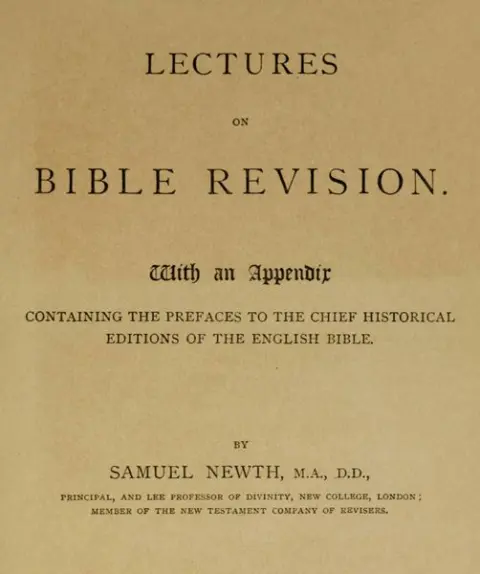
"Lectures on Bible Revision" by Samuel Newth is a scholarly examination written in the late 19th century. The text focuses on the significance of biblical revisions, particularly the need for an updated understanding of the English Bible in light of historical and linguistic changes. It serves as a resource for Sunday-school and Bible-class teachers to navigate the complexities of these revisions and engage thoughtfully with their communities. The opening of the work introduces the author's aim to clarify the distinctions between the substance and form of Scripture, urging readers to acknowledge that while the truths contained in the Bible are eternal, the language and translations are subject to change. Newth emphasizes that reverence for the Scriptures should focus on the underlying truths rather than the specific wording, which has evolved over time. He reflects on historical translations and revisions, illustrating how the English Bible has transformed through various interpreters and linguistic shifts, underscoring the necessity of ongoing revision to maintain its relevance and accuracy for contemporary readers.
Introduction adapted from the source catalogue; source summaries may be automatically generated.
Free to read · English · 79,829 words · No account needed
MAKE TIME FOR A GOOD BOOK
On by default. Untick to stop anonymous reading totals. Each page counts after 10 seconds in view. How this works.
Anonymous counting is on unless you have switched it off.
A Preface into the Byble
folowyng.
Of all the sentences pronounced by our Sauiour Christe in his whole doctrine, none is more serious or more worthy to be borne in remembraunce, than that which he spake openly in his Gospell, saying: [Sidenote: John v.] Scrutamini scripturas, quia vos putatis in ipsis vitam eternam habere, et illæ sunt quæ testimonium perhibent de me. Search ye the scriptures, for in them ye think to have eternall lyfe, and those they be which beare witnes of me. These wordes were first spoken vnto the Jewes by our Sauiour, but by hym in his doctrine ment to all: for they concerne all, of what nation, of what tongue, of what profession soeuer any man be. For to all belongeth it to be called vnto eternal life, so many as by the witnes of the scriptures desire to find eternall life. No man, woman, or chylde, is excluded from this saluation, and therefore to euery of them is this spoke proportionally yet, and in their degrees and ages, and as the reason and congruitie of their vocation may aske. For not so lyeth it in charge to the worldly artificer to searche, or to any other priuate man so exquisitely to studie, as it lyeth to the charge of the publike teacher to searche in the scriptures, to be the more able to walke in the house of God [Sidenote: 1 Tim. iii.] (which is the church of the lyuyng God, the pyller and ground of truth) to the establishing of the true doctrine of the same, and to the impugnyng of the false. And though whatsoever difference there may be betwixt the preacher in office, and the auditor in his vocation, yet to both it is said, =Search ye the scriptures=, whereby ye may fynde eternall lyfe, and gather witnesses of that saluation which is in =Christe Jesus= our Lorde. [Sidenote: Deut. xvii.] For although the prophete of God Moyses, byddeth the kyng when he is once set in the throne of his kingdome, to describe before his eyes the volume of God’s lawe, according to the example whiche he shoulde receaue of the priestes of the liuiticall tribe, to haue it with him, and to reade it in all the dayes of his life, to thende[143] that he might learne to feare the Lorde his God, and to observe his lawes, that his heart be not aduanced in pryde ouer his brethren, not to swarue eyther on the ryght hande or on the left: yet the reason of this precept for that it concerneth all men, may reasonably be thought to be commanded to all men, and all men may take it to be spoken to them selfe in their degree. [Sidenote: Iosue i.] Though almightie God him selfe spake to his captayne Iosue in precise wordes, Non recedat volumen legis huius ab ore tuo sed meditaberis in eo diebus ac noctibus, &c. Let not the volume of this booke depart from thy mouth, but muse therein both dayes and nyghtes, that thou mayest kepe and perfourme all thinges which be written in it, that thou mayest direct well thy way and vnderstande the same: yet as well spake almightie God this precept to all his people in the directions of their wayes to himwarde, as he ment it to Iosue: [Sidenote: Peter v. Ephe. vi.] For that he hath care of all, he accepteth no man’s person, his wyll is that all men should he saued, [Sidenote: 1 Tim. ii. Ioh xiiii.] his wyll is that all men should come to the way of trueth. Howe coulde this be more conueniently declared by God to man, then when Christe his welbeloued sonne our most louing sauiour, the way, the trueth, and the lyfe of vs all, dyd byd vs openly =Search the scriptures=, assuring vs herein to finde eternall life, to finde full testification of all his graces and benefites towardes vs in the treasure thereof. Therefore it is most conuenient that we shoulde all suppose that Christe spake to vs all in this his precept of searching the scriptures. If this celestiall doctour (so aucthorised by the father of heauen, and commaunded [Sidenote: Matt. xvii.] as his only sonne, to be hearde of vs all) biddeth vs busily to =Search the scriptures=: of what spirite can it proceede to forbid the reading and studying of the scriptures? If the grosse Iewes vsed to reade them, as some men thinke that our sauiour Christ dyd shew by such kynd of speaking, their vsage, with their opinion they had therin to finde eternall lyfe, and were not of Christe rebuked, or disproued, either for their searching, or for the opinion they had, howe superstitiously or superficially soeuer some of them vsed to expende the scriptures; How muche more vnaduisedly do suche as bost them selfe to be either Christe’s vicars, or be of his garde, to lothe christen men from reading, by their couert slaunderous reproches of the scriptures, or in their aucthoritie by lawe or statute to contract this libertie of studiyng the worde of eternall saluation. Christe calleth them not onlye to the single readyng of scriptures (saith Chrisostome) but sendeth them to the exquisite searching of them, for in them is eternall lyfe to be founde, and they be (saith hym selfe) the witnesse of me: for they declare out his office, they commende his beneuolence towardes vs, they recorde his whole workes wrought for vs to our saluation. Antechriste therefore he must be, that vnder whatsoeuer colour woulde geue contrary precept or counsayle to that whiche Christe dyd geue vnto vs. Very litle do they resemble Christes louing spirite mouing vs to searche for our comfort, that wyll discourage vs from suche searching, or that woulde wishe ignoraunce and forgetfulnesse of his benefite to raigne in vs, so that they might by our ignoraunce raigne the more frankly in our consciences, to the danger of our saluation. Who can take the light from us in this miserable vale of blindnesse, and meane not to haue us stumble in the pathes of perdition to the ruine of our soules: who wyll enuie vs this bread of lyfe prepared and set on the table for our eternall sustenaunce, and meane not to famishe vs, or in steede thereof with their corrupt traditions and doctrines of men to infect vs: All the whole scripture, saith the holy apostle [Sidenote: ii. Tim. iii.] Saint Paul inspired from God aboue, is profitable to teache, to reproue, to refourme, to instruct in righteousnesse, that the man of God may be sounde and perfect, instructed to euery good worke.
Your reading position is saved on this browser. Take it to another device with a library code. Reading pages adapt to text, rather than matching a printed edition.
BEHIND THE BOOK
This eBook is for the use of anyone anywhere in the United States and most other parts of the world at no cost and with almost no restrictions whatsoever. You may copy it, give it away or re-use it under the terms of the Project Gutenberg License included with this eBook or online at www.gutenberg.org. If you are not located in the United States, you will have to check the laws of the country where you are located before using this eBook. Read the source licence.
The original source file, including credits and licence, is retained by this library. Request an original-format copy at no charge. Please include the book title and Project Gutenberg identifier #42514.
KEEP YOUR CURIOSITY GOING
David Patterson (Spirit) Hatch

David Patterson (Spirit) Hatch

David Patterson (Spirit) Hatch
Cécile Tormay

Moritz Busch
John L. Ransom