
The Wound Dresser A Series of Letters Written from the Hospitals in Washington during the War of the Rebellion
Walt Whitman
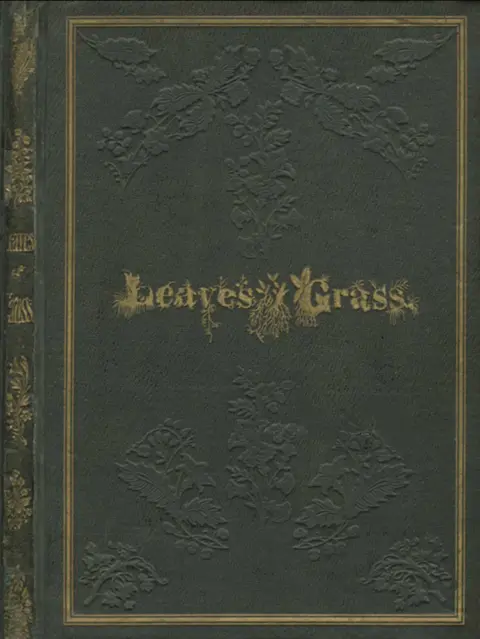
THE CLASSIC COLLECTION · 1855
"Leaves of Grass" by Walt Whitman is a poetry collection first published in 1855. Beginning with just twelve poems, Whitman continuously revised and expanded this work throughout his life, eventually creating a collection of over four hundred poems. He celebrates American democracy, nature, the human body, and sensual pleasure in verse that breaks traditional rules of rhyme and meter. The book's explicit content sparked controversy and condemnation, yet it ultimately became recognized as one of the central works of American poetry.
Introduction adapted from the source catalogue; source summaries may be automatically generated.
Free to read · English · 123,719 words · No account needed
MAKE TIME FOR A GOOD BOOK
On by default. Untick to stop anonymous reading totals. Each page counts after 10 seconds in view. How this works.
Anonymous counting is on unless you have switched it off.
Every existence has its idiom, every thing has an idiom and tongue, He resolves all tongues into his own and bestows it upon men, and any man translates, and any man translates himself also, One part does not counteract another part, he is the joiner, he sees how they join.
He says indifferently and alike How are you friend? to the President at his levee, And he says Good-day my brother, to Cudge that hoes in the sugar-field, And both understand him and know that his speech is right.
He walks with perfect ease in the capitol, He walks among the Congress, and one Representative says to another, Here is our equal appearing and new.
Then the mechanics take him for a mechanic, And the soldiers suppose him to be a soldier, and the sailors that he has follow’d the sea, And the authors take him for an author, and the artists for an artist, And the laborers perceive he could labor with them and love them, No matter what the work is, that he is the one to follow it or has follow’d it, No matter what the nation, that he might find his brothers and sisters there.
The English believe he comes of their English stock,
A Jew to the Jew he seems, a Russ to the Russ, usual and near,
removed from none.
Whoever he looks at in the traveler’s coffee-house claims him, The Italian or Frenchman is sure, the German is sure, the Spaniard is sure, and the island Cuban is sure, The engineer, the deck-hand on the great lakes, or on the Mississippi or St. Lawrence or Sacramento, or Hudson or Paumanok sound, claims him.
The gentleman of perfect blood acknowledges his perfect blood, The insulter, the prostitute, the angry person, the beggar, see themselves in the ways of him, he strangely transmutes them, They are not vile any more, they hardly know themselves they are so grown.
2 The indications and tally of time, Perfect sanity shows the master among philosophs, Time, always without break, indicates itself in parts, What always indicates the poet is the crowd of the pleasant company of singers, and their words, The words of the singers are the hours or minutes of the light or dark, but the words of the maker of poems are the general light and dark, The maker of poems settles justice, reality, immortality, His insight and power encircle things and the human race, He is the glory and extract thus far of things and of the human race.
Your reading position is saved on this browser. Take it to another device with a library code. Reading pages adapt to text, rather than matching a printed edition.
Walt Whitman

Anne (Anne Burrows) Gilchrist & Walt Whitman
Walt Whitman
Walt Whitman
BEHIND THE BOOK
This eBook is for the use of anyone anywhere in the United States and most other parts of the world at no cost and with almost no restrictions whatsoever. You may copy it, give it away or re-use it under the terms of the Project Gutenberg License included with this eBook or online at www.gutenberg.org. If you are not located in the United States, you will have to check the laws of the country where you are located before using this eBook. Read the source licence.
The original source file, including credits and licence, is retained by this library. Request an original-format copy at no charge. Please include the book title and Project Gutenberg identifier #1322.
KEEP YOUR CURIOSITY GOING

Eric Mackay
Edmund Gosse
Sophia Margaretta Hensley
Gilbert Parker
George MacDonald

Elizabeth Bibesco