THE CLASSIC COLLECTION✦My diaries, being a personal narrative of events 1888-1914, Part 2 (1900-1914)CLASSIC FREE BOOKS
My diaries, being a personal narrative of events 1888-1914, Part 2 (1900-1914)
Wilfrid Scawen Blunt
THE CLASSIC COLLECTION · 1902
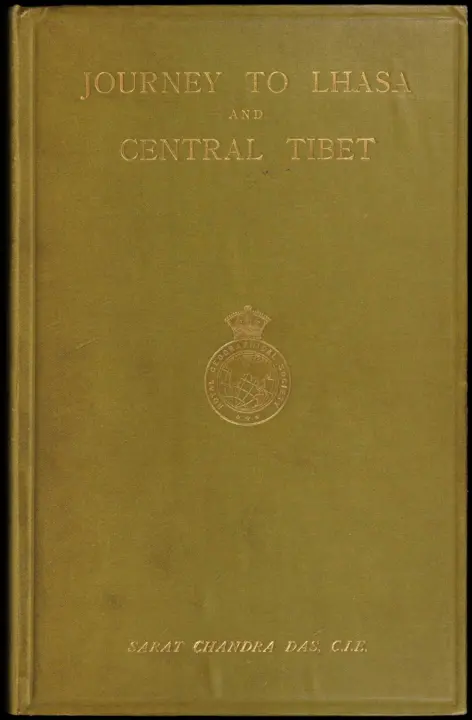
"Journey to Lhasa and Central Tibet" by Sarat Chandra Das is a travelogue published in 1902. The book chronicles Das's second expedition to Tibet in 1881, undertaken under British colonial orders. Das ventures into the forbidden Tibetan capital and central regions, documenting his observations as both explorer and covert agent. Contemporary reviews praised it as the most authentic account of Tibet available, highlighting Das's courage and keen insight into this mysterious land.
Introduction adapted from the source catalogue; source summaries may be automatically generated.
Free to read · English · 110,516 words · No account needed
MAKE TIME FOR A GOOD BOOK
On by default. Untick to stop anonymous reading totals. Each page counts after 10 seconds in view. How this works.
Anonymous counting is on unless you have switched it off.
[51] Also visited by Hooker. He says that it was (in 1848) a miserable collection of 200 to 300 stone huts. Its altitude is about 13,500 feet above sea-level. See Hooker, op. cit., i. 238. On p. 242 of his work is a “diagram of the glacial terraces at the fork of the Yangma valley.”—(W. R.)
[52] Yang-ma, meaning “broad.”—(W. R.)
[53] Rtsa, “grass;” mtsams, “boundary-line, limit.”—(W. R.)
[54] Tara, or tarak, is made of curdled milk slightly cooked and stirred up in the process. It is a favourite dish throughout Tibet and Western Mongolia, in which latter country it is also known as tarak. It is generally eaten just before meals. In Eastern Tibet and the Kokonor it is called djo (pr. sho). It is the same as the yaurt of the Turks and the people of the Balkanic States.—(W. R.)
[55] Shape is the colloquial title given to the ministers of State (Kalon) of the Tale lama. The word is possibly gshags, “justice;” dpe, “model,” though it is now written as in the text. See infra, p. 174.—(W. R.)
[56] Gyagar Khamba means “Indian Khamba,” the same as probably Hooker’s Khumba of Sikkim. See p. 107, note; and Hooker, i. 136.—(W. R.)
[57] Nyingma, or Ngangyur, the old or red-hat sect of lamas. Their chief stronghold is Ulterior Tibet, Sikkim, and Bhutan.—(W. R.)
[58] The famous “six-syllable prayer.” See my ‘Land of the Lamas,’ p. 326 et sqq.—(W. R.)
[59] A small stream emptying into the Taya Tsangpo of our maps.—(W. R.)
[60] Ugyen-gyatso visited in 1883 another rock-cut hermitage in this neighbourhood, at a place called Kyil-khor ta dub, some 10 miles from the She-kar gomba, at the foot of the Lama la. It was about a quarter mile long. Padma Sambhava is said to have lived in it. See ‘Report on Explorations in Bhutan, etc.,’ p. 20, § 20.—(W. R.)
[61] Written phyug-po. Med (from me), “no.”—(W. R.)
[62] Written hbrog, and usually pronounced dru, du, or do. The name dopa or drupa applies equally to all pastoral tribes, and they, when speaking, use it with the acceptation of “house, dwelling, tent, home.”—(W. R.)
[63] Three Tibetan tankas are the equivalent of one rupee. There were four varieties of tankas then current in Tibet, two of Nepalese minting, two made at Lhasa, the best being that known as Gadan tanka, and made at the Castle of Gadan.—(W. R.)
[64] In 1879 Chandra Das crossed the Chorten nyima la, probably 20 to 30 miles south of the village of Tebong (called then by him Thekong). He followed the Chorten nyima river from its source in the mountain of the same name to near its mouth at Tebong, where his route joined the one described in the present narrative.—(W. R.)
Your reading position is saved on this browser. Take it to another device with a library code. Reading pages adapt to text, rather than matching a printed edition.
BEHIND THE BOOK
This eBook is for the use of anyone anywhere in the United States and most other parts of the world at no cost and with almost no restrictions whatsoever. You may copy it, give it away or re-use it under the terms of the Project Gutenberg License included with this eBook or online at www.gutenberg.org. If you are not located in the United States, you will have to check the laws of the country where you are located before using this eBook. Read the source licence.
The original source file, including credits and licence, is retained by this library. Request an original-format copy at no charge. Please include the book title and Project Gutenberg identifier #68898.
KEEP YOUR CURIOSITY GOING
Wilfrid Scawen Blunt
Wilfrid Scawen Blunt

E. W. (Edgar Watson) Howe
Francis Greenleaf Allinson & Anne C. E. (Anne Crosby Emery) Allinson
Cyrenus Cole

John Martineau