THE CLASSIC COLLECTION✦My diaries, being a personal narrative of events 1888-1914, Part 2 (1900-1914)CLASSIC FREE BOOKS
My diaries, being a personal narrative of events 1888-1914, Part 2 (1900-1914)
Wilfrid Scawen Blunt
THE CLASSIC COLLECTION · 1902
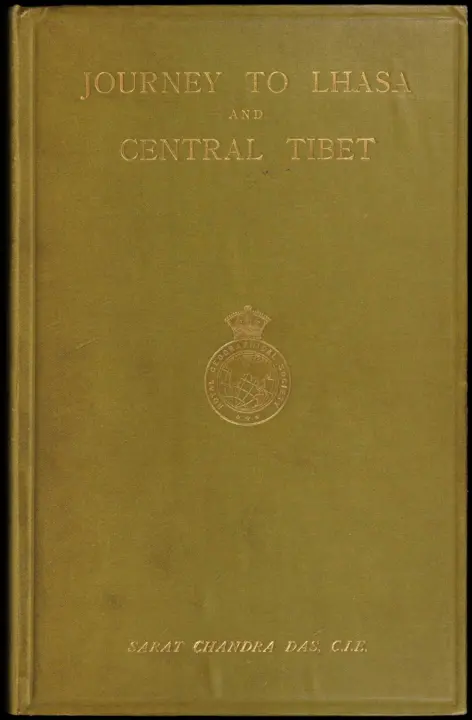
"Journey to Lhasa and Central Tibet" by Sarat Chandra Das is a travelogue published in 1902. The book chronicles Das's second expedition to Tibet in 1881, undertaken under British colonial orders. Das ventures into the forbidden Tibetan capital and central regions, documenting his observations as both explorer and covert agent. Contemporary reviews praised it as the most authentic account of Tibet available, highlighting Das's courage and keen insight into this mysterious land.
Introduction adapted from the source catalogue; source summaries may be automatically generated.
Free to read · English · 110,516 words · No account needed
MAKE TIME FOR A GOOD BOOK
On by default. Untick to stop anonymous reading totals. Each page counts after 10 seconds in view. How this works.
Anonymous counting is on unless you have switched it off.
[38] From this description of Pemazang, it may be inferred that he was a Khamba, a Tibetan from the north-east. We know by Hooker, op. cit., i. 137, that many Khamba came to Sikkim with the first Sikkim rajah. They are, as a people, famous “rain-makers;” while the people from other parts of Tibet are not much given to performing rain-making or rain-dispelling ceremonies. Cf. ‘The Land of the Lamas,’ p. 188.—(W. R.)
[39] The term ani (also pronounced aneh) is used to designate a wife, concubine, or nun. In the present case it certainly means a nun living in a state of concubinage with a lama. It is a common practice in Tibet, and in many places lamas (graba) and ani live in the same convent. See ‘Report on Explorations in Sikkim, Bhutan, etc., from 1856 to 1886,’ pp. 9 and 12, and infra, p. 42.—(W. R.)
[40] Written, according to Jaeschke, op. cit., dkyar. The word and the thing are unknown, I believe, in other parts of Tibet.—(W. R.)
[41] Throughout Tibet and the greater part of Mongolia, the intestines, stuffed with the hashed heart, liver, and lights, compose the first meal made from a freshly killed sheep or kid. The head and pelt are usually given to the person who has sold the sheep, this not being included in the price paid. Cf. infra, p. 41.—(W. R.)
[42] The Kirata are well known as a tribe of non-Brahmanical people (Mleccha) in the Veda. See Chr. Lassen, ‘Indis. Alterthumskunde,’ vol. i. p. 78: “The land between the San Roci and Kankaji is approximately the same as that of the Kiratas.” A complete discussion on the Kiratas is to be found in ‘Zeitschrift für die Kunde des Morgenlandes,’ vol. ii. p. 35 ff. See supra, p. 3.—(W. R.)
[43] Yarsa probably means “upper (yar) land (sa).” Yara mara, or yarka marka, meaning “upper and lower,” are terms used throughout Tibet.—(W. R.)
[44] Tetraogallus Tibetanas.
[45] Cf. Hooker, op. cit., i. 250–254. He made the altitude of this pass to be 15,770 feet above sea-level.—(W. R.)
[46] Hok (or og) means “lower,” kong or gong means “upper.”—(W. R.)
[47] See infra, p. 37, note 2.
[48] Purug is rather a poor transcription of the word phrug (pronounced truk), but better known by the Chinese name of pulo. Pulo, though now a Chinese word, is a borrowed term, probably the Tibetan name. Phrug is native Tibetan cloth made in pieces usually nine or ten fathoms (damba in Tibetan) long and about fourteen inches broad.—(W. R.)
[49] Mi, “man;” za, “to eat.”—(W. R.)
[50] Mthong-wa, “seen;” kun, “entire;” grol, “freedom.”—(W. R.)
Your reading position is saved on this browser. Take it to another device with a library code. Reading pages adapt to text, rather than matching a printed edition.
BEHIND THE BOOK
This eBook is for the use of anyone anywhere in the United States and most other parts of the world at no cost and with almost no restrictions whatsoever. You may copy it, give it away or re-use it under the terms of the Project Gutenberg License included with this eBook or online at www.gutenberg.org. If you are not located in the United States, you will have to check the laws of the country where you are located before using this eBook. Read the source licence.
The original source file, including credits and licence, is retained by this library. Request an original-format copy at no charge. Please include the book title and Project Gutenberg identifier #68898.
KEEP YOUR CURIOSITY GOING
Wilfrid Scawen Blunt
Wilfrid Scawen Blunt

E. W. (Edgar Watson) Howe
Francis Greenleaf Allinson & Anne C. E. (Anne Crosby Emery) Allinson
Cyrenus Cole

John Martineau