THE CLASSIC COLLECTION✦My diaries, being a personal narrative of events 1888-1914, Part 2 (1900-1914)CLASSIC FREE BOOKS
My diaries, being a personal narrative of events 1888-1914, Part 2 (1900-1914)
Wilfrid Scawen Blunt
THE CLASSIC COLLECTION · 1902
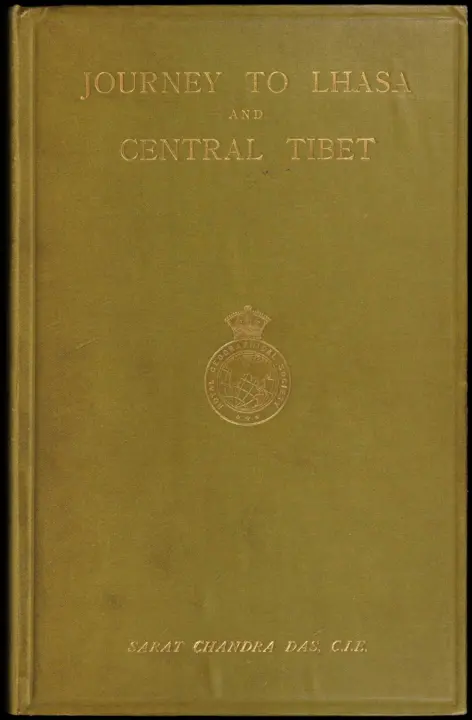
"Journey to Lhasa and Central Tibet" by Sarat Chandra Das is a travelogue published in 1902. The book chronicles Das's second expedition to Tibet in 1881, undertaken under British colonial orders. Das ventures into the forbidden Tibetan capital and central regions, documenting his observations as both explorer and covert agent. Contemporary reviews praised it as the most authentic account of Tibet available, highlighting Das's courage and keen insight into this mysterious land.
Introduction adapted from the source catalogue; source summaries may be automatically generated.
Free to read · English · 110,516 words · No account needed
MAKE TIME FOR A GOOD BOOK
On by default. Untick to stop anonymous reading totals. Each page counts after 10 seconds in view. How this works.
Anonymous counting is on unless you have switched it off.
[65] Or, more correctly, Drang-lung; for he says, in his diary for 1879, that it means “cold valley.”—(W. R.)
[66] Nabu, or, more correctly, Nabo, means “host, landlord.”—(W. R.)
[67] Called satu by Anglo-Indian writers. This word is also found in Georgi, ‘Alphabetum Tibetanum’ (1762), p. 445: “Hordei farinam in jentaculi, pultisque formam subactam Satù communi vocabulo dicunt.”—(W. R.)
[68] This is the ordinary style of Mongol fur cap, very generally used
in Tibet.—(W. R.)
[69] On this organization, see chap. vii. p. 180.
[70] In his journey of 1879, he speaks of Mende as “the pretty village of Mende.... Facing the village is a flower-garden, in which are also dwarf willows, stunted birch and juniper trees.” He also says that Targe (Targye) is on the Yaru-tsang-po (the Taya tsang-po of the maps), probably a local appellation for the upper Arun. Taya tsang-po is probably Targye tsang-po, “the river of the Tar-gye.”—(W. R.)
[71] Probably Khyab-dvang, “all-powerful,” a title in frequent use in
Tibet.—(W. R.)
[72] This river is the Che chu (or Chi chu), the great Arun. Kurma, the author tells us in his journal of 1879, is a “Dokpa town containing about six hundred families.... All supplies are brought here from Shigatse.”—(W. R.)
[73] Hence the name phag, “pig;” ra, “goat.” S. C. D. says they roast them alive. This must be a mistake. I never heard of meat being roasted in Tibet. He evidently means that the sheep are cooked without the skin being removed. The Mongols do the same thing, throwing the carcass (some say the live sheep) in boiling water. These carcasses are sold in a frozen state by the Mongols in Peking in winter, and are known as Tang-yang, or “scalded sheep,” in Chinese. Cf. C. R. Markham’s ‘Narrative of the Mission of Geo. Bogle,’ 86.—(W. R.)
[74] It is called Ya-go on the maps. S. C. D. says, in the account of his first journey, that this village is on the boundary-line between Lhasa and Ulterior Tibet, belonging to the former country.—(W. R.)
[75] The Tagmar of our maps. The writer says elsewhere that it has about two hundred houses.—(W. R.)
[76] The Bra-gyin pa gomba of the maps.—(W. R.)
[77] The Ngambu dung la of our maps, altitude 14,800 feet; but in the account of his first journey S. C. D. says it is 13,500 feet high. The descent on the north side, he adds, is very steep.—(W. R.)
[78] Or Luguri jong, as he calls it elsewhere.—(W. R.)
[79] S. C. D. reached this city for the first time on July 7, 1879.
Your reading position is saved on this browser. Take it to another device with a library code. Reading pages adapt to text, rather than matching a printed edition.
BEHIND THE BOOK
This eBook is for the use of anyone anywhere in the United States and most other parts of the world at no cost and with almost no restrictions whatsoever. You may copy it, give it away or re-use it under the terms of the Project Gutenberg License included with this eBook or online at www.gutenberg.org. If you are not located in the United States, you will have to check the laws of the country where you are located before using this eBook. Read the source licence.
The original source file, including credits and licence, is retained by this library. Request an original-format copy at no charge. Please include the book title and Project Gutenberg identifier #68898.
KEEP YOUR CURIOSITY GOING
Wilfrid Scawen Blunt
Wilfrid Scawen Blunt

E. W. (Edgar Watson) Howe
Francis Greenleaf Allinson & Anne C. E. (Anne Crosby Emery) Allinson
Cyrenus Cole

John Martineau