THE CLASSIC COLLECTION✦My diaries, being a personal narrative of events 1888-1914, Part 2 (1900-1914)CLASSIC FREE BOOKS
My diaries, being a personal narrative of events 1888-1914, Part 2 (1900-1914)
Wilfrid Scawen Blunt
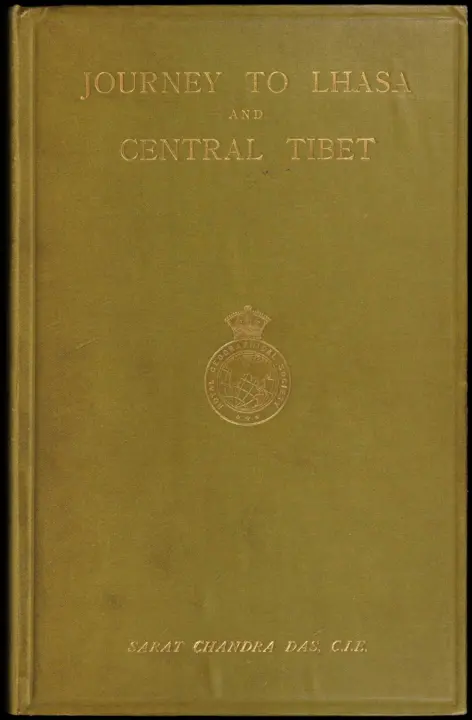
THE CLASSIC COLLECTION · 1902
"Journey to Lhasa and Central Tibet" by Sarat Chandra Das is a travelogue published in 1902. The book chronicles Das's second expedition to Tibet in 1881, undertaken under British colonial orders. Das ventures into the forbidden Tibetan capital and central regions, documenting his observations as both explorer and covert agent. Contemporary reviews praised it as the most authentic account of Tibet available, highlighting Das's courage and keen insight into this mysterious land.
Introduction adapted from the source catalogue; source summaries may be automatically generated.
Free to read · English · 110,516 words · No account needed
MAKE TIME FOR A GOOD BOOK
On by default. Untick to stop anonymous reading totals. Each page counts after 10 seconds in view. How this works.
Anonymous counting is on unless you have switched it off.
[24] Trees or shrubs, with aromatic wood or having sweet-smelling flowers, are frequently called chandan in Tibet. At Kumbum, for example, the famous tree, which is said to have sprung from the hair cut from the head of Tsongkhapa, and which is in all probability a Syringa, is called Tsandan (or Chandan) karpo.—(W. R.)
[25] This work of Sakya Pandita, the Sanskrit title of which is ‘Subhashita ratna nidhi,’ is well known to Oriental scholars by the translation, accompanied by the Tibetan text, published by Csoma de Kőrös in vols. xxiv. and xxv. of the Journ. Bengal Asiat. Soc., and by the French translation of a selection from it made by Ph. E. Foucaux, Paris, 1858, 8vo., under the title of ‘Le trésor des belles paroles.’ The original work is in 454 stanzas. Csoma only translated the 234 first. Sakya Pandita’s Indian name was Ananda Dhwadja; he lived in the thirteenth century. His Tibetan name is derived from that of the lamasery of Sakya, near Tashilhunpo, where he resided.—(W. R.)
[26] Dug, “poison;” shing, “tree or wood.”—(W. R.)
[27] Cf. Hooker, op. cit., i. 254.
[28] Written, I believe, gsha.—(W. R.)
[29] Utpala, or Udpala, is the blue lotus of India, also used medicinally. Mr. Jaeschke, ‘Tib.-Engl. Dict.,’ s.v., says, “In Lhadak this name seems to be transferred to Polemonium caeruleum.”—(W. R.)
[30] Hares, I take it, are meant.—(W. R.)
[31] Dr. Hooker, op. cit., i. 255, states having found similar pheasants near the Nango la. The male bird had two to five spurs on each of its legs, according to its age.—(W. R.) Ithagenes Cruentus.
[32] Cf. Hooker, op. cit., i. 275.—(W. R.)
[33] See Hooker, op. cit., i. 263.—(W. R.)
[34] Tibetan beer. Its preparation is thus described by Jaeschke, op. cit., s.v., Chang: “When the boiled barley has grown cold, some phabs (yeast or dry barm prepared in Balti of flour, mixed with some ginger and aconite) is added, after which it is left standing for two or three days, until fermentation commences, when it is called glum. Having sufficiently fermented, some water is poured to it, and the beer is considered to be ready for use.”—(W. R.)
[35] Hooker’s Kambachen (op. cit., i. 257). He gives its altitude at 11,380 feet above sea-level.—(W. R.)
[36] Hooker (loc. cit.) says that the only cultivation here consists of radishes, potatoes, and barley: no wheat is grown.—(W. R.)
[37] This custom of putting a little piece of butter on the mouth of a bottle or neck of a jug of wine when offered to any one is observed by all Tibetans, and by most of the Mongol tribes with which I am acquainted.—(W. R.)
Your reading position is saved on this browser. Take it to another device with a library code. Reading pages adapt to text, rather than matching a printed edition.
BEHIND THE BOOK
This eBook is for the use of anyone anywhere in the United States and most other parts of the world at no cost and with almost no restrictions whatsoever. You may copy it, give it away or re-use it under the terms of the Project Gutenberg License included with this eBook or online at www.gutenberg.org. If you are not located in the United States, you will have to check the laws of the country where you are located before using this eBook. Read the source licence.
The original source file, including credits and licence, is retained by this library. Request an original-format copy at no charge. Please include the book title and Project Gutenberg identifier #68898.
KEEP YOUR CURIOSITY GOING
Wilfrid Scawen Blunt
Wilfrid Scawen Blunt

E. W. (Edgar Watson) Howe
Francis Greenleaf Allinson & Anne C. E. (Anne Crosby Emery) Allinson
Cyrenus Cole

John Martineau