
Life of Edwin Forrest, the American Tragedian. Volume 2 (of 2)
William Rounseville Alger & Horatio, Jr. Alger
THE CLASSIC COLLECTION · 1899
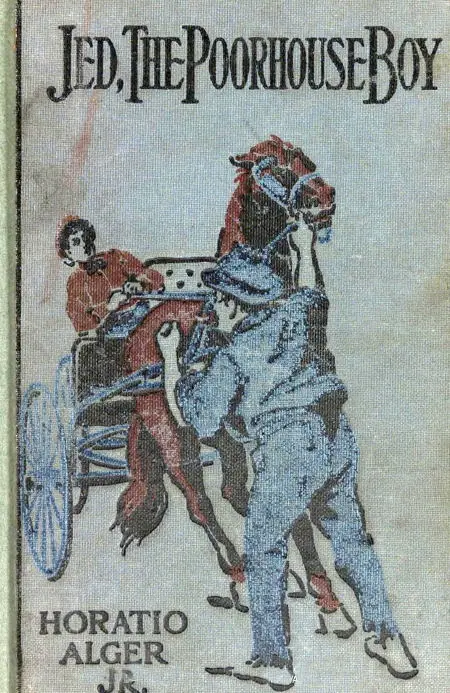
"Jed, the Poorhouse Boy" by Horatio Alger, Jr. is a novel written in the late 19th century. The story follows Jed, a resilient and strong-willed boy living in a poorhouse under the harsh management of Mr. and Mrs. Fogson. As Jed struggles against their tyranny and dreams of a better life, his journey of self-discovery and pursuit of independence begins to unfold. At the start of the narrative, we are introduced to Jed, who is subjected to the cruel treatment of the Fogsons, the poorhouse overseers. His character is depicted as resourceful and assertive despite the oppressive environment, highlighting the contrast between his spirit and that of his tyrannical caretakers. The opening establishes his dissatisfaction with life in the poorhouse and hints at his longing to escape and find his own way in the world—setting the stage for his impending adventures.
Introduction adapted from the source catalogue; source summaries may be automatically generated.
Free to read · English · 57,085 words · No account needed
MAKE TIME FOR A GOOD BOOK
On by default. Untick to stop anonymous reading totals. Each page counts after 10 seconds in view. How this works.
Anonymous counting is on unless you have switched it off.
"How many packages will you take?" he asked pleasantly.
"I guess I'll take a dozen to begin with," said the young man from the
country.
"A dozen!" replied Hugo, much disappointed. "My, that's no order at all. You would have to come back for more before the day was out."
"Well, I'll take fifteen," said the young man after reflection.
"You'd better take fifty. Very few of our agents take less than fifty."
"No, I ain't got much money. I'll only take fifteen to begin with."
And to this determination he adhered, in spite of the persuasions of Mr.
Higgins.
As Hugo wrapped up the packages and received back two dollars and twenty-five cents, he regretted that he had so hastily agreed to buy back Mr. Schmidt's boxes at an advance on the original cost.
"Where would you advise me to sell?" asked the young man.
"Country towns are best," said Hugo. "Some distance from the city, I advise, as those who live near New York can come here and buy, and are less ready to patronize agents."
Jed smiled to himself. He understood that Mr. Higgins wished to guard against a visit from the young man in case his business failed to meet his anticipations. He lingered behind after the rural visitor had gone.
"I hope," said Hugo, "you took no stock in what that stupid Dutchman
said."
"Well," replied Jed, "it shows that some of your agents are not
successful."
"A man like that could not succeed in selling anything," said Hugo scornfully. "Now it is different with you. You look smart."
Jed smiled. He began to understand Mr. Higgins and his methods.
"Then you remember the letters from the agents which I read you."
"Yes," answered Jed, but he felt convinced now that the letters were bogus, and manufactured by Mr. Higgins himself.
"When you can command the necessary funds I shall be glad to have you call and buy a bundle of samples."
"I don't think I shall care to enter into the business, Mr. Higgins," said Jed. "It would be an experiment, and I am not in a position to try experiments."
Higgins looked at Jed, and saw that he was understood.
"Very well!" he said coldly. "You must do as you like, but you are
making a mistake."
Jed left the office and went down stairs. What had happened did not encourage him. It seemed a good deal harder to make a living in a large city than he supposed.
Your reading position is saved on this browser. Take it to another device with a library code. Reading pages adapt to text, rather than matching a printed edition.
William Rounseville Alger & Horatio, Jr. Alger

William Rounseville Alger & Horatio, Jr. Alger

Horatio, Jr. Alger

Horatio, Jr. Alger
BEHIND THE BOOK
This eBook is for the use of anyone anywhere in the United States and most other parts of the world at no cost and with almost no restrictions whatsoever. You may copy it, give it away or re-use it under the terms of the Project Gutenberg License included with this eBook or online at www.gutenberg.org. If you are not located in the United States, you will have to check the laws of the country where you are located before using this eBook. Read the source licence.
The original source file, including credits and licence, is retained by this library. Request an original-format copy at no charge. Please include the book title and Project Gutenberg identifier #54350.
KEEP YOUR CURIOSITY GOING
Coulson Kernahan

Maurice Baring
Frances Wright
Cécile Tormay

Frederic Jesup Stimson

W. H. P. (William Henry Pope) Jarvis