
Life of Edwin Forrest, the American Tragedian. Volume 2 (of 2)
William Rounseville Alger & Horatio, Jr. Alger
THE CLASSIC COLLECTION · 1899
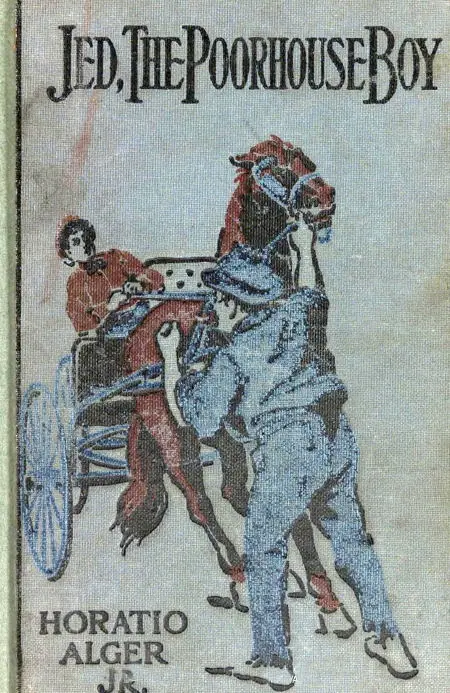
"Jed, the Poorhouse Boy" by Horatio Alger, Jr. is a novel written in the late 19th century. The story follows Jed, a resilient and strong-willed boy living in a poorhouse under the harsh management of Mr. and Mrs. Fogson. As Jed struggles against their tyranny and dreams of a better life, his journey of self-discovery and pursuit of independence begins to unfold. At the start of the narrative, we are introduced to Jed, who is subjected to the cruel treatment of the Fogsons, the poorhouse overseers. His character is depicted as resourceful and assertive despite the oppressive environment, highlighting the contrast between his spirit and that of his tyrannical caretakers. The opening establishes his dissatisfaction with life in the poorhouse and hints at his longing to escape and find his own way in the world—setting the stage for his impending adventures.
Introduction adapted from the source catalogue; source summaries may be automatically generated.
Free to read · English · 57,085 words · No account needed
MAKE TIME FOR A GOOD BOOK
On by default. Untick to stop anonymous reading totals. Each page counts after 10 seconds in view. How this works.
Anonymous counting is on unless you have switched it off.
Several gentlemen were sitting on the piazza in front of the hotel. Among them was Jed's acquaintance of the night before, Harry Bertram.
When he saw Mr. Mordaunt in the buggy he advanced to greet him.
"I am glad to see you, Mr. Mordaunt," he said. "I wanted to consult
you."
"Any hitch, Bertram?" asked the manager.
"Yes. Young Clinton is sick and can't play to-night."
"What's the matter with the boy?"
"He is threatened with fever."
"Couldn't he play to-night? His part is a small one, but it is
important."
"The doctor absolutely forbids his appearing on the stage."
"That is awkward. If we were in the city we might get a substitute, but a common country boy would make a mess of the part."
"You have a boy with you. Do you think he would do?"
"You have known him longer than I. I refer the matter to you."
"Why, it's Jed!" exclaimed Bertram, examining our hero closely.
"Didn't you know me, Mr. Bertram?" asked Jed smilingly.
"Who could, with such a change of dress? You must have met some good fairy. And how did you fall in with Mr. Mordaunt?"
"He kindly offered me a ride."
"Then you have left Scranton for good?"
"For good, I hope. If I can help you in any way I will do my best."
"Try him, Bertram," said the manager. "He is very presentable. Take him in hand, and see if you can't get him ready to take Ralph Clinton's place."
"Then no time is to be lost. Come up to my room, Jed, and I will tell you what you are expected to do--that is, if you have had supper."
"I ate my supper on the road before I fell in with Mr. Mordaunt."
"Follow me, then, Jed."
Harry Bertram led the way to a comfortable chamber on the second floor.
"Now sit down, and I'll tell you what you will have to do. First, do you think you have the nerve to stand before an audience and play the part of a telegraph boy?"
"Yes, sir. I am not troubled with bashfulness."
"Have you ever spoken in public?"
"Yes, at school examinations."
"Then I think you'll do. Here is your part."
He handed Jed a small manuscript book containing the lines of his rôle,
with the cues.
"You see it isn't long. I may be able to give you a little rehearsal, as you appear only in the first and last acts."
The next half hour was devoted to teaching Jed his part. Bertram was delighted with the aptitude shown by his pupil.
Your reading position is saved on this browser. Take it to another device with a library code. Reading pages adapt to text, rather than matching a printed edition.
William Rounseville Alger & Horatio, Jr. Alger

William Rounseville Alger & Horatio, Jr. Alger

Horatio, Jr. Alger

Horatio, Jr. Alger
BEHIND THE BOOK
This eBook is for the use of anyone anywhere in the United States and most other parts of the world at no cost and with almost no restrictions whatsoever. You may copy it, give it away or re-use it under the terms of the Project Gutenberg License included with this eBook or online at www.gutenberg.org. If you are not located in the United States, you will have to check the laws of the country where you are located before using this eBook. Read the source licence.
The original source file, including credits and licence, is retained by this library. Request an original-format copy at no charge. Please include the book title and Project Gutenberg identifier #54350.
KEEP YOUR CURIOSITY GOING
Coulson Kernahan

Maurice Baring
Frances Wright
Cécile Tormay

Frederic Jesup Stimson

W. H. P. (William Henry Pope) Jarvis