
Life of Edwin Forrest, the American Tragedian. Volume 2 (of 2)
William Rounseville Alger & Horatio, Jr. Alger
THE CLASSIC COLLECTION · 1899
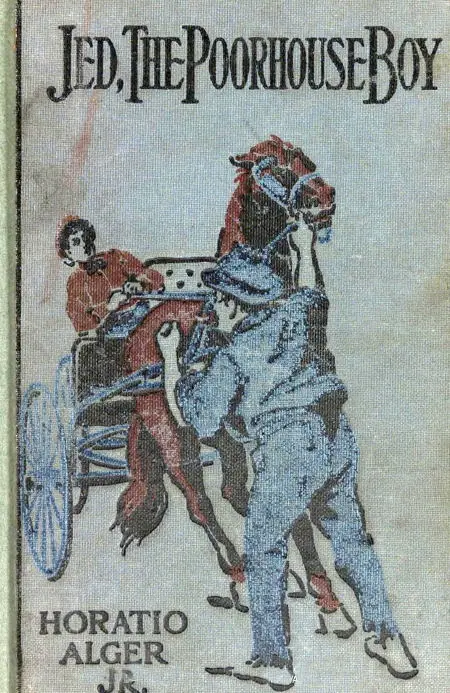
"Jed, the Poorhouse Boy" by Horatio Alger, Jr. is a novel written in the late 19th century. The story follows Jed, a resilient and strong-willed boy living in a poorhouse under the harsh management of Mr. and Mrs. Fogson. As Jed struggles against their tyranny and dreams of a better life, his journey of self-discovery and pursuit of independence begins to unfold. At the start of the narrative, we are introduced to Jed, who is subjected to the cruel treatment of the Fogsons, the poorhouse overseers. His character is depicted as resourceful and assertive despite the oppressive environment, highlighting the contrast between his spirit and that of his tyrannical caretakers. The opening establishes his dissatisfaction with life in the poorhouse and hints at his longing to escape and find his own way in the world—setting the stage for his impending adventures.
Introduction adapted from the source catalogue; source summaries may be automatically generated.
Free to read · English · 57,085 words · No account needed
MAKE TIME FOR A GOOD BOOK
On by default. Untick to stop anonymous reading totals. Each page counts after 10 seconds in view. How this works.
Anonymous counting is on unless you have switched it off.
There is nothing that makes one feel so helpless as to be without a penny in a strange city. If Jed had had even a dollar he would have felt better.
The fact of his poverty was emphasized when a boy came up to him and asked him to buy a morning paper. Jed instinctively felt in his pocket for a penny, but not even a cent was forthcoming.
"I have no change," he said, by way of excuse.
"I can change a dollar," responded the newsboy, who was more than
usually enterprising.
"I wish I could," thought Jed, but he only said, "No, it is no
matter."
So he walked along Broadway, fairly well dressed, but, so far as money went, a pauper. Yes, though no longer an inmate of the Scranton poorhouse, he was even poorer than when he was there, for then he had a home, and now he had none.
"I wonder when it is all going to end?" reflected poor Jed despondently. Then his anger was excited when he thought of the unprincipled rascal who had brought him to this pass.
"If I could only get hold of him," muttered Jed vengefully, "I would give him something to remember me by."
All the while Jed walked on, though his walk was aimless. He was as well off in one part of the city as another, and only walked to fill up time.
He found himself passing a drug store. Just outside the door he saw the sign "Boy wanted," and with a little kindling of hope he entered the store.
Just behind the counter stood a man with a sandy beard, who appeared to be the proprietor. To him Jed addressed himself.
"I see you want a boy," he said.
"Yes; do you want a place?"
"Yes, sir."
"I hardly think you would be satisfied with the wages we pay, unless you particularly wish to learn our business."
"What do you pay, sir?"
"Three dollars a week."
Three dollars a week! It was certainly better than no income at all, but Jed knew well that it would be impossible to live on this sum, and he had no reserve fund to draw upon.
"No," he said, "I am afraid I couldn't get along on that salary."
"Are you entirely dependent on your earnings?" asked the druggist.
"Yes, sir."
"Have you parents residing in the city?"
"No, sir; I am all alone."
"That would be an objection. We prefer to employ those who live at
home."
"Do most employers require that, sir?"
"Many do."
Your reading position is saved on this browser. Take it to another device with a library code. Reading pages adapt to text, rather than matching a printed edition.
William Rounseville Alger & Horatio, Jr. Alger

William Rounseville Alger & Horatio, Jr. Alger

Horatio, Jr. Alger

Horatio, Jr. Alger
BEHIND THE BOOK
This eBook is for the use of anyone anywhere in the United States and most other parts of the world at no cost and with almost no restrictions whatsoever. You may copy it, give it away or re-use it under the terms of the Project Gutenberg License included with this eBook or online at www.gutenberg.org. If you are not located in the United States, you will have to check the laws of the country where you are located before using this eBook. Read the source licence.
The original source file, including credits and licence, is retained by this library. Request an original-format copy at no charge. Please include the book title and Project Gutenberg identifier #54350.
KEEP YOUR CURIOSITY GOING
Coulson Kernahan

Maurice Baring
Frances Wright
Cécile Tormay

Frederic Jesup Stimson

W. H. P. (William Henry Pope) Jarvis