
Life of Edwin Forrest, the American Tragedian. Volume 2 (of 2)
William Rounseville Alger & Horatio, Jr. Alger
THE CLASSIC COLLECTION · 1899
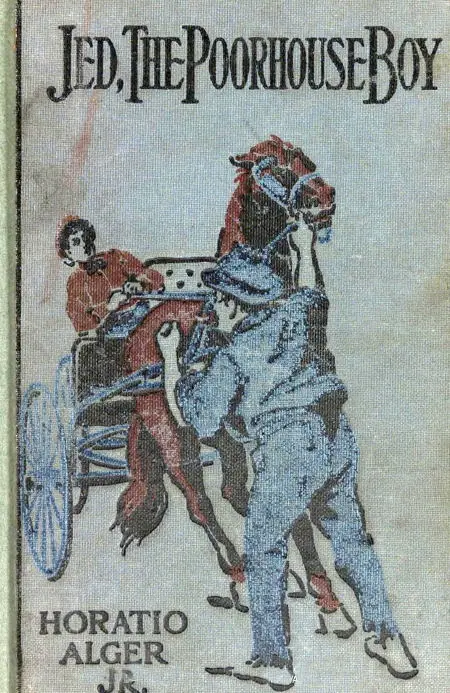
"Jed, the Poorhouse Boy" by Horatio Alger, Jr. is a novel written in the late 19th century. The story follows Jed, a resilient and strong-willed boy living in a poorhouse under the harsh management of Mr. and Mrs. Fogson. As Jed struggles against their tyranny and dreams of a better life, his journey of self-discovery and pursuit of independence begins to unfold. At the start of the narrative, we are introduced to Jed, who is subjected to the cruel treatment of the Fogsons, the poorhouse overseers. His character is depicted as resourceful and assertive despite the oppressive environment, highlighting the contrast between his spirit and that of his tyrannical caretakers. The opening establishes his dissatisfaction with life in the poorhouse and hints at his longing to escape and find his own way in the world—setting the stage for his impending adventures.
Introduction adapted from the source catalogue; source summaries may be automatically generated.
Free to read · English · 57,085 words · No account needed
MAKE TIME FOR A GOOD BOOK
On by default. Untick to stop anonymous reading totals. Each page counts after 10 seconds in view. How this works.
Anonymous counting is on unless you have switched it off.
Jed was not mistaken.
When he returned to the poorhouse supper was ready, and Mr. and Mrs. Fogson were waiting for him with sour and angry faces.
"Where have you been?" demanded Fogson.
"Absent on business," announced Jed coolly.
"Don't you know that your business is to stay here and work?"
"I have been working all day."
"No, you haven't. You have been to the village."
"I had a good reason for going."
"Why didn't you ask permission of me or Mrs. Fogson?"
"Because there wasn't time."
"You are two minutes late for supper. I've a good mind to let you go
without," said Mrs. Fogson.
"It wouldn't be much of a loss," answered Jed, not looking much alarmed.
"You are getting more and more impudent every day. Why do you say there wasn't time to ask permission to leave your work?"
"Because the runaway horse wouldn't stop while I was asking."
"What runaway horse?" demanded Fogson with sudden interest.
"While I was splitting wood I saw Dr. Redmond's wife being run away with. She looked awfully frightened. I ran out to the bend and stopped the horse. Then she wanted me to drive her home, for she was afraid he would run off again."
"Is that so? Well, of course that makes a difference. Did she give you
anything?"
"Now it's coming," thought Jed.
"Yes," he answered.
"How much?" asked Mr. Fogson with a greedy look.
"A dollar."
"Quite handsome, on my word. Well, hand it over."
"What?" ejaculated Jed.
"Give me the dollar!" said Fogson in a peremptory tone.
"The dollar is mine."
"You are a pauper. You can't hold any property. It's against the law."
"Is it? Who told you so?"
"No matter who told me so. I hope I understand the law."
"I hope I understand my rights."
"Boy, this is trifling. You'd better not make me any trouble, or you will find yourself in a bad box."
"What do you want to do with the dollar?"
"None of your business! I shall keep it."
"I have no doubt you will if you get it, but it is mine," said Jed
firmly.
"Mrs. Fogson," said her husband solemnly, "did you ever hear of such
perverseness?"
"No. The boy is about the worst I ever see."
"Mr. Fogson," said Jed, "when Mr. Avery was here I had money given me several times, though never as much as this. He never thought of asking me for it, but always allowed me to spend it for myself."
"Mr. Avery and I are two different persons," remarked Mr. Fogson with
asperity.
"You are right, there," said Jed, in hearty concurrence with the
speaker.
Your reading position is saved on this browser. Take it to another device with a library code. Reading pages adapt to text, rather than matching a printed edition.
William Rounseville Alger & Horatio, Jr. Alger

William Rounseville Alger & Horatio, Jr. Alger

Horatio, Jr. Alger

Horatio, Jr. Alger
BEHIND THE BOOK
This eBook is for the use of anyone anywhere in the United States and most other parts of the world at no cost and with almost no restrictions whatsoever. You may copy it, give it away or re-use it under the terms of the Project Gutenberg License included with this eBook or online at www.gutenberg.org. If you are not located in the United States, you will have to check the laws of the country where you are located before using this eBook. Read the source licence.
The original source file, including credits and licence, is retained by this library. Request an original-format copy at no charge. Please include the book title and Project Gutenberg identifier #54350.
KEEP YOUR CURIOSITY GOING
Coulson Kernahan

Maurice Baring
Frances Wright
Cécile Tormay

Frederic Jesup Stimson

W. H. P. (William Henry Pope) Jarvis