
Life of Edwin Forrest, the American Tragedian. Volume 2 (of 2)
William Rounseville Alger & Horatio, Jr. Alger
THE CLASSIC COLLECTION · 1899
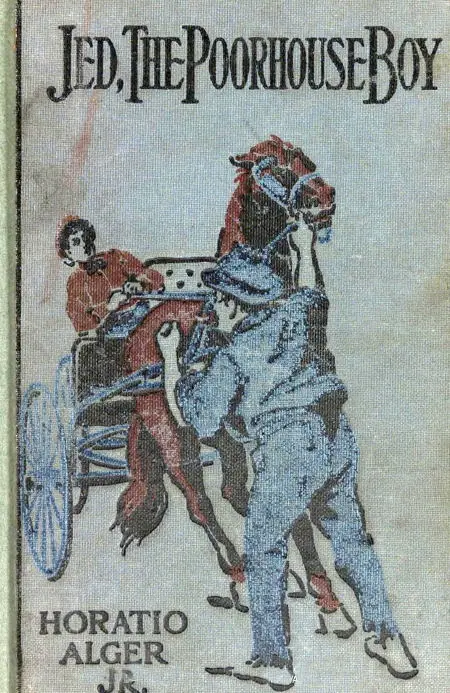
"Jed, the Poorhouse Boy" by Horatio Alger, Jr. is a novel written in the late 19th century. The story follows Jed, a resilient and strong-willed boy living in a poorhouse under the harsh management of Mr. and Mrs. Fogson. As Jed struggles against their tyranny and dreams of a better life, his journey of self-discovery and pursuit of independence begins to unfold. At the start of the narrative, we are introduced to Jed, who is subjected to the cruel treatment of the Fogsons, the poorhouse overseers. His character is depicted as resourceful and assertive despite the oppressive environment, highlighting the contrast between his spirit and that of his tyrannical caretakers. The opening establishes his dissatisfaction with life in the poorhouse and hints at his longing to escape and find his own way in the world—setting the stage for his impending adventures.
Introduction adapted from the source catalogue; source summaries may be automatically generated.
Free to read · English · 57,085 words · No account needed
MAKE TIME FOR A GOOD BOOK
On by default. Untick to stop anonymous reading totals. Each page counts after 10 seconds in view. How this works.
Anonymous counting is on unless you have switched it off.
"It is hardly likely that he ever wrote an article for the Tribune or any other of the city dailies. I hope he did not get all your money?"
"No, sir. I have considerable besides."
"I advise you to take good care of it, and to steer clear of
questionable acquaintances."
Mr. Claflin turned to a letter which he was writing, and Jed felt that he was dismissed. Mr. Claflin had said nothing about taking him into his employment, and he went down stairs feeling mortified and depressed.
Mingled with these feelings was one of anger at having been so cruelly deceived by his steamboat acquaintance.
"I'd just like to meet him again!" soliloquized Jed, involuntarily
doubling up his fist.
"I wonder whether he really writes for the Tribune?" he asked himself.
He decided to solve this question at once, though he had not much doubt on the subject. He wanted to know exactly what he had to depend on.
He walked up to Broadway, then down to the City Hall Park, and asked a boy whom he met, "Where is the Tribune office?"
"There it is across the park," said the boy, pointing to a tall building with a lofty tower. "What do you want to do--sell papers?"
"No," answered Jed. "I want to ask about one of the editors."
"You're from the country, ain't you?"
"Yes. What makes you think so?"
"Because all the boys in the city know the Tribune building. Say, what do you do for a livin'?" inquired the boy confidentially.
This was rather a puzzling question, but Jed, remembering that he had been on the stage for a time, felt justified in answering, "I am an actor."
"Cracky! you don't say. You ain't little Lord Fauntleroy, are you?"
"No; I played the telegraph boy in the play of 'The Gold King.'"
"How did you like it?" asked the newsboy, becoming interested.
"Very much."
"Are you goin' to play it again?"
"No; I took the place of the regular actor for a few weeks while he was sick. Now he is well, and I am not needed."
"Say, does actin' pay well?" asked the boy curiously.
"I was paid pretty well."
"Do you think you could get me a chance?"
"I am afraid I can't get another chance myself."
The newsboy had no more questions to ask, and Jed, following directions, crossed the park and the street beyond to the Tribune building.
He entered the office, and walked up to a window, beyond which stood a young man who was handing out papers to a purchaser who wanted some back numbers.
Jed presented himself next, and the clerk looked at him inquiringly.
Your reading position is saved on this browser. Take it to another device with a library code. Reading pages adapt to text, rather than matching a printed edition.
William Rounseville Alger & Horatio, Jr. Alger

William Rounseville Alger & Horatio, Jr. Alger

Horatio, Jr. Alger

Horatio, Jr. Alger
BEHIND THE BOOK
This eBook is for the use of anyone anywhere in the United States and most other parts of the world at no cost and with almost no restrictions whatsoever. You may copy it, give it away or re-use it under the terms of the Project Gutenberg License included with this eBook or online at www.gutenberg.org. If you are not located in the United States, you will have to check the laws of the country where you are located before using this eBook. Read the source licence.
The original source file, including credits and licence, is retained by this library. Request an original-format copy at no charge. Please include the book title and Project Gutenberg identifier #54350.
KEEP YOUR CURIOSITY GOING
Coulson Kernahan

Maurice Baring
Frances Wright
Cécile Tormay

Frederic Jesup Stimson

W. H. P. (William Henry Pope) Jarvis