
Life of Edwin Forrest, the American Tragedian. Volume 2 (of 2)
William Rounseville Alger & Horatio, Jr. Alger
THE CLASSIC COLLECTION · 1899
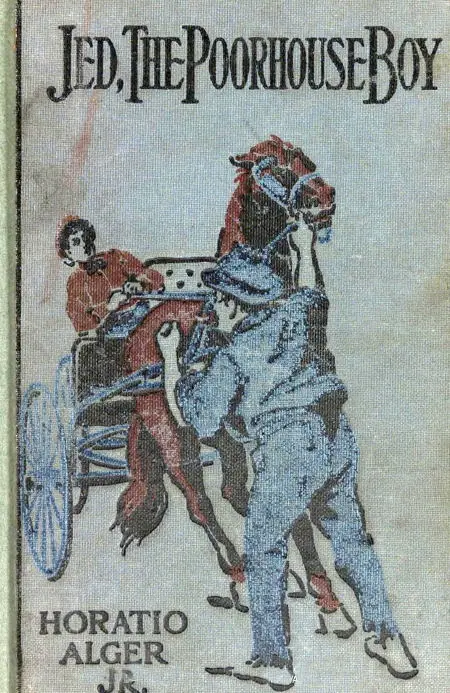
"Jed, the Poorhouse Boy" by Horatio Alger, Jr. is a novel written in the late 19th century. The story follows Jed, a resilient and strong-willed boy living in a poorhouse under the harsh management of Mr. and Mrs. Fogson. As Jed struggles against their tyranny and dreams of a better life, his journey of self-discovery and pursuit of independence begins to unfold. At the start of the narrative, we are introduced to Jed, who is subjected to the cruel treatment of the Fogsons, the poorhouse overseers. His character is depicted as resourceful and assertive despite the oppressive environment, highlighting the contrast between his spirit and that of his tyrannical caretakers. The opening establishes his dissatisfaction with life in the poorhouse and hints at his longing to escape and find his own way in the world—setting the stage for his impending adventures.
Introduction adapted from the source catalogue; source summaries may be automatically generated.
Free to read · English · 57,085 words · No account needed
MAKE TIME FOR A GOOD BOOK
On by default. Untick to stop anonymous reading totals. Each page counts after 10 seconds in view. How this works.
Anonymous counting is on unless you have switched it off.
"Well, that would have helped me. But don't you think it would have been better to have left me the whole?"
"Yes, it would; but I am very unlucky."
"I am afraid you don't deserve good luck. Isn't there anything you can
do?"
"Yes."
"Can't you find another broker to take you in his office?"
"I never was in a broker's office," confessed Graham.
"What was your business, then? I suppose you had some way of making a
living?"
"I am a barber by trade, but I got tired of the confinement, and so I thought I'd become a sport. I started out with a hundred dollars which it took me a year to save up, and I got rid of it in two weeks. Then I fell in with you."
"And with my thirty-five dollars."
"Yes."
"The best thing you can do is to go back to your business."
"I would if I could."
"Why can't you?"
"Because my razors are in hock."
It is the custom of journeymen barbers to supply their own razors and a pair of shears for hair-cutting.
"I suppose that means in pawn?"
"Yes."
"When can you get a place if you get your razors back?"
"I can go to work to-morrow."
"What sum will get them out?"
"Four dollars and a half."
"Where are they?"
"In a pawnshop on the Bowery."
"Come with me and I will get them out for you if you will promise to go
to work."
"I will," answered Graham earnestly. "I'll give you my word I will."
"Come back on the next boat, then, and I will go with you to the
pawnshop."
"It will take up your time. You don't mean to give me in charge when we reach New York?" said Graham apprehensively.
"No; I am willing to give you a fresh chance. I hope you will improve
it."
Jed took out his watch to note the time.
"Is that watch yours? It's a beauty," said Graham.
"Yes; it came from Tiffany's."
"Did you have it when I met you?"
"No; if I had, that would have gone the same way as the money."
"You must be awfully lucky!"
"I suppose I have been. At any rate I have been honest."
"Honesty seems to pay. I must try it."
"I advise you to," said Jed, smiling.
When Jed parted from Graham it occurred to him that he would call on Mrs. Gately. She had provided him with a breakfast when he needed one, and seemed kindly disposed towards him.
When he rang the bell of the small house on Twenty-Seventh Street, Mrs. Gately herself came to the door.
"Did you wish to see me, sir?"
Your reading position is saved on this browser. Take it to another device with a library code. Reading pages adapt to text, rather than matching a printed edition.
William Rounseville Alger & Horatio, Jr. Alger

William Rounseville Alger & Horatio, Jr. Alger

Horatio, Jr. Alger

Horatio, Jr. Alger
BEHIND THE BOOK
This eBook is for the use of anyone anywhere in the United States and most other parts of the world at no cost and with almost no restrictions whatsoever. You may copy it, give it away or re-use it under the terms of the Project Gutenberg License included with this eBook or online at www.gutenberg.org. If you are not located in the United States, you will have to check the laws of the country where you are located before using this eBook. Read the source licence.
The original source file, including credits and licence, is retained by this library. Request an original-format copy at no charge. Please include the book title and Project Gutenberg identifier #54350.
KEEP YOUR CURIOSITY GOING
Coulson Kernahan

Maurice Baring
Frances Wright
Cécile Tormay

Frederic Jesup Stimson

W. H. P. (William Henry Pope) Jarvis