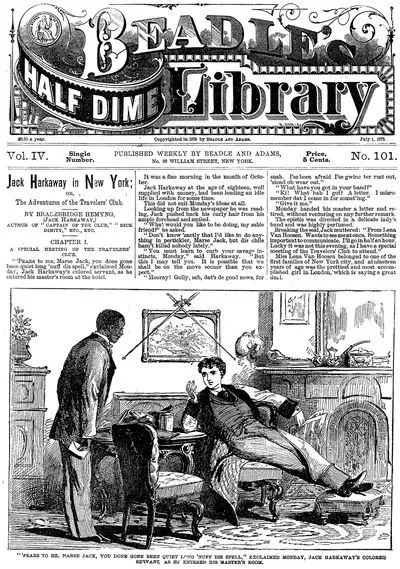
Jack Harkaway in New York; or, The Adventures of the Travelers’ Club
Bracebridge Hemyng
THE CLASSIC COLLECTION · 1900
"Jack Harkaway's Boy Tinker Among The Turks" by Bracebridge Hemyng is a fictional novel written in the late 19th century. The story follows young Jack Harkaway and his companion, the orphan Mr. Figgins, as they navigate various adventures and moral lessons during their travels in Turkey. The narrative is characterized by Jack's daring personality and wit, along with the humorous predicaments that arise as they encounter local customs and people. The opening portion of the book sets the stage for Jack Harkaway's escapades, beginning with a confrontation involving the ship's captain regarding their previous adventures. Jack’s boldness leads him to reflect on his actions and make amends, which introduces themes of bravery and moral growth. The scene also hints at the cultural peculiarities they will encounter, especially with Mr. Figgins expressing fears about Turkish customs, particularly regarding matrimony. The chapter ends with hints of impending visitors, creating anticipation for further encounters that will challenge the characters in both humorous and serious ways.
Introduction adapted from the source catalogue; source summaries may be automatically generated.
Free to read · English · 83,525 words · No account needed
MAKE TIME FOR A GOOD BOOK
On by default. Untick to stop anonymous reading totals. Each page counts after 10 seconds in view. How this works.
Anonymous counting is on unless you have switched it off.
Several Arabs, a few Turkish soldiers, and two of the gaolers had been killed, and there were many wounded men that required attending to.
The commander had enough to do in restoring matters to order, therefore he left the punishment of Mole to his lieutenant.
"Remove all the prisoners, for the present, to the guardroom," said the lieutenant. "When I open my council at noon in the divan bring them all before me."
"Your excellency's word is law," answered the head gaoler, bowing.
The lieutenant turned his horse, and, followed by his bodyguard, rode
home in a very ill temper.
An hour or two's rest, however, and the soothing effects of pipe and coffee, had somewhat restored his equanimity by the time he re-entered the divan.
Punctually at noon, the prisoners were brought before him by the head
gaoler.
"Let me see," said the lieutenant, referring to the document, and checking off the captives as they were identified; "horse-stealing, highway robbery, drunkenness, assault--yes, I have resolved what to do. As these offences seem comparatively light, and as our prison is for the present inefficient, I shall order all these men to be punished with the bastinado."
"There is one more," said the lieutenant. "This, I find, is the wretched Frank who dared to personate our great pasha."
"Nothing escapes your honour's penetration," answered the vizier.
"Such a crime deserves a heavier punishment. However, when his turn comes, give him twenty-five blows."
"It shall be done, illustrious governor," was the response.
And forthwith were summoned the two burly officials whose unpopular duty it was to administer castigation.
One bore a stout rattan, the other several pieces of strong rope.
The frame to which they were to be lashed was then brought into the room, it being the lieutenant's intention that the punishment should be administered in his presence.
The first prisoner was then seized, and his slippers--stockings not being worn by the majority of Turks--taken off.
He was then bound hand and foot, and securely tied to the frame.
The two executioners then took it in turns to administer ten heavy blows upon the bare soles of the criminal.
At the first blow, the patient set up a howl, which seemed but to increase the vigour and energy of the operator.
It was indeed a terrible sight for any person of sensitiveness to see a human being--though deserving--suffer in this manner.
Mole, however, didn't feel any anxiety on that score, and he made up his mind to do the brave and noble Englishman, for he knew that they might hammer away at his cork soles for ever, without hurting him much.
Your reading position is saved on this browser. Take it to another device with a library code. Reading pages adapt to text, rather than matching a printed edition.
BEHIND THE BOOK
This eBook is for the use of anyone anywhere in the United States and most other parts of the world at no cost and with almost no restrictions whatsoever. You may copy it, give it away or re-use it under the terms of the Project Gutenberg License included with this eBook or online at www.gutenberg.org. If you are not located in the United States, you will have to check the laws of the country where you are located before using this eBook. Read the source licence.
The original source file, including credits and licence, is retained by this library. Request an original-format copy at no charge. Please include the book title and Project Gutenberg identifier #20320.
KEEP YOUR CURIOSITY GOING
Coulson Kernahan

Maurice Baring
Frances Wright
Cécile Tormay

Frederic Jesup Stimson

W. H. P. (William Henry Pope) Jarvis