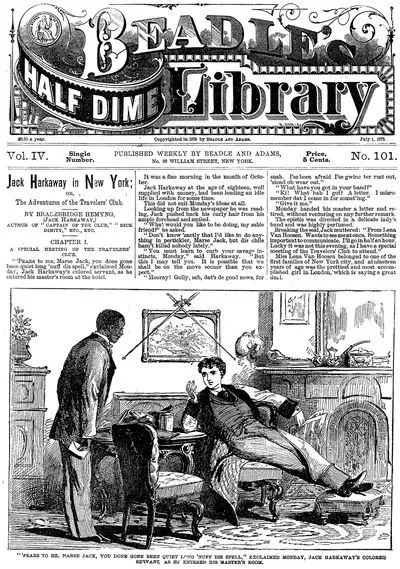
Jack Harkaway in New York; or, The Adventures of the Travelers’ Club
Bracebridge Hemyng
THE CLASSIC COLLECTION · 1900
"Jack Harkaway's Boy Tinker Among The Turks" by Bracebridge Hemyng is a fictional novel written in the late 19th century. The story follows young Jack Harkaway and his companion, the orphan Mr. Figgins, as they navigate various adventures and moral lessons during their travels in Turkey. The narrative is characterized by Jack's daring personality and wit, along with the humorous predicaments that arise as they encounter local customs and people. The opening portion of the book sets the stage for Jack Harkaway's escapades, beginning with a confrontation involving the ship's captain regarding their previous adventures. Jack’s boldness leads him to reflect on his actions and make amends, which introduces themes of bravery and moral growth. The scene also hints at the cultural peculiarities they will encounter, especially with Mr. Figgins expressing fears about Turkish customs, particularly regarding matrimony. The chapter ends with hints of impending visitors, creating anticipation for further encounters that will challenge the characters in both humorous and serious ways.
Introduction adapted from the source catalogue; source summaries may be automatically generated.
Free to read · English · 83,525 words · No account needed
MAKE TIME FOR A GOOD BOOK
On by default. Untick to stop anonymous reading totals. Each page counts after 10 seconds in view. How this works.
Anonymous counting is on unless you have switched it off.
"The other two," proceeded Abdullah, "are fair Circassians in the very summer of youth and beauty."
Moley Pasha uttered a profound sigh.
"Ah, that's much better."
"I expect they will be here soon, at least some of them," said
Abdullah, the interpreter.
The subject then dropped for a time, and the great Moley also
dropped--asleep, from the combined effects of the pipe, the coffee, and
the wine.
He was suddenly awakened by Abdullah shouting in his ear--
"May it please your excellency, they've come."
"Who--who?" gasped Mole, in fearful terror; for he had just been dreaming of the rack and the bowstring.
"The noble Ladies Alme and Hannifar, widows of the late lamented
Youssouf-Pasha," was the reply.
"Gracious mercy!" exclaimed the persecuted Mole; "they've come to claim me, perhaps to bear me off by main force."
"Ho, there, guards; stand round; not without a struggle will Isaac Mole surrender his liberty as a single man, that is as a married man, but not--Heaven, my brain is growing utterly confused in this terrible position. Where's that boy Jack?"
"Their excellencies Yakoob and Haroun Pasha are both gone out," was the
response.
"Then, Abdullah, I command you to stand up in my defence. Come here."
The old interpreter approached with a low bow.
"Write on two pieces of card the words--'Admire Moley Pasha, but touch
not him.'"
"In Turkish?"
"Turkish and English, too."
"Pasha, to hear is to obey."
At this moment a young negro attendant announced--
"The Ladies Alme and Hannifar are impatient to be admitted to your
sublime presence."
"Let them wait; it will do them good," cried Mole, desperately. "Have
you written it, Abdullah?"
"One moment, your highness," was the reply. "There," he added, finishing up with an elaborate flourish; "all will understand that. And now what am I to do with them?"
"Fasten one notice on my back, and the other on my chest," answered Mole, "so that the ladies may understand and keep at a respectful distance. That's right. Be still, my trembling heart. Now you can admit them."
The negro drew aside the curtains of the chamber, and two female forms of majestic height and proportions, in gorgeous Oriental costumes, but closely veiled, entered.
They made a very graceful salute to the pasha, and were walking straight up to him, when he sprang backwards, and leaping upon a high sofa, turned his back to them, not in contempt, but in order that they might read the Turkish inscription thereon inscribed.
Then he turned and pointed to it on his breast in English.
Far, however, from being struck with awe and covered with confusion, the ladies were highly amused and laughed consumedly.
Your reading position is saved on this browser. Take it to another device with a library code. Reading pages adapt to text, rather than matching a printed edition.
BEHIND THE BOOK
This eBook is for the use of anyone anywhere in the United States and most other parts of the world at no cost and with almost no restrictions whatsoever. You may copy it, give it away or re-use it under the terms of the Project Gutenberg License included with this eBook or online at www.gutenberg.org. If you are not located in the United States, you will have to check the laws of the country where you are located before using this eBook. Read the source licence.
The original source file, including credits and licence, is retained by this library. Request an original-format copy at no charge. Please include the book title and Project Gutenberg identifier #20320.
KEEP YOUR CURIOSITY GOING
Coulson Kernahan

Maurice Baring
Frances Wright
Cécile Tormay

Frederic Jesup Stimson

W. H. P. (William Henry Pope) Jarvis