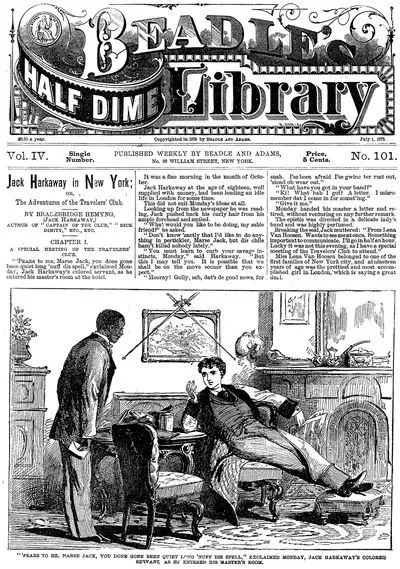
Jack Harkaway in New York; or, The Adventures of the Travelers’ Club
Bracebridge Hemyng
THE CLASSIC COLLECTION · 1900
"Jack Harkaway's Boy Tinker Among The Turks" by Bracebridge Hemyng is a fictional novel written in the late 19th century. The story follows young Jack Harkaway and his companion, the orphan Mr. Figgins, as they navigate various adventures and moral lessons during their travels in Turkey. The narrative is characterized by Jack's daring personality and wit, along with the humorous predicaments that arise as they encounter local customs and people. The opening portion of the book sets the stage for Jack Harkaway's escapades, beginning with a confrontation involving the ship's captain regarding their previous adventures. Jack’s boldness leads him to reflect on his actions and make amends, which introduces themes of bravery and moral growth. The scene also hints at the cultural peculiarities they will encounter, especially with Mr. Figgins expressing fears about Turkish customs, particularly regarding matrimony. The chapter ends with hints of impending visitors, creating anticipation for further encounters that will challenge the characters in both humorous and serious ways.
Introduction adapted from the source catalogue; source summaries may be automatically generated.
Free to read · English · 83,525 words · No account needed
MAKE TIME FOR A GOOD BOOK
On by default. Untick to stop anonymous reading totals. Each page counts after 10 seconds in view. How this works.
Anonymous counting is on unless you have switched it off.
"Beautiful," added Harry Girdwood. "What would little Emily say, Jack, if she knew you were looking with loving eyes at that little beauty?"
The mention of little Emily's name made Jack silent for a minute or
two.
Presently he asked--
"Are these professional performers?"
"The dancer and the singer are two out of three Circassian slaves that have been sent to the pasha as a present during his journey. He will be pleased with the new acquisition when he returns, although one has met an untimely end."
"Slaves! Is it possible?" said young Jack.
"Rather, my boy."
"What will they do with these slaves?"
"Various things. Perhaps keep them to amuse the ladies of the harem, as you see now; perhaps make them beasts of burden; perhaps make more wives of them. His excellency is not particular to a wife or two."
"He's a beast!" said young Jack; "and I should like to kick him."
"Gently, gently; it's the system of the country, dear boys, nothing
more."
"But," said Jack, "when you speak of the Circassian girl being sent as a present to the pasha, do you mean the real pasha or the deputy? For this Turk is the one that cheated the poor orphan out of his money."
"This is only the deputy; I mean the pasha himself," returned the Irish Turk. "The deputy would like to appropriate the slaves himself."
"Do you think so?"
"I know it, and he does not mind what you would call murder now and
then."
"Perhaps that would account for what we saw in the bay, for the horrible business with the sack."
"More than likely," said the Irish Turk, gravely. "But a slave, more or less, even if it's a lovely girl, doesn't count for much in these parts."
The boys gave a shudder.
They were not used to hearing murder discussed in such a cold-blooded
fashion.
"Tinker," said Jack, by way of changing the topic suddenly, "do you think that you or Bogey could dance like that girl?"
"Go an' dance like dat," he said contemptuously. "Me an' dat nigger dance a lot better, sar. Bogey!"
"Wall!"
"Over wid you."
And then, to the surprise and dismay of all the rest, the two darkeys vaulted over the balustrade and dropped into the room beneath.
Had a bombshell fallen into the midst of the ladies of the harem, they could not have been more surprised.
There was a half-stifled shriek from one, and they all flew into a corner, where they stood huddled up together for protection.
But Tinker and his man were not at all put out by these strange demonstrations upon the part of the ladies.
"Bogey."
"Yes, Massa Tinker."
Your reading position is saved on this browser. Take it to another device with a library code. Reading pages adapt to text, rather than matching a printed edition.
BEHIND THE BOOK
This eBook is for the use of anyone anywhere in the United States and most other parts of the world at no cost and with almost no restrictions whatsoever. You may copy it, give it away or re-use it under the terms of the Project Gutenberg License included with this eBook or online at www.gutenberg.org. If you are not located in the United States, you will have to check the laws of the country where you are located before using this eBook. Read the source licence.
The original source file, including credits and licence, is retained by this library. Request an original-format copy at no charge. Please include the book title and Project Gutenberg identifier #20320.
KEEP YOUR CURIOSITY GOING
Coulson Kernahan

Maurice Baring
Frances Wright
Cécile Tormay

Frederic Jesup Stimson

W. H. P. (William Henry Pope) Jarvis