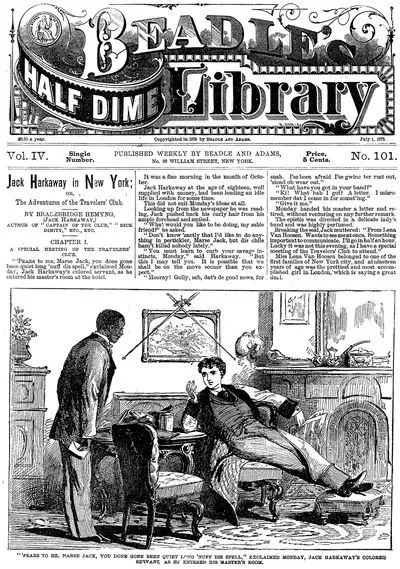
Jack Harkaway in New York; or, The Adventures of the Travelers’ Club
Bracebridge Hemyng
THE CLASSIC COLLECTION · 1900
"Jack Harkaway's Boy Tinker Among The Turks" by Bracebridge Hemyng is a fictional novel written in the late 19th century. The story follows young Jack Harkaway and his companion, the orphan Mr. Figgins, as they navigate various adventures and moral lessons during their travels in Turkey. The narrative is characterized by Jack's daring personality and wit, along with the humorous predicaments that arise as they encounter local customs and people. The opening portion of the book sets the stage for Jack Harkaway's escapades, beginning with a confrontation involving the ship's captain regarding their previous adventures. Jack’s boldness leads him to reflect on his actions and make amends, which introduces themes of bravery and moral growth. The scene also hints at the cultural peculiarities they will encounter, especially with Mr. Figgins expressing fears about Turkish customs, particularly regarding matrimony. The chapter ends with hints of impending visitors, creating anticipation for further encounters that will challenge the characters in both humorous and serious ways.
Introduction adapted from the source catalogue; source summaries may be automatically generated.
Free to read · English · 83,525 words · No account needed
MAKE TIME FOR A GOOD BOOK
On by default. Untick to stop anonymous reading totals. Each page counts after 10 seconds in view. How this works.
Anonymous counting is on unless you have switched it off.
Whilst the judge dipped once more into the cash-box, the executioner went for weapons, and shortly reappeared with a couple of enormous scimitars, which he placed in the hands of the combatants.
A dead silence fell upon the eager crowd, who longed for the fight to
commence.
"Are you ready?" demanded the bashaw.
"N-n-n-no, I'm not," faltered the orphan, whose ferocity had entirely disappeared with the loss of his flute; "I'm not a fighting man, and I don't like fighting with swords--I might get hurt. I would rather forgive Mr. Bosja than kill him."
His opponent evinced his satisfaction at this humane proposal by a
ghastly smile.
But his tongue stuck to the roof of his mouth with terror, and he said
nothing.
But the bashaw was not to be thwarted in this manner.
"It is my will that you fight," he said, in a determined tone; "and fight you must, or each find a substitute."
The combatants strained their eyes eagerly amongst the crowd.
But no one volunteered to take their places.
Suddenly Mr. Figgins caught sight of a black figure that was pantomiming to him very eagerly in the distance.
A flash of joy rushed across his troubled spirit.
It was Tinker.
He could judge by his actions he was ready to take his place, and
therefore he exclaimed aloud--
"I've found a substitute."
"Where?" demanded the bashaw, looking intensely disappointed.
"Here de dustibute," shouted Tinker, in reply; "make way, you whitey-brown Turkies, an' let de rale colour come forrards."
As he spoke, he elbowed his way through the crowd till he reached the space in front of the seat of justice.
Here he shook hands with Mr. Figgins, and nodded as familiarly to the bashaw as though he had been a particular friend of his.
"What son of Jehanum is that?" growled the bashaw, scowling fiercely at
Tinker.
"He is my substitute," exclaimed the grocer.
"Is he? And do you know what you must pay to be allowed to make use of
him?" asked the bashaw.
"No, you old thief, I don't," said Figgins, softly; then aloud--"how
much?"
"Two hundred sequins," said the judge.
"Oh, certainly," assented the orphan; "no doubt you intend to empty my box before you let me go."
This restored the complacency of the bashaw, who, having by this last demand used up all the grocer's cash, finished by taking possession of his cash-box to carry it away in.
Having locked it safely up, he cried--
"I wish to be amused. Let the fight commence at once."
Tinker received a scimitar from the hands of Mr. Figgins, and flourished it gaily round his head.
Your reading position is saved on this browser. Take it to another device with a library code. Reading pages adapt to text, rather than matching a printed edition.
BEHIND THE BOOK
This eBook is for the use of anyone anywhere in the United States and most other parts of the world at no cost and with almost no restrictions whatsoever. You may copy it, give it away or re-use it under the terms of the Project Gutenberg License included with this eBook or online at www.gutenberg.org. If you are not located in the United States, you will have to check the laws of the country where you are located before using this eBook. Read the source licence.
The original source file, including credits and licence, is retained by this library. Request an original-format copy at no charge. Please include the book title and Project Gutenberg identifier #20320.
KEEP YOUR CURIOSITY GOING
Coulson Kernahan

Maurice Baring
Frances Wright
Cécile Tormay

Frederic Jesup Stimson

W. H. P. (William Henry Pope) Jarvis