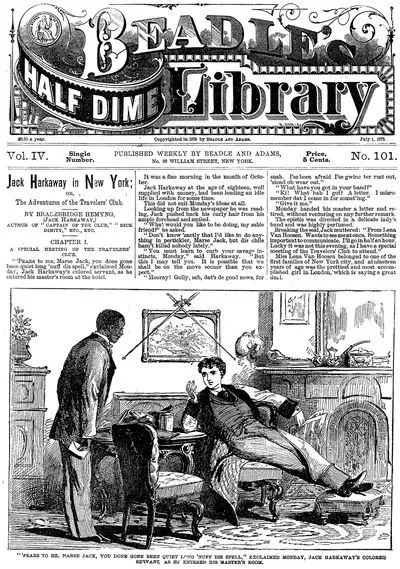
Jack Harkaway in New York; or, The Adventures of the Travelers’ Club
Bracebridge Hemyng
THE CLASSIC COLLECTION · 1900
"Jack Harkaway's Boy Tinker Among The Turks" by Bracebridge Hemyng is a fictional novel written in the late 19th century. The story follows young Jack Harkaway and his companion, the orphan Mr. Figgins, as they navigate various adventures and moral lessons during their travels in Turkey. The narrative is characterized by Jack's daring personality and wit, along with the humorous predicaments that arise as they encounter local customs and people. The opening portion of the book sets the stage for Jack Harkaway's escapades, beginning with a confrontation involving the ship's captain regarding their previous adventures. Jack’s boldness leads him to reflect on his actions and make amends, which introduces themes of bravery and moral growth. The scene also hints at the cultural peculiarities they will encounter, especially with Mr. Figgins expressing fears about Turkish customs, particularly regarding matrimony. The chapter ends with hints of impending visitors, creating anticipation for further encounters that will challenge the characters in both humorous and serious ways.
Introduction adapted from the source catalogue; source summaries may be automatically generated.
Free to read · English · 83,525 words · No account needed
MAKE TIME FOR A GOOD BOOK
On by default. Untick to stop anonymous reading totals. Each page counts after 10 seconds in view. How this works.
Anonymous counting is on unless you have switched it off.
It was Bosja into whose hands it had fallen, when Mr. Figgins was
escaping from the mob.
"That is my turban," he cried, as with one hand he dragged it from his enemy's head, with dauntless vehemence, and bringing his flute down with a smart crack on the Turk's bald pate.
The Turk, who was much more of a bully than a hero, was quite confounded at the excited energy which the Frankish lodger displayed. Dropping his scimitar, he then had a struggle for the flute.
Round the room they went, pulling and hauling.
At length, lurching against the door, it burst open.
The combatants now found themselves on the landing.
Here the struggle continued, till, at length, giving a desperate tug, the flute came in half, and Bosja fell backwards, head over heels, down the stairs, with the upper joint of the instrument in his hand.
The landlady, who thought the house was falling, came hurrying to see what had happened, and found the Turk lying in a heap at the bottom of the stairs, with the breath almost knocked out of his body.
It took some time to bring him to himself.
It was just as he was recovering there was a loud knocking at the
street door.
On opening it, a body of Turkish soldiers appeared drawn up in front of
it.
"What is the cause of this disturbance?" inquired the leader of the
troop.
Bosja quickly gave his own version of what had happened.
Of course, it was highly exaggerated.
He, a true believer, had been assaulted, robbed of his turban, and thrown downstairs by a rascally dog of a Giaour, who lodged in a room next to him.
This was quite sufficient to arouse the indignation of the officer, and, with three of his troop, that functionary ascended to seize the delinquent.
But, on reaching the room, it was discovered to be empty.
"The Frankish hound laughs at our beards," said the officer. "He has
escaped by the window."
And such had been the intention of Mark Antony Figgins.
But not being accustomed to such perilous descents, he had found himself baffled in his flight, and was now perched on a ledge, half way between the window and the ground, unable either to proceed or to return.
He was soon espied by the soldiers, and a shout announced his
detection.
A ladder was quickly procured, and the luckless orphan very shortly
found himself a prisoner.
"What dirt have you been eating?" demanded the officer, sternly.
"I haven't been eating dirt at all," returned the indignant Figgins, "but I believe that fat Turk has swallowed half of my flute."
Your reading position is saved on this browser. Take it to another device with a library code. Reading pages adapt to text, rather than matching a printed edition.
BEHIND THE BOOK
This eBook is for the use of anyone anywhere in the United States and most other parts of the world at no cost and with almost no restrictions whatsoever. You may copy it, give it away or re-use it under the terms of the Project Gutenberg License included with this eBook or online at www.gutenberg.org. If you are not located in the United States, you will have to check the laws of the country where you are located before using this eBook. Read the source licence.
The original source file, including credits and licence, is retained by this library. Request an original-format copy at no charge. Please include the book title and Project Gutenberg identifier #20320.
KEEP YOUR CURIOSITY GOING
Coulson Kernahan

Maurice Baring
Frances Wright
Cécile Tormay

Frederic Jesup Stimson

W. H. P. (William Henry Pope) Jarvis