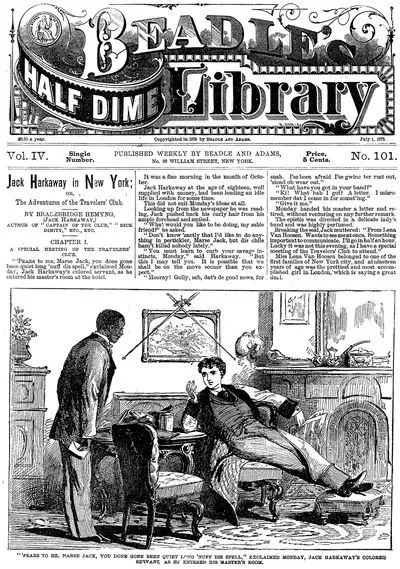
Jack Harkaway in New York; or, The Adventures of the Travelers’ Club
Bracebridge Hemyng
THE CLASSIC COLLECTION · 1900
"Jack Harkaway's Boy Tinker Among The Turks" by Bracebridge Hemyng is a fictional novel written in the late 19th century. The story follows young Jack Harkaway and his companion, the orphan Mr. Figgins, as they navigate various adventures and moral lessons during their travels in Turkey. The narrative is characterized by Jack's daring personality and wit, along with the humorous predicaments that arise as they encounter local customs and people. The opening portion of the book sets the stage for Jack Harkaway's escapades, beginning with a confrontation involving the ship's captain regarding their previous adventures. Jack’s boldness leads him to reflect on his actions and make amends, which introduces themes of bravery and moral growth. The scene also hints at the cultural peculiarities they will encounter, especially with Mr. Figgins expressing fears about Turkish customs, particularly regarding matrimony. The chapter ends with hints of impending visitors, creating anticipation for further encounters that will challenge the characters in both humorous and serious ways.
Introduction adapted from the source catalogue; source summaries may be automatically generated.
Free to read · English · 83,525 words · No account needed
MAKE TIME FOR A GOOD BOOK
On by default. Untick to stop anonymous reading totals. Each page counts after 10 seconds in view. How this works.
Anonymous counting is on unless you have switched it off.
Suddenly the door burst open, and the distressed orphan, in all his brilliant array, shot backwards into some shrubs of a prickly nature, whose sharp thorns added to his agonizing sensations.
"Will anybody be kind enough to put an end to my misery?" he wailed, as he lay on his back, feeling as though he had been transformed into a human pincushion.
He was not a little surprised to hear a familiar voice exclaim--
"Lor' bless me! dat you, Massa Figgins?"
Glancing up, he espied the black face of Bogey looking down upon him.
"Yes, it's me," he answered, in a wailing tone; "help me up."
"Gib me you fist," cried Bogey.
Mr. Figgins extended his hand, and the negro grasping it, by a vigorous jerk hoisted the prostrate grocer out of his thorny bed, tingling all over as though he had been stung by nettles.
Bogey was quite astounded at the transformation of his dress.
"Why, Massa Figgins, what out-and-out guy you look!" he exclaimed;
"whar all you hair gone to?"
The orphan only groaned.
He was thinking of another h-air (without the h), the air he had heard
on the Turkish flute.
Just at that moment the too-too-too of the instrument sounded again.
Figgins stood like one absorbed.
All his agonizing pains were at once forgotten.
"How sweet, how plaintive!" he murmured to himself; "too-too-too, tooty-tooty-too!" he hummed, in imitation of the sound.
Bogey heard it also, and involuntarily put his hands on big stomach and made a comically wry face.
"Whar dat orful squeakin' row?" he asked.
"Hush, hush!" exclaimed the orphan, holding up his hands reprovingly, and turning up his eyes at the same time; "it's heavenly music; it's a flute, my boyhood's favourite instrument."
"Gorra!" muttered Bogey; "it 'nuff to gib a fellar de mullingrubs all down him back and up him belly."
He looked towards Mr. Figgins, and seeing him standing with his hands clasped looking like a white-washed Turk in a trance, he said--
"What de matter wid yer, Massa Figgins? Am you ill?"
"That flute, that melodious flute, that breathes forth dulcet notes of peace," murmured the orphan, in a deep, absorbed whisper. "I must have that flute."
Bogey felt a little anxious.
"Me t'ink Massa Figgins getting lilly soft in him nut; him losing him hair turn him mad," he said to himself.
"I must have that flute," repeated the grocer, in the same abstracted tone and manner. "I should think it cheap at ten pounds."
Bogey, on hearing this, opened his eyes very wide.
He thought he saw a chance of doing a profitable bit of business on his
own account.
So, after an instant, he said quietly--
Your reading position is saved on this browser. Take it to another device with a library code. Reading pages adapt to text, rather than matching a printed edition.
BEHIND THE BOOK
This eBook is for the use of anyone anywhere in the United States and most other parts of the world at no cost and with almost no restrictions whatsoever. You may copy it, give it away or re-use it under the terms of the Project Gutenberg License included with this eBook or online at www.gutenberg.org. If you are not located in the United States, you will have to check the laws of the country where you are located before using this eBook. Read the source licence.
The original source file, including credits and licence, is retained by this library. Request an original-format copy at no charge. Please include the book title and Project Gutenberg identifier #20320.
KEEP YOUR CURIOSITY GOING
Coulson Kernahan

Maurice Baring
Frances Wright
Cécile Tormay

Frederic Jesup Stimson

W. H. P. (William Henry Pope) Jarvis