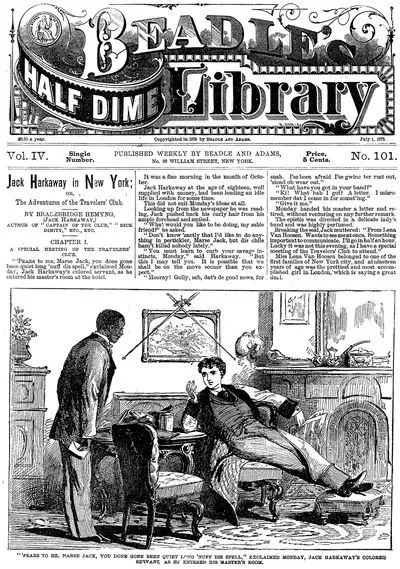
Jack Harkaway in New York; or, The Adventures of the Travelers’ Club
Bracebridge Hemyng
THE CLASSIC COLLECTION · 1900
"Jack Harkaway's Boy Tinker Among The Turks" by Bracebridge Hemyng is a fictional novel written in the late 19th century. The story follows young Jack Harkaway and his companion, the orphan Mr. Figgins, as they navigate various adventures and moral lessons during their travels in Turkey. The narrative is characterized by Jack's daring personality and wit, along with the humorous predicaments that arise as they encounter local customs and people. The opening portion of the book sets the stage for Jack Harkaway's escapades, beginning with a confrontation involving the ship's captain regarding their previous adventures. Jack’s boldness leads him to reflect on his actions and make amends, which introduces themes of bravery and moral growth. The scene also hints at the cultural peculiarities they will encounter, especially with Mr. Figgins expressing fears about Turkish customs, particularly regarding matrimony. The chapter ends with hints of impending visitors, creating anticipation for further encounters that will challenge the characters in both humorous and serious ways.
Introduction adapted from the source catalogue; source summaries may be automatically generated.
Free to read · English · 83,525 words · No account needed
MAKE TIME FOR A GOOD BOOK
On by default. Untick to stop anonymous reading totals. Each page counts after 10 seconds in view. How this works.
Anonymous counting is on unless you have switched it off.
"Where am I?" he asked himself. "How am I to get home? I shall be sure to meet some of the rabble, and with them and the dogs I shall be torn to pieces. What will become of me--wretched orphan that I am! What shall I do?"
Hardly had he uttered these distressful exclamations when a prolonged note of melody caught his ear.
"Hark!" he said to himself, "there is music. 'Music hath charms to soothe the savage breast,' says the poet, and it seems to have a soothing effect upon my nerves."
The strain had died away, and was heard no longer.
Mark Antony Figgins was in despair.
"Play again, sweet instrument," he cried, anxiously, "play again."
Again the sweet note sounded and again the solitary orphan felt
comforted.
"It's a flute; it must be a flute," he murmured to himself, as he listened. "I always liked the flute. It's so soft and melancholy."
The grocer had a faint recollection of his boyhood's days, when he had been a tolerably efficient performer on a penny whistle.
Just at this moment the mournful note he heard recalled the past
vividly.
So vividly, that Mr. Figgins, in the depths of his loneliness, fixed his eyes sadly on the turned-up toes of his leather slippers, and wept.
As the melody proceeded, so did the drops pour more copiously from the
orphan's eyes.
And no wonder, for of all the doleful too-tooings ever uttered by wind instrument, this was the dolefullest.
But it suited Mr. Figgin's mood at that moment.
"It's a Turkish flute, I suppose," he sobbed; "but it's very beau-u-u-tiful. I wish I had a flute."
He got up and looked round, and found himself outside an enclosure of
thick trees.
It was evidently within this enclosure the flute player was located.
As the reader knows, there was nothing bold or daring about Mark Antony
Figgins.
But now the flute seemed to have inspired him with a kind of
supernatural recklessness.
"I'd give almost any thing for that flute," he murmured to himself. "I feel that I should like to play the flute. I wonder who it is playing it, and whether he'd sell it?"
The unseen performer, at this juncture, burst forth into such a
powerfully shrill cadence that the orphan was quite thrilled with
delight.
"A railway whistle's a fool to it!" he cried, as he clapped his hands in ecstasy. "Bravo, bravo! Encore!"
Having shouted his applause till he was hoarse, he walked along by the side of the wall, seeking anxiously for some place of entrance.
At length he came to an open gate.
Your reading position is saved on this browser. Take it to another device with a library code. Reading pages adapt to text, rather than matching a printed edition.
BEHIND THE BOOK
This eBook is for the use of anyone anywhere in the United States and most other parts of the world at no cost and with almost no restrictions whatsoever. You may copy it, give it away or re-use it under the terms of the Project Gutenberg License included with this eBook or online at www.gutenberg.org. If you are not located in the United States, you will have to check the laws of the country where you are located before using this eBook. Read the source licence.
The original source file, including credits and licence, is retained by this library. Request an original-format copy at no charge. Please include the book title and Project Gutenberg identifier #20320.
KEEP YOUR CURIOSITY GOING
Coulson Kernahan

Maurice Baring
Frances Wright
Cécile Tormay

Frederic Jesup Stimson

W. H. P. (William Henry Pope) Jarvis