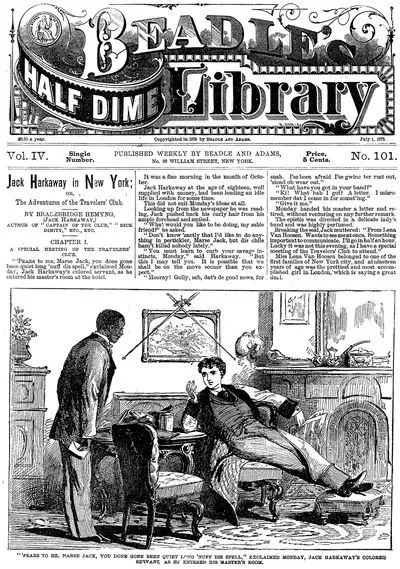
Jack Harkaway in New York; or, The Adventures of the Travelers’ Club
Bracebridge Hemyng
THE CLASSIC COLLECTION · 1900
"Jack Harkaway's Boy Tinker Among The Turks" by Bracebridge Hemyng is a fictional novel written in the late 19th century. The story follows young Jack Harkaway and his companion, the orphan Mr. Figgins, as they navigate various adventures and moral lessons during their travels in Turkey. The narrative is characterized by Jack's daring personality and wit, along with the humorous predicaments that arise as they encounter local customs and people. The opening portion of the book sets the stage for Jack Harkaway's escapades, beginning with a confrontation involving the ship's captain regarding their previous adventures. Jack’s boldness leads him to reflect on his actions and make amends, which introduces themes of bravery and moral growth. The scene also hints at the cultural peculiarities they will encounter, especially with Mr. Figgins expressing fears about Turkish customs, particularly regarding matrimony. The chapter ends with hints of impending visitors, creating anticipation for further encounters that will challenge the characters in both humorous and serious ways.
Introduction adapted from the source catalogue; source summaries may be automatically generated.
Free to read · English · 83,525 words · No account needed
MAKE TIME FOR A GOOD BOOK
On by default. Untick to stop anonymous reading totals. Each page counts after 10 seconds in view. How this works.
Anonymous counting is on unless you have switched it off.
"Yes," returned the physician dryly, "and so has Jack's father, by all
accounts."
"Ahem!"
"And yet I really believe that he enjoys the recollection of the boy's infamous practical jokes."
"I believe you are right," responded Harkaway.
A day or two later on the doctor was seated with Mr. Mole.
"Mr. Mole."
"Doctor."
"Your health must be looked to. You'll have to travel."
"How, doctor?" said Mole.
"Young Harkaway is in foreign parts, and his prolonged absence causes
his parents considerable uneasiness, and you must go and look after
him."
Mole's eyes twinkled.
"Do you mean it?"
"I do. When would you like to start?"
"To-day."
"Very good. The sooner the better," said the doctor.
Mr. Mole's countenance fell suddenly.
An ugly thought crossed him.
What would Mrs. Mole say?
"There is one matter I would like to consult you on, doctor."
"What might that be?" demanded the doctor.
"My wife might have a word to say upon the subject."
"I will undertake to remove her scruples," said the doctor.
"You will?"
"Yes. She will never object when she knows how important your mission
is."
"Doctor," exclaimed Mr. Mole, joyously; "you are a trump."
A delay naturally occurred, however.
Mr. Mole could not travel with his wooden stumps, his friends one and
all agreed.
No.
He must have a pair of cork legs made.
The doctor who had been attending our old friend knew of a maker of artificial limbs who was a wonderful man, according to all accounts.
"Yes," said Mole, "cork legs well hosed will----"
At this moment a voice tuning up under the window cut him short,
"He gave his own leg to the undertaker,
And sent for a skilful cork-leg maker.
Ritooral looral."
"That's Dick Harvey. Infamous!" ejaculated Mr. Mole.
"On a brace of broomsticks never I'll walk,
But I'll have symmetrical limbs of cork.
Ritooral looral."
"Monstrous!" exclaimed Mr. Mole; "close the window, sir, if you
please."
It was all very well to say "Close it," but this was easier said than
done.
Dick Harvey had fixed it beyond the skill of that skilful mechanician
to unfasten.
The aggravating minstrel continued without--
"Than timber this cork is better by half,
Examine likewise my elegant calf.
Ritooral looral----"
"I will have that window closed," cried Mole.
He arose, forgetting in his haste that he was minus one leg, and down
he rolled.
The artificial limb-maker lunged after him, and succeeded with infinite difficulty in getting him on to his feet again.
"Dear, dear!" said Mr. Mole. "No matter, I can manage it."
He picked up the nearest object to hand, and hurled it out of window.
Your reading position is saved on this browser. Take it to another device with a library code. Reading pages adapt to text, rather than matching a printed edition.
BEHIND THE BOOK
This eBook is for the use of anyone anywhere in the United States and most other parts of the world at no cost and with almost no restrictions whatsoever. You may copy it, give it away or re-use it under the terms of the Project Gutenberg License included with this eBook or online at www.gutenberg.org. If you are not located in the United States, you will have to check the laws of the country where you are located before using this eBook. Read the source licence.
The original source file, including credits and licence, is retained by this library. Request an original-format copy at no charge. Please include the book title and Project Gutenberg identifier #20320.
KEEP YOUR CURIOSITY GOING
Coulson Kernahan

Maurice Baring
Frances Wright
Cécile Tormay

Frederic Jesup Stimson

W. H. P. (William Henry Pope) Jarvis