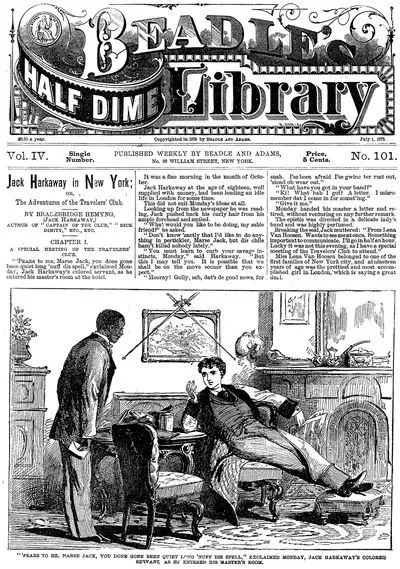
Jack Harkaway in New York; or, The Adventures of the Travelers’ Club
Bracebridge Hemyng
THE CLASSIC COLLECTION · 1900
"Jack Harkaway's Boy Tinker Among The Turks" by Bracebridge Hemyng is a fictional novel written in the late 19th century. The story follows young Jack Harkaway and his companion, the orphan Mr. Figgins, as they navigate various adventures and moral lessons during their travels in Turkey. The narrative is characterized by Jack's daring personality and wit, along with the humorous predicaments that arise as they encounter local customs and people. The opening portion of the book sets the stage for Jack Harkaway's escapades, beginning with a confrontation involving the ship's captain regarding their previous adventures. Jack’s boldness leads him to reflect on his actions and make amends, which introduces themes of bravery and moral growth. The scene also hints at the cultural peculiarities they will encounter, especially with Mr. Figgins expressing fears about Turkish customs, particularly regarding matrimony. The chapter ends with hints of impending visitors, creating anticipation for further encounters that will challenge the characters in both humorous and serious ways.
Introduction adapted from the source catalogue; source summaries may be automatically generated.
Free to read · English · 83,525 words · No account needed
MAKE TIME FOR A GOOD BOOK
On by default. Untick to stop anonymous reading totals. Each page counts after 10 seconds in view. How this works.
Anonymous counting is on unless you have switched it off.
It certainly seemed at first that our young hero had got himself into a bad fix, for the evidence was much against him.
The police had captured them in Lenoir's workshop.
They had been seen in conversation with him not only there, but at the cafe the police had been warned of their nefarious doings and so forth.
"Have you any witnesses to call, prisoner?" ask the judge, addressing
young Jack.
"Yes, Monsieur le Juge; and the first of them is Pierre Lenoir. Let him
be called."
"What folly is this?" demanded the judge, sternly.
"I ask that Pierre Lenoir shall be summoned to give evidence," repeated young Jack, who had been told by Delamarre what line of defence to adopt.
"Do you think he will respond if called?"
"If he does not respond, I shall derive no benefit from his evidence."
"Let Pierre Lenoir be called," said the judge, rather angrily.
And Pierre Lenoir was called by an officer of the court.
"Here!"
The answer was clear and distinct.
And the next moment Pierre Lenoir, escorted by two gensdarmes, marched
into the court-room.
Chivey touched Murray on the arm, and both had an idea of sneaking
away.
But the polite and attentive officer who had brought them back from the railway, stood in the doorway, and was evidently watching them.
In fact, he spoke to them.
"Things are getting interesting, gentlemen," said he; "it was worth losing a train to see such a dramatic trial as this promises to be."
"Interferes with our business, rather."
"Not so much, monsieur. But hush!"
The evidence of Pierre Lenoir was then taken.
The public prosecutor objected at first to his evidence; but it was urged by the counsel for the defence that although accused of many offences, he was at present convicted of none, and therefore was entitled to full credence.
"Your name is Pierre Lenoir?" asked Jack's counsel.
"It is."
"Do you know the prisoners?"
"But slightly."
"Say when you met them."
"I met them at my own house where they came by invitation to see some specimens of my skill as a medal engraver."
"Did those Englishmen assist you in any way to pass counterfeit coin?"
"Neither of those Englishmen; but that man did."
And turning half round, he pointed at the wretched Murray, alias
Markby.
And at the same time the affable police officer drew nearer, smiling
more blandly than ever.
"'Tis false!" shrieked the wretched Murray.
"The public must maintain silence in the court," said the judge.
"It's a base lie!" exclaimed Murray.
"The officer of the court will arrest the disorderly person."
The smiling gendarme at once swooped down on his prey.
Your reading position is saved on this browser. Take it to another device with a library code. Reading pages adapt to text, rather than matching a printed edition.
BEHIND THE BOOK
This eBook is for the use of anyone anywhere in the United States and most other parts of the world at no cost and with almost no restrictions whatsoever. You may copy it, give it away or re-use it under the terms of the Project Gutenberg License included with this eBook or online at www.gutenberg.org. If you are not located in the United States, you will have to check the laws of the country where you are located before using this eBook. Read the source licence.
The original source file, including credits and licence, is retained by this library. Request an original-format copy at no charge. Please include the book title and Project Gutenberg identifier #20320.
KEEP YOUR CURIOSITY GOING
Coulson Kernahan

Maurice Baring
Frances Wright
Cécile Tormay

Frederic Jesup Stimson

W. H. P. (William Henry Pope) Jarvis