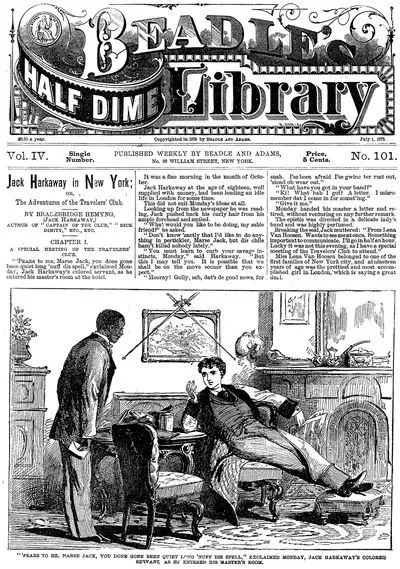
Jack Harkaway in New York; or, The Adventures of the Travelers’ Club
Bracebridge Hemyng
THE CLASSIC COLLECTION · 1900
"Jack Harkaway's Boy Tinker Among The Turks" by Bracebridge Hemyng is a fictional novel written in the late 19th century. The story follows young Jack Harkaway and his companion, the orphan Mr. Figgins, as they navigate various adventures and moral lessons during their travels in Turkey. The narrative is characterized by Jack's daring personality and wit, along with the humorous predicaments that arise as they encounter local customs and people. The opening portion of the book sets the stage for Jack Harkaway's escapades, beginning with a confrontation involving the ship's captain regarding their previous adventures. Jack’s boldness leads him to reflect on his actions and make amends, which introduces themes of bravery and moral growth. The scene also hints at the cultural peculiarities they will encounter, especially with Mr. Figgins expressing fears about Turkish customs, particularly regarding matrimony. The chapter ends with hints of impending visitors, creating anticipation for further encounters that will challenge the characters in both humorous and serious ways.
Introduction adapted from the source catalogue; source summaries may be automatically generated.
Free to read · English · 83,525 words · No account needed
MAKE TIME FOR A GOOD BOOK
On by default. Untick to stop anonymous reading totals. Each page counts after 10 seconds in view. How this works.
Anonymous counting is on unless you have switched it off.
He might have passed for a clerk, a second-rate shopkeeper, or a superior artisan; anyone passing him in the street would have taken no notice whatever of such an everyday kind of a man.
Yet, after all, a very close observer would have noticed something very peculiar about him. His eyes!
One moment they seemed to pierce the inmost recesses of your very soul, yet when you tried, through them, to find a clue to their owner's thoughts, you were utterly defeated, for they became misty and expressionless.
"What do I think of the affair, monsieur?"
"Yes."
"Well, so early in the case, it is difficult to pronounce a decided
opinion," said Delamarre.
"That is very true, Monsieur Delamarre," said the consul.
"But as your excellency has sought my professional assistance in this case, I feel my reputation is at stake, and shall exert myself to the utmost."
"Monsieur Delamarre is one of the cleverest gentlemen we have in this line of business," said the governor.
The middle-aged gentleman bowed.
"You are kind enough to say so, sir."
"You have made a good selection, Monsieur le Consul. In the detective police Monsieur Delamarre has few equals."
Again the detective bowed, and addressing the consul, said--
"When shall I next have the honour of waiting on you again, monsieur?"
"As soon as you have learned any thing you think of sufficient
importance to tell me."
"At the consulate, of course?"
"Will it be safe for you to be seen there?"
"Monsieur, I stake my professional reputation that, when I call on you, you shall not recognise me till I choose to reveal myself. There is an extremely artful person mixed up in this affair, but I shall prove still more artful than any of them; take the word of Hocquart Clermont Delamarre."
With another bow the French detective made his exit.
He proceeded in the first place to his own temporary residence, where he made a considerable alteration in his personal appearance.
Then making straight for the quarter of the city mostly inhabited by the respectable working classes, he made a friendly call on Pierre Lenoir the coiner, who, as it will be remembered, the police had been unable to trace since his encounter with Herbert Murray and the waggoner.
A friendly call we have termed it, and so it seemed at first, for the detective and the criminal shook hands in the most friendly manner.
"Hullo, friend Clermont," exclaimed Lenoir, "what brings you from
Paris!"
"Why, it was too hot for me there."
There was a pause.
"And you, too," continued the detective. "I have heard your name mentioned very much of late. How did that affair happen?"
Your reading position is saved on this browser. Take it to another device with a library code. Reading pages adapt to text, rather than matching a printed edition.
BEHIND THE BOOK
This eBook is for the use of anyone anywhere in the United States and most other parts of the world at no cost and with almost no restrictions whatsoever. You may copy it, give it away or re-use it under the terms of the Project Gutenberg License included with this eBook or online at www.gutenberg.org. If you are not located in the United States, you will have to check the laws of the country where you are located before using this eBook. Read the source licence.
The original source file, including credits and licence, is retained by this library. Request an original-format copy at no charge. Please include the book title and Project Gutenberg identifier #20320.
KEEP YOUR CURIOSITY GOING
Coulson Kernahan

Maurice Baring
Frances Wright
Cécile Tormay

Frederic Jesup Stimson

W. H. P. (William Henry Pope) Jarvis