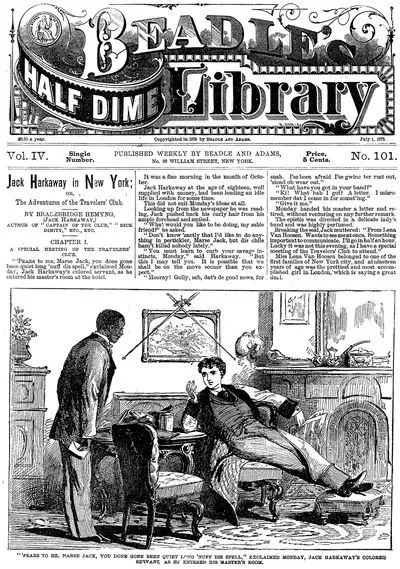
Jack Harkaway in New York; or, The Adventures of the Travelers’ Club
Bracebridge Hemyng
THE CLASSIC COLLECTION · 1900
"Jack Harkaway's Boy Tinker Among The Turks" by Bracebridge Hemyng is a fictional novel written in the late 19th century. The story follows young Jack Harkaway and his companion, the orphan Mr. Figgins, as they navigate various adventures and moral lessons during their travels in Turkey. The narrative is characterized by Jack's daring personality and wit, along with the humorous predicaments that arise as they encounter local customs and people. The opening portion of the book sets the stage for Jack Harkaway's escapades, beginning with a confrontation involving the ship's captain regarding their previous adventures. Jack’s boldness leads him to reflect on his actions and make amends, which introduces themes of bravery and moral growth. The scene also hints at the cultural peculiarities they will encounter, especially with Mr. Figgins expressing fears about Turkish customs, particularly regarding matrimony. The chapter ends with hints of impending visitors, creating anticipation for further encounters that will challenge the characters in both humorous and serious ways.
Introduction adapted from the source catalogue; source summaries may be automatically generated.
Free to read · English · 83,525 words · No account needed
MAKE TIME FOR A GOOD BOOK
On by default. Untick to stop anonymous reading totals. Each page counts after 10 seconds in view. How this works.
Anonymous counting is on unless you have switched it off.
"It ought," said Murray; "but I question if it will."
Murray was doomed to a sad disappointment in his operations, for do what he would, he could not "get at" the man charged with delivering the Harkaways' letters.
But he contrived to ascertain who the man was, and to give a
description of him to the tiger.
Chivey saw the man come out of the prison, and he thought over various plans for getting hold of the letter which he knew that he must be carrying.
His first idea was to go up to him and address him straight off upon the subject; but this would not do.
The messenger would in all probability take the alarm.
He next had an idea of following up the messenger, and after giving him a crack on the head, rifling his pockets.
This idea he abandoned even sooner than the first, and this for sundry
wholesome reasons.
Firstly, the man's road did not lead him into any sufficiently quiet
places for such an attempt.
Secondly, the man was a tough-looking customer, and an awkward fellow
to tackle.
And thirdly--but the second reason sufficed to send Chivey's mind away from all ideas of violence.
No; deeds of daring were not at all in Chivey's line.
He had a notion, however, and this was to go as fast as he could to the British consul's, and there to be ready for the messenger when he came.
His plans were not more matured than this; but chance seemed to very much favour this precious pair of youthful scamps--for the time being, at any rate.
Chivey timed his own arrival at the consul's residence, so as to be there just a few minutes in advance of the prison messenger.
The servant who admitted him was an Englishman, and told Chivey that his master was particularly engaged just then, and would not be visible for some considerable time.
"Be so good as to ask when I can see your master," said Chivey, with an air of lofty condescension.
"I must not disturb him now," said the servant.
"He will be very vexed with you if you don't," returned Chivey, "when
he knows my business."
The servant being only impressed with this threat, went off at once to obey the insidious tiger, who of course was not in livery.
Barely had the consul's servant disappeared, when the messenger from
the prison entered.
Chivey recognised him instantly.
"Une lettre pour Monsieur le Consul," said the messenger.
Chivey held out his hand, and the man, taking it for granted that Chivey belonged to the consular establishment, gave it to him.
Your reading position is saved on this browser. Take it to another device with a library code. Reading pages adapt to text, rather than matching a printed edition.
BEHIND THE BOOK
This eBook is for the use of anyone anywhere in the United States and most other parts of the world at no cost and with almost no restrictions whatsoever. You may copy it, give it away or re-use it under the terms of the Project Gutenberg License included with this eBook or online at www.gutenberg.org. If you are not located in the United States, you will have to check the laws of the country where you are located before using this eBook. Read the source licence.
The original source file, including credits and licence, is retained by this library. Request an original-format copy at no charge. Please include the book title and Project Gutenberg identifier #20320.
KEEP YOUR CURIOSITY GOING
Coulson Kernahan

Maurice Baring
Frances Wright
Cécile Tormay

Frederic Jesup Stimson

W. H. P. (William Henry Pope) Jarvis