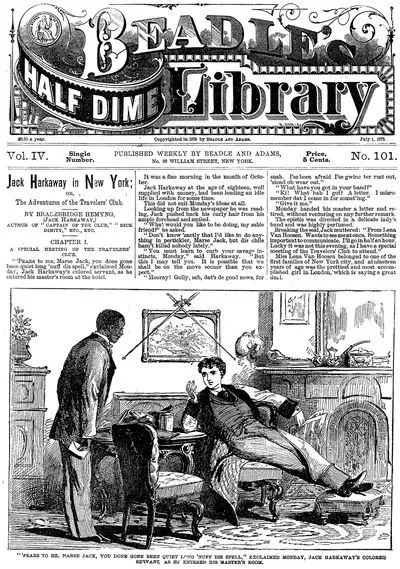
Jack Harkaway in New York; or, The Adventures of the Travelers’ Club
Bracebridge Hemyng
THE CLASSIC COLLECTION · 1900
"Jack Harkaway's Boy Tinker Among The Turks" by Bracebridge Hemyng is a fictional novel written in the late 19th century. The story follows young Jack Harkaway and his companion, the orphan Mr. Figgins, as they navigate various adventures and moral lessons during their travels in Turkey. The narrative is characterized by Jack's daring personality and wit, along with the humorous predicaments that arise as they encounter local customs and people. The opening portion of the book sets the stage for Jack Harkaway's escapades, beginning with a confrontation involving the ship's captain regarding their previous adventures. Jack’s boldness leads him to reflect on his actions and make amends, which introduces themes of bravery and moral growth. The scene also hints at the cultural peculiarities they will encounter, especially with Mr. Figgins expressing fears about Turkish customs, particularly regarding matrimony. The chapter ends with hints of impending visitors, creating anticipation for further encounters that will challenge the characters in both humorous and serious ways.
Introduction adapted from the source catalogue; source summaries may be automatically generated.
Free to read · English · 83,525 words · No account needed
MAKE TIME FOR A GOOD BOOK
On by default. Untick to stop anonymous reading totals. Each page counts after 10 seconds in view. How this works.
Anonymous counting is on unless you have switched it off.
But before he had got more than two hundred yards the pace began to
tell upon him.
He felt that he would have to give in.
"I must go easier, or I shall fail altogether."
So reasoning, he slackened his pace, and dropped into that slinging trot that runners in France know as the pas gymnastique.
If your strength and wind are of average quality, you can keep up for a
prodigious time at that.
Murray flew on, anxious to get away from his furious pursuer.
He increased his lead.
But presently the pace told upon him likewise.
He collected his thoughts and his prudence as he went, and rested.
Glancing over his shoulder, he saw Lenoir come bounding along, a considerable distance in the rear.
"Savage beast!" thought Murray. "He means mischief."
Murray meant tiring him out.
This, however, was not so easily done.
The Englishman was a capital runner, and had been one of the crack men
of his school-club.
But his forte was pace.
The Frenchman, on the contrary, was a stayer.
It looked bad for Murray.
On they went, and when a good mile had been covered, Murray, on glancing back, felt convinced that it was only a question of time.
He must tire out the Frenchman in the end, he thought.
He believed that an Englishman must always be more than a match for a Frenchman at any kind of athletics.
He reckoned without his host, for while he (Murray) was getting blown, Lenoir swung on at pas gymnastique, having got his second wind, and being, to all appearance, capable of keeping on for any length of time.
"I shall have to give it up," gasped Murray, when, at the end of the second mile, he looked over his shoulder again.
An unpleasant fact revealed itself.
While he was faltering, the Frenchman was rather improving his pace.
Yes.
The distance between them was lessening.
And now he could hear Lenoir's menaces quite plainly as the coiner
gained upon him.
"I shall have you directly, and I shall beat your skull in!" the
Frenchman said.
Murray's craven heart leapt to his mouth.
Already he felt as if his cranium was cracked by the brutal fist of the
savage coiner.
Fear lent him wings.
He put on a spurt.
"Oh, if I had but a pistol," thought Murray; "what a fool I was to come unarmed on such a job as this."
He partially flagged again.
The distance between them was still decreasing.
Your reading position is saved on this browser. Take it to another device with a library code. Reading pages adapt to text, rather than matching a printed edition.
BEHIND THE BOOK
This eBook is for the use of anyone anywhere in the United States and most other parts of the world at no cost and with almost no restrictions whatsoever. You may copy it, give it away or re-use it under the terms of the Project Gutenberg License included with this eBook or online at www.gutenberg.org. If you are not located in the United States, you will have to check the laws of the country where you are located before using this eBook. Read the source licence.
The original source file, including credits and licence, is retained by this library. Request an original-format copy at no charge. Please include the book title and Project Gutenberg identifier #20320.
KEEP YOUR CURIOSITY GOING
Coulson Kernahan

Maurice Baring
Frances Wright
Cécile Tormay

Frederic Jesup Stimson

W. H. P. (William Henry Pope) Jarvis