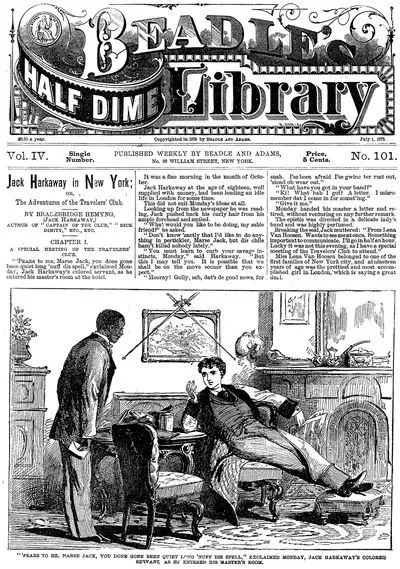
Jack Harkaway in New York; or, The Adventures of the Travelers’ Club
Bracebridge Hemyng
THE CLASSIC COLLECTION · 1900
"Jack Harkaway's Boy Tinker Among The Turks" by Bracebridge Hemyng is a fictional novel written in the late 19th century. The story follows young Jack Harkaway and his companion, the orphan Mr. Figgins, as they navigate various adventures and moral lessons during their travels in Turkey. The narrative is characterized by Jack's daring personality and wit, along with the humorous predicaments that arise as they encounter local customs and people. The opening portion of the book sets the stage for Jack Harkaway's escapades, beginning with a confrontation involving the ship's captain regarding their previous adventures. Jack’s boldness leads him to reflect on his actions and make amends, which introduces themes of bravery and moral growth. The scene also hints at the cultural peculiarities they will encounter, especially with Mr. Figgins expressing fears about Turkish customs, particularly regarding matrimony. The chapter ends with hints of impending visitors, creating anticipation for further encounters that will challenge the characters in both humorous and serious ways.
Introduction adapted from the source catalogue; source summaries may be automatically generated.
Free to read · English · 83,525 words · No account needed
MAKE TIME FOR A GOOD BOOK
On by default. Untick to stop anonymous reading totals. Each page counts after 10 seconds in view. How this works.
Anonymous counting is on unless you have switched it off.
What further reason he may have had for cultivating the friendship of the rover, Pierre Lenoir, will probably show itself in due course.
"I have disposed of that last batch of five-franc pieces," said Markby.
"Here are the proceeds."
"Keep it back," exclaimed Lenoir hurriedly.
"What for?"
"It is sheer madness for us to be seen conversing together," replied Lenoir, casting an anxious glance about him from behind his hat, which he held in his hand so as to shield his features, "much less to be seen exchanging money--why, it is suicidal--nothing less."
"Is there any danger, do you think?"
"Do I think? Do I know? Why, this place is literally alive with spies--mouchards as we called them here. Every second man you meet is a mouchard."
"Do you mean it?"
"Rather."
"That's not a pleasant thing to know," said Markby.
"I don't agree with you there," replied Lenoir. "'Forewarned, forearmed,' is a proverb in your language. But now tell me about this friend and countryman of yours."
"He's no friend of mine," returned Markby. "I know him as a great traveller, and one who has opportunities of placing more false----"
"Hush, imprudent!" interrupted Lenoir. "Call it stock. You know not how many French spies may be passing, or how near we may be to danger."
Markby took the hint given him, and continued--
"Well, stock. He can place more--he has probably placed more than any man alive. He travels about en grand seigneur--lords it in high places and disposes of the counterf----"
"Stock."
"Stock, in regular loads. But he's as wary as a fox--nothing can
approach him in cunning."
"The very man I want," exclaimed Lenoir. "This fellow could, with my aid, make a fortune for himself and me in less than a year--a large fortune."
"You are very sanguine," said Markby, with a smile.
"I am, but not over sanguine. I speak by the book, for I know well what I am talking of. You must introduce me."
"You are running on wildly," said Markby. "Did I not tell you that he did not know me--that he would not know me if he did? So careful is he that his own brother would fail to draw any thing from him concerning the way in which he gets his living."
"Dame!" muttered Lenoir, "he seems a precious difficult fellow to
approach."
"Yes, on that subject," responded Markby; "but he's genial and agreeable enough if you introduce yourself by accident, as it were, and chat upon social topics generally, without the vaguest reference to the subject nearest your heart."
"How shall I ever lead him up to the point?"
Your reading position is saved on this browser. Take it to another device with a library code. Reading pages adapt to text, rather than matching a printed edition.
BEHIND THE BOOK
This eBook is for the use of anyone anywhere in the United States and most other parts of the world at no cost and with almost no restrictions whatsoever. You may copy it, give it away or re-use it under the terms of the Project Gutenberg License included with this eBook or online at www.gutenberg.org. If you are not located in the United States, you will have to check the laws of the country where you are located before using this eBook. Read the source licence.
The original source file, including credits and licence, is retained by this library. Request an original-format copy at no charge. Please include the book title and Project Gutenberg identifier #20320.
KEEP YOUR CURIOSITY GOING
Coulson Kernahan

Maurice Baring
Frances Wright
Cécile Tormay

Frederic Jesup Stimson

W. H. P. (William Henry Pope) Jarvis