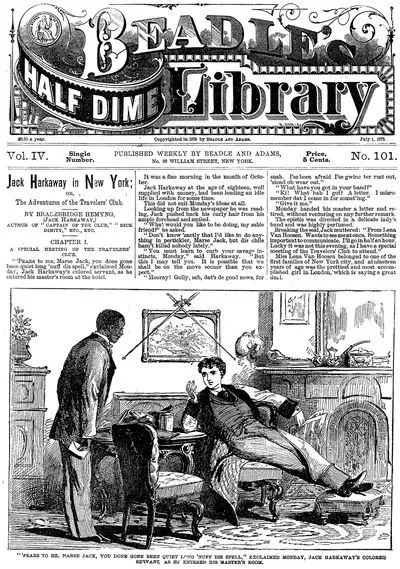
Jack Harkaway in New York; or, The Adventures of the Travelers’ Club
Bracebridge Hemyng
THE CLASSIC COLLECTION · 1900
"Jack Harkaway's Boy Tinker Among The Turks" by Bracebridge Hemyng is a fictional novel written in the late 19th century. The story follows young Jack Harkaway and his companion, the orphan Mr. Figgins, as they navigate various adventures and moral lessons during their travels in Turkey. The narrative is characterized by Jack's daring personality and wit, along with the humorous predicaments that arise as they encounter local customs and people. The opening portion of the book sets the stage for Jack Harkaway's escapades, beginning with a confrontation involving the ship's captain regarding their previous adventures. Jack’s boldness leads him to reflect on his actions and make amends, which introduces themes of bravery and moral growth. The scene also hints at the cultural peculiarities they will encounter, especially with Mr. Figgins expressing fears about Turkish customs, particularly regarding matrimony. The chapter ends with hints of impending visitors, creating anticipation for further encounters that will challenge the characters in both humorous and serious ways.
Introduction adapted from the source catalogue; source summaries may be automatically generated.
Free to read · English · 83,525 words · No account needed
MAKE TIME FOR A GOOD BOOK
On by default. Untick to stop anonymous reading totals. Each page counts after 10 seconds in view. How this works.
Anonymous counting is on unless you have switched it off.
France was then going through one of its periodical upsets, and a good deal of unnecessary bother was made along the coast upon the landing of passengers.
Passports were partly dispensed with, but questions were put by fierce officials as to your name and nationality, which all led up to nothing, for they accepted your reply implicitly as truth, and while it inconvenienced the general public, the Royalist, Republican, Orleanist, or whoever might chance to be of the revolutionary party for the time being, could chuckle as he told his fibs and passed on to the forbidden land.
M. le Commissaire confronted Mr. Mole, and barred his passage to
interrogate him.
"Pardon, m'sieur, veuillez bien me dire votre nom?"
"What's that?" said Mole.
"Votre nom, s'il vous plait," repeated the commissaire.
"Really, I haven't the pleasure of your acquaintance."
"Sapristi!" ejaculated the commissaire, to one of his subordinates.
"Quel type!"
"Now, Mr. Mole," said Jack, who was close behind the old gentleman,
"why don't you speak up?"
"I don't quite follow him."
"He's only asking a question, you know. You polly-voo like a native."
"Yes; precisely, Jack. But I don't follow his accent. He's some
peasant, I suppose."
"Votre nom!" demanded the official, rather fiercely this time.
"Now, then, Mr. Mole," cried a voice in the rear, "you're stopping everyone. Get it out and move on."
"Dear, dear me!" said Mole. "What does it mean?"
"He's asking your name," said Jack, "and you can't understand it."
"Oh!"
"I'll tell him for you, as you don't seem to know a word," said Jack. "Il s'appelle Ikey Mole," he added to the commissaire.
"Aike Moll," repeated the commissaire. "Il est Arabe?"
"Oui, monsieur. C'est un des lieutenants du grand Abd-el-Kader."
"Vraiment!" exclaimed the commissaire, in a tone of mingled surprise and respect. "Passez, M'sieur Aike Moll."[2]
[2] "He calls himself Ikey Mole," says Jack to the commissaire
de police.
"Aike Moll!" repeats the commissaire, pronouncing the
incongruous sounds as nearly as he can. "Why, he must be an
Arab."
To which Jack, with all his ready impudence, replies--
"Yes, sir, he is an Arab. He was one of Abd-el-Kader's
lieutenants."
We need scarcely remind our readers that Abd-el-Kader was the doughty Arab chief who made so heroic a resistance to the French in Algiers.
This satisfied the commissaire, who respectfully bade Mole pass
on.
They went on, and Mole anxiously questioned Jack.
"I'm getting quite deaf," said he, by way of a pretext for not having understood the conversation. "Whatever were you saying?"
"I told him your name was Isaac Mole, sir," returned Jack.
"You said Ikey Mole, sir," retorted Mole, "and that is a very great
liberty, sir."
Your reading position is saved on this browser. Take it to another device with a library code. Reading pages adapt to text, rather than matching a printed edition.
BEHIND THE BOOK
This eBook is for the use of anyone anywhere in the United States and most other parts of the world at no cost and with almost no restrictions whatsoever. You may copy it, give it away or re-use it under the terms of the Project Gutenberg License included with this eBook or online at www.gutenberg.org. If you are not located in the United States, you will have to check the laws of the country where you are located before using this eBook. Read the source licence.
The original source file, including credits and licence, is retained by this library. Request an original-format copy at no charge. Please include the book title and Project Gutenberg identifier #20320.
KEEP YOUR CURIOSITY GOING
Coulson Kernahan

Maurice Baring
Frances Wright
Cécile Tormay

Frederic Jesup Stimson

W. H. P. (William Henry Pope) Jarvis