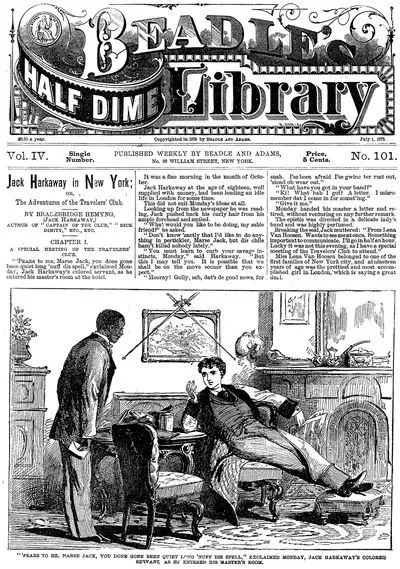
Jack Harkaway in New York; or, The Adventures of the Travelers’ Club
Bracebridge Hemyng
THE CLASSIC COLLECTION · 1900
"Jack Harkaway's Boy Tinker Among The Turks" by Bracebridge Hemyng is a fictional novel written in the late 19th century. The story follows young Jack Harkaway and his companion, the orphan Mr. Figgins, as they navigate various adventures and moral lessons during their travels in Turkey. The narrative is characterized by Jack's daring personality and wit, along with the humorous predicaments that arise as they encounter local customs and people. The opening portion of the book sets the stage for Jack Harkaway's escapades, beginning with a confrontation involving the ship's captain regarding their previous adventures. Jack’s boldness leads him to reflect on his actions and make amends, which introduces themes of bravery and moral growth. The scene also hints at the cultural peculiarities they will encounter, especially with Mr. Figgins expressing fears about Turkish customs, particularly regarding matrimony. The chapter ends with hints of impending visitors, creating anticipation for further encounters that will challenge the characters in both humorous and serious ways.
Introduction adapted from the source catalogue; source summaries may be automatically generated.
Free to read · English · 83,525 words · No account needed
MAKE TIME FOR A GOOD BOOK
On by default. Untick to stop anonymous reading totals. Each page counts after 10 seconds in view. How this works.
Anonymous counting is on unless you have switched it off.
Abdullah's plans were deeply laid.
He wished to capture the Greek girl, that he might curry favour with the Pasha Ibrahim by presenting her to him.
He was resolved to secure and punish Harkaway and the other Christians, to turn away every public suspicion from himself and Ibrahim, as to the late pasha's assassination.
After that, it is exceedingly probable that the unscrupulous
interpreter meant in some way to destroy Ibrahim, and set up as pasha
himself.
These subtle treacheries are common under the corruptions of Oriental
rule.
The vizier intended to take the Arabs by surprise, and he would have succeeded in this, had it not been for Thyra.
Instead, therefore, of finding a sleeping encampment, he found the whole tribe up in arms, and ready to receive him.
Other tactics were therefore necessary, but Abdullah believed that his own superiority in numbers would ensure victory.
As the Turkish regiment approached, they spread themselves out, their object being to surround the force opposed to them.
On came the Turks.
Their sabres flashing and clashing.
The steeds neighing.
The sands of the desert rising up in clouds beneath their thundering
tread.
Arrived within a short distance, the two armies halted and surveyed
each other.
Then a trumpet sounded to parley, and a messenger rode forward to communicate with the Arab chief.
"To the Emir Kara-al Zariel," said the soldier, "thus saith the great Lord Ibrahim, pasha of Alla-hissar. Whereas, though thou hast been often a rebel against his highness's lawful authority, yet will he pardon thee all past misdeeds on condition that thou shalt give up the Frankish men and the Greek woman, who are accused of the secret murder of his late highness, Moley Pasha. Refuse this, and no mercy will be shown to thee or to thy tribe.
"Tell thy ruler or his officers," thus replied Kara-al Zariel, "that I refuse his proffered pardon; that Ibrahim is an assassin and usurper I despise and defy; that I will never deliver up to his hands those who have sought my hospitality, and that I and my tribe, and my guests, will resist him and his, to the death."
This rebuff was sufficiently conclusive.
There was nothing now but to commence the fight.
Shots came forth from the midst of the mass of Turkish horsemen, and were promptly answered from the muskets of the Arabs.
The battle cry of the Bedouins rang out clear in the morning air.
The first rays of the sun now lit up the plain, piercing the clouds of mist and desert-dust, and gleaming upon the rapidly-moving blades and barrels.
Now shone out the white naiks of the Arabs and the red caps of the
Turks.
Your reading position is saved on this browser. Take it to another device with a library code. Reading pages adapt to text, rather than matching a printed edition.
BEHIND THE BOOK
This eBook is for the use of anyone anywhere in the United States and most other parts of the world at no cost and with almost no restrictions whatsoever. You may copy it, give it away or re-use it under the terms of the Project Gutenberg License included with this eBook or online at www.gutenberg.org. If you are not located in the United States, you will have to check the laws of the country where you are located before using this eBook. Read the source licence.
The original source file, including credits and licence, is retained by this library. Request an original-format copy at no charge. Please include the book title and Project Gutenberg identifier #20320.
KEEP YOUR CURIOSITY GOING
Coulson Kernahan

Maurice Baring
Frances Wright
Cécile Tormay

Frederic Jesup Stimson

W. H. P. (William Henry Pope) Jarvis