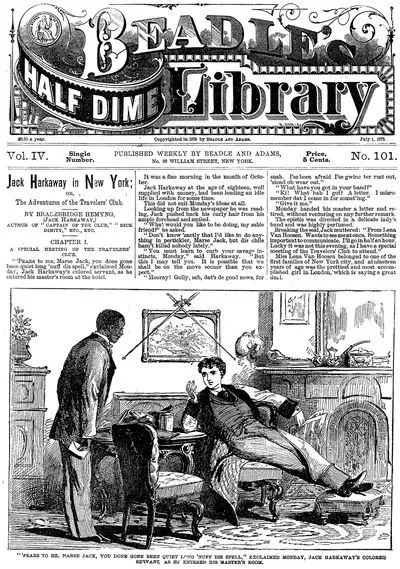
Jack Harkaway in New York; or, The Adventures of the Travelers’ Club
Bracebridge Hemyng
THE CLASSIC COLLECTION · 1900
"Jack Harkaway's Boy Tinker Among The Turks" by Bracebridge Hemyng is a fictional novel written in the late 19th century. The story follows young Jack Harkaway and his companion, the orphan Mr. Figgins, as they navigate various adventures and moral lessons during their travels in Turkey. The narrative is characterized by Jack's daring personality and wit, along with the humorous predicaments that arise as they encounter local customs and people. The opening portion of the book sets the stage for Jack Harkaway's escapades, beginning with a confrontation involving the ship's captain regarding their previous adventures. Jack’s boldness leads him to reflect on his actions and make amends, which introduces themes of bravery and moral growth. The scene also hints at the cultural peculiarities they will encounter, especially with Mr. Figgins expressing fears about Turkish customs, particularly regarding matrimony. The chapter ends with hints of impending visitors, creating anticipation for further encounters that will challenge the characters in both humorous and serious ways.
Introduction adapted from the source catalogue; source summaries may be automatically generated.
Free to read · English · 83,525 words · No account needed
MAKE TIME FOR A GOOD BOOK
On by default. Untick to stop anonymous reading totals. Each page counts after 10 seconds in view. How this works.
Anonymous counting is on unless you have switched it off.
She glided like a smooth serpent, or an invisible spirit; her presence was unseen, unfelt, unsuspected.
She enters the inner chamber where lies the unconscious pasha.
She bends over him, she draws forth a knife, slender, tapering to a
point almost like a needle.
The pasha still slept on, the fountain outside made sweet music, heard through the curtains and windows.
A smile played upon the pasha's lips.
He was dreaming, perchance, of the rosy bowers and the dark-eyed
houris of Paradise.
Suddenly the knife descended, there was the flash of a moment, while it hovered like a hawk over its quarry, the next instant it was buried in the pasha's heart.
A deep groan was the only effort of expiring nature.
The fiercely flashing eyes, and a part of the face of the murderer were now exposed; the dress was that of a woman, but the form and features were those of Abdullah the interpreter.
For a moment he stood gazing on his deed, then lifted some tapestry which concealed a small door, and disappeared.
What cry was that which startles the seraglio from its siesta?
What combined lamentation disturbs the whole palace with its harrowing
intensity?
All the inmates of the establishment have been rudely awakened from
their slumbers.
It was the pasha's favourite wife who had broken in upon the privacy of her lord, and she had found him dead.
Dead, plainly by the assassin's dagger, but what assassin, none could
even suspect.
None could conjecture by what means any stranger could have obtained
entrance and exit.
Then arose that dreadful wail of despair, that beating of breasts, and
tearing of tresses.
The news soon spread, and the whole town was in a fever of commotion.
Who had done the deed?
Who was to be Moley Pasha's successor?
The conspirators played their parts well.
Ibrahim Bey pretended to be terribly amazed and shocked: he refused to be placed at the head of affairs until the sultan's will should be known, and he offered rewards for the discovery of the assassin.
A council, consisting of Ibrahim and others, was now established to
temporarily rule the town.
A grand funeral, at which all the dignitaries of the place attended,
was given to the unfortunate pasha, the evening after his
assassination.
The same night arrived a firman from the sultan, proclaiming Ibrahim
Pasha of Allahissar.
Such is the perilous nature of the power and dignity in Eastern lands.
Ibrahim at once appointed Abdullah his vizier, and gave all the other conspirators important posts.
Several perfectly innocent men were arrested and hanged on a pretended suspicion of having caused the late pasha's death.
Your reading position is saved on this browser. Take it to another device with a library code. Reading pages adapt to text, rather than matching a printed edition.
BEHIND THE BOOK
This eBook is for the use of anyone anywhere in the United States and most other parts of the world at no cost and with almost no restrictions whatsoever. You may copy it, give it away or re-use it under the terms of the Project Gutenberg License included with this eBook or online at www.gutenberg.org. If you are not located in the United States, you will have to check the laws of the country where you are located before using this eBook. Read the source licence.
The original source file, including credits and licence, is retained by this library. Request an original-format copy at no charge. Please include the book title and Project Gutenberg identifier #20320.
KEEP YOUR CURIOSITY GOING
Coulson Kernahan

Maurice Baring
Frances Wright
Cécile Tormay

Frederic Jesup Stimson

W. H. P. (William Henry Pope) Jarvis