
Letters to a Friend, Written to Mrs. Ezra S. Carr, 1866-1879
John Muir
THE CLASSIC COLLECTION · 1913
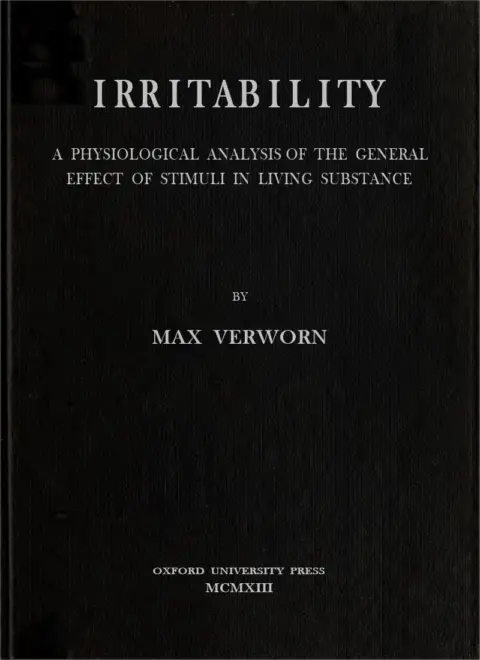
"Irritability: A Physiological Analysis of the General Effect of Stimuli" by Max Verworn is a scientific publication written in the early 20th century. The text appears to focus on the concept of irritability as it pertains to living substances, exploring how different stimuli can affect physiological reactions and the laws governing these responses. The author discusses the historical perspectives on irritability and aims to unite experiments conducted over decades to form a systematic understanding of this fundamental physiological concept. The opening of the work introduces the reader to the historical context surrounding the study of irritability, outlining significant thinkers such as Francis Glisson and Albrecht von Haller, and their contributions to the understanding of living substances' responses to stimuli. Verworn sets the stage for a comprehensive exploration by discussing the philosophical and scientific evolutions that have shaped the field. He emphasizes the importance of studying irritability as a gateway to better understanding life's processes. The author also signals his intention to methodically investigate the effects of stimulation across various biological systems, laying a foundation for the detailed analysis that will follow in the subsequent chapters.
Introduction adapted from the source catalogue; source summaries may be automatically generated.
Free to read · English · 85,158 words · No account needed
MAKE TIME FOR A GOOD BOOK
On by default. Untick to stop anonymous reading totals. Each page counts after 10 seconds in view. How this works.
Anonymous counting is on unless you have switched it off.
[64] H. v. Baeyer: “Zur Kenntniss des Stoffwechsels in den nervösen Centren.” Zeitschr. f. allgem. Physiol. Bd. I, 1902.
[65] Gustav Mann: “Histological changes induced in sympathetic motor and sensory nerve cells by functional activity.” In Journ. of Anat. and Physiol. 1894. Further: Gordon Holmes: “On morphological changes in exhausted ganglion cells.” Zeitschrift f. allgem. Physiol. Bd. II, 1903.
[66] Wallengren: “Inanitionserscheinungen der Zelle.” Zeitschrift f. allgem. Physiol. Bd. I, 1902.
[67] W. Pfeffer: “Ueber die regulatorische Bildung von Diastase.” In der math. phys. Klasse d. Königl. Sächs Ges. d. Wiss. zu Leipzig 1896.
[68] De Bary: “Sur la fermentation de la cellulose.” In Bull. de la Soc. bot. de France 1879.
Entirely different is the question if the cell also possesses a reserve store of oxygen. In this respect views have widely differed, and even today no conformity of opinions has been arrived at. The fact that many purely aërobic organisms and tissues can exist under complete exclusion of oxygen for a longer or shorter period, retaining their excitability and producing carbon dioxide, has for a long time led a great number of investigators, such as Liebig, Matteucci, Engelmann, Pettenkofer and Voit, Claude Bernard, Verworn, H. v. Baeyer and others, to the supposition that a reserve store of oxygen must exist in the living substance which maintains its excitability for a time. More recent information, however, of the transition of the oxydative to the anoxydative disintegration under a deficiency of oxygen, as can be observed in plants and certain invertebrate animals, indicates that here also there is the possibility of another explanation of these facts. Various attempts have been made to solve the problem if reserve oxygen is present in the cell or not. The experiments of Rosenthal,[69] carried out with his respiration calorimeter, seemed to point directly to an oxygen reserve in the organism of the mammal. He observed that during respiration in an atmosphere rich in oxygen the respiratory quotient (CO{2} : O{2}) became lower than in ordinary air, that is, that oxygen, and that indeed in considerable quantity, must be retained in the organism. Nevertheless Falloise[70] found that when rabbits, which had been kept in an atmosphere containing 80 per cent of oxygen, were asphyxiated, the time necessary to produce death was no longer than in animals which had been kept previously in ordinary air. The correctness of the observations of Rosenthal have been disputed by Durig.[71] Winterstein[72] also, employing the microrespiration methods of Thunberg upon the spinal cord of the frog, believed that he had found proof that an oxygen reserve cannot take place. He reasoned thus: If the cells of the spinal cord contain reserve oxygen, which is used up when pure nitrogen only is breathed, then it necessarily follows that after reintroduction of oxygen, following asphyxiation, a definite quantity must be stored up again as reserve. In consequence, the respiratory quotient following the intake of oxygen after asphyxiation should be smaller than when the animal is in air. He found, however, that the respiratory quotient does not essentially change and concluded from this that storage of oxygen does not take place. In these experiments, however, there exists no certain indicator as to the state of the spinal cord during asphyxiation and recovery in the given case. The spinal cord may be severely injured and even undergo degeneration during asphyxiation, and the recovery following the reintroduction of oxygen may be either incomplete or nil, without there being a method for its determination. Apart from this, Lesser[73] has already emphasized, in opposition to these experiments, that the respiratory quotient in recovery is no criterion to guide us. It is immaterial whether during asphyxiation oxygen respiration occurs following a reserve supply, or that an anoxydative formation of carbon dioxide has taken place, for in both instances the respiratory quotient would be less after asphyxiation when there is again an oxygen supply. It is, therefore, quite impossible to decide the question by the employment of this method. For this reason Lesser has attempted to solve the problem by means of quite another method, and was convinced that he had refuted finally the belief in the existence of reserve oxygen. His method consists in the employment of the Bunsen ice calorimeter, by which he determines the heat production of frogs, kept first in air, then in nitrogen, and at the end of each experiment ascertaining the amount of output of carbon dioxide, respectively in air and nitrogen. He found that the quantity of heat, calculated in terms of 100 grms. body weight per hour, produced in nitrogen was considerably less than that under corresponding conditions in air, but that the production of carbon dioxide, on the other hand, during the first hours in nitrogen was doubled in amount, as compared to that in air. From this he concludes that the carbon dioxide formation in nitrogen must be different from that in air, as it is associated with a reduced heat production. In other words, carbon dioxide formation, while the animal is in a nitrogen atmosphere, does not have its origin in oxydative processes at the cost of stored up oxygen. I regret that I am unable to accept these arguments as conclusive evidence against the assumption of an oxygen reserve, as this question cannot be decided by the use of such methods. Lesser does not measure the amount of carbon dioxide until the end of his experiments, that is, he learns merely the entire carbon dioxide production during a period of many hours. No conclusions can be drawn from this as to the conditions existing in the first period of time, directly after the animals have been subjected to an atmosphere of nitrogen. It is quite possible that subsequent to the change to nitrogen an oxydative carbon dioxide formation may have continued in decreasing degree, without this being shown in the final result. The problem of the existence of a reserve supply of oxygen is in no way solved by these experiments.
Your reading position is saved on this browser. Take it to another device with a library code. Reading pages adapt to text, rather than matching a printed edition.
BEHIND THE BOOK
This eBook is for the use of anyone anywhere in the United States and most other parts of the world at no cost and with almost no restrictions whatsoever. You may copy it, give it away or re-use it under the terms of the Project Gutenberg License included with this eBook or online at www.gutenberg.org. If you are not located in the United States, you will have to check the laws of the country where you are located before using this eBook. Read the source licence.
The original source file, including credits and licence, is retained by this library. Request an original-format copy at no charge. Please include the book title and Project Gutenberg identifier #66767.
KEEP YOUR CURIOSITY GOING
John Muir

Asa Gray
Asa Gray

Florence Nightingale
Elizabeth Robins Pennell
Denison Olmsted