
Letters to a Friend, Written to Mrs. Ezra S. Carr, 1866-1879
John Muir
THE CLASSIC COLLECTION · 1913
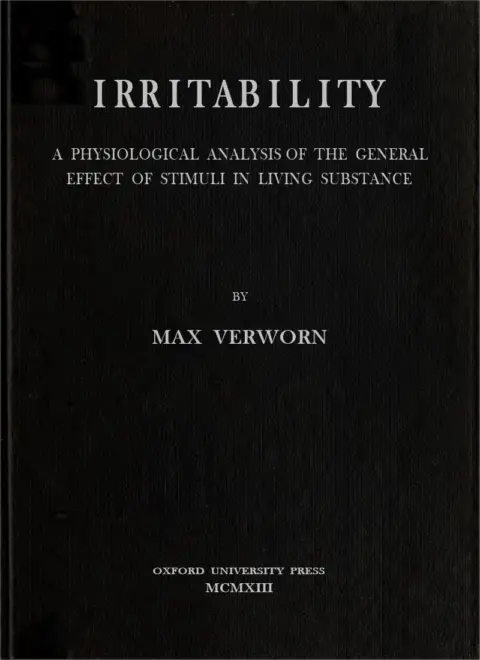
"Irritability: A Physiological Analysis of the General Effect of Stimuli" by Max Verworn is a scientific publication written in the early 20th century. The text appears to focus on the concept of irritability as it pertains to living substances, exploring how different stimuli can affect physiological reactions and the laws governing these responses. The author discusses the historical perspectives on irritability and aims to unite experiments conducted over decades to form a systematic understanding of this fundamental physiological concept. The opening of the work introduces the reader to the historical context surrounding the study of irritability, outlining significant thinkers such as Francis Glisson and Albrecht von Haller, and their contributions to the understanding of living substances' responses to stimuli. Verworn sets the stage for a comprehensive exploration by discussing the philosophical and scientific evolutions that have shaped the field. He emphasizes the importance of studying irritability as a gateway to better understanding life's processes. The author also signals his intention to methodically investigate the effects of stimulation across various biological systems, laying a foundation for the detailed analysis that will follow in the subsequent chapters.
Introduction adapted from the source catalogue; source summaries may be automatically generated.
Free to read · English · 85,158 words · No account needed
MAKE TIME FOR A GOOD BOOK
On by default. Untick to stop anonymous reading totals. Each page counts after 10 seconds in view. How this works.
Anonymous counting is on unless you have switched it off.
Contents: Indicators for the investigation of the process of excitation. Latent period. The question of the existence of assimilatory excitations. Dissimilatory excitations. Excitations of the partial components of functional metabolism. Production of energy in the chemical splitting up processes. Oxydative and anoxydative disintegration. Theory of oxydative disintegration. Dependence of irritability on oxygen. Experiments on unicellular organisms, nerve centers and nerve fibers. Restitution after disintegration by metabolic self-regulation. Organic reserve supplies of the cell. The question of a reserve supply of oxygen of the cell. Metabolic self-regulation as a form of the law of mass effect, and metabolic equilibrium as a condition of chemical equilibrium. Functional hypertrophy.
If it is true that all primary effects of stimulation consist either in an excitation or depression of the metabolism, and that all other effects of stimulation secondarily follow this primary alteration of the metabolism of rest, then every thorough analysis of the mechanics of reaction must have its beginning in the investigation of these primary processes. I desire to adopt this method here and will analyze somewhat further the primary process of excitation and its immediate and remote sequences. This will be followed later by the analysis of the process of primary depression and its results.
The investigation of the more obscure processes in the living substance places us in a difficult position, for their details cannot be observed by the unaided senses. That which we can perceive is merely the grosser vital action, consisting of a complex combination of the individual processes, the total result of a multitude of different components. For this reason the conception of excitation can only be established by observations based upon the combined vital actions, which are produced by the effect of stimulation upon the complex system. In the beginning, the process of excitation was studied exclusively on the muscle and nervous system. A physical factor served as indicator, such as muscle contraction or production of electricity. These showed, besides the direct and primary effect of stimulation, the secondary process of conductivity. Even graphic registration is merely an expression of the phenomena composed of a great mass of individual elements. The visible course of the phenomena, as shown, for instance, by the latent period by the ascent and descent of the curve of contraction, represents as it were a reflected picture of the actual excitation processes similar to an object seen in a distorting mirror; the first and the last parts of the process are not even perceptible. Later, when organ physiology was extended into a cell physiology the processes of excitation were studied in numerous simple organisms, such as the plant cell, the rhizopoda, the infusoria, etc. Later, in this way, by the use of comparative methods many essential facts were discovered. However, even the single cell, in spite of its minuteness, is, compared with the size of a molecule, a gigantic system, and it would be a grave error if we should consider this system even in its simplest aspect as homogeneous. In order, therefore, to analyze the vital activities in the cell, cell physiology must endeavor to penetrate into molecular conditions. For this purpose the indicators employed must be essentially of a chemical nature, capable of magnifying the processes of molecular dimension to such a degree that we are enabled to base conclusions upon these not otherwise directly perceptible phenomena. To obtain a sufficient magnification we must necessarily place somewhat larger quantities of living substance under observation and apply a stimulus of such frequency or length of duration that the chemical alterations as a result of excitation are so increased as to be plainly perceptible with the aid of our chemical indicators. Unfortunately, we do not possess specific chemical indicators for every individual molecular constituent process of the cell and so cannot dispose with the help of indicators of the combined happenings in a greater quantity of living substance. It remains for us to obtain data concerning the cycle of excitation processes in the living substances by the aid of the combined employment of the most varied kinds of physical as well as chemical indicators. If we use the most varied types of living substance of widely differing properties, showing us the greatest variety of vital manifestations, we may hope by the use of comparative physiological methods, even though with difficulty, to separate more and more the essential details of the general processes of excitation. At present we are still at the very beginning of this task and vast fields of unexplored regions are yet before us. But it is the unknown which has a particular fascination, especially if we succeed from time to time in making new advances.
Your reading position is saved on this browser. Take it to another device with a library code. Reading pages adapt to text, rather than matching a printed edition.
BEHIND THE BOOK
This eBook is for the use of anyone anywhere in the United States and most other parts of the world at no cost and with almost no restrictions whatsoever. You may copy it, give it away or re-use it under the terms of the Project Gutenberg License included with this eBook or online at www.gutenberg.org. If you are not located in the United States, you will have to check the laws of the country where you are located before using this eBook. Read the source licence.
The original source file, including credits and licence, is retained by this library. Request an original-format copy at no charge. Please include the book title and Project Gutenberg identifier #66767.
KEEP YOUR CURIOSITY GOING
John Muir

Asa Gray
Asa Gray

Florence Nightingale
Elizabeth Robins Pennell
Denison Olmsted